AI Agents Explained: From Claude to Devin, How Intelligent Agents Are Reshaping Computing

AI Agents autonomously break down goals, call tools, and execute tasks — moving AI from answering to doing.
Unlike chatbots that respond to prompts, AI Agents receive a goal and autonomously plan steps, invoke tools, evaluate results, and iterate until the task is done. Major players like OpenAI, Anthropic, Google, and Microsoft are building platform-level agent capabilities, while specialized agents like Manus, Devin, and Cursor are rapidly delivering results in autonomous execution, coding, and research. Evaluating any agent requires assessing five dimensions: autonomy, tool use, memory, computer control, and multi-agent collaboration. More broadly, AI Agents may shift computing from "open an app, learn to use it" toward "describe a goal, let AI orchestrate it" — becoming a new layer between people and all digital software.
What Is an AI Agent: From Answering Questions to Executing Tasks
The most fundamental difference between an AI Agent and an ordinary chatbot is that an agent can actively act rather than passively respond. A regular AI chatbot waits for your instructions and provides answers. An AI Agent, by contrast, receives a goal, autonomously breaks it down into the steps required to achieve it, calls tools, makes decisions, and keeps working until the result is reached.
A fitting analogy: asking "How do I book a flight?" is entirely different from saying "Find me the best flight and plan my entire itinerary." The first requires information; the second requires action. This is the core value of an AI Agent — it combines the reasoning power of a language model with the ability to operate in the real world.
How AI Agents Work
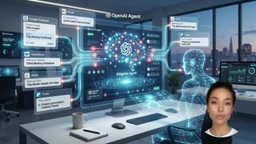
Most AI Agents follow a relatively simple loop: receive a goal → analyze the task → formulate a plan → call tools to execute each step → review the results → decide what to do next. This cycle often repeats multiple times until the task is complete.
Within this loop, the language model handles reasoning and decision-making, while tools give the agent the ability to interact with the world. An agent might need to search the web, read files, run code, call APIs, operate a browser, or communicate with other software systems. The variety and permissions of available tools directly determine what an agent can actually accomplish.
This is the fundamental difference between a chatbot and an agent. Faced with a spreadsheet, a chatbot can analyze the data inside it — but an agent might open the spreadsheet, inspect the data, run an analysis, generate charts, and ultimately produce a complete report. The difference isn't about who is "smarter"; it's that an agent can combine reasoning, planning, tools, memory, and action.
This loop is technically known as the "ReAct" framework (Reasoning + Acting), or more broadly as the "Think-Act-Observe" cycle. At each step, the language model generates internal reasoning (sometimes called a "chain of thought"), decides which tool to call and with what parameters, and then updates its judgment based on the tool's output. This is fundamentally different from traditional "one-shot inference" — an agent can detect errors mid-execution and self-correct, rather than stopping after its first output. It's worth noting that the reliability of this loop is highly dependent on the underlying language model's reasoning capability: the stronger the model, the less likely the agent is to make mistakes, go in circles, or fail partway through a complex task. This is precisely why more powerful models like GPT-4 and Claude 3 directly improve the practical usability of agents.
The Current AI Agent Landscape
Major players are entering the agent space in very different ways, with clearly distinct strategies.
Platform-Level Moves from Big Tech
OpenAI is building systems that can go beyond simple conversation and interact directly with tools and software, making AI an interface between users and multiple digital systems. Anthropic's Claude ecosystem has also shifted toward agentic workflows — useful for research, coding, document processing, and computer operation — moving beyond text generation to connect with environments that can actually execute multi-step tasks.

Google's Gemini, with its control over the full stack of Search, Workspace, Android, and more, has the potential to connect AI to every aspect of daily computing — the goal being an assistant that doesn't just answer questions but actually helps you operate your digital life. Microsoft Copilot targets enterprise use cases, leveraging existing products like Windows, Office, and Teams to let agents work directly within the tools businesses already use — making enterprise AI agents one of the most important areas to watch.
Autonomous and Specialized Agents
Manus has drawn attention for presenting AI as something close to an "autonomous digital worker." Users provide a high-level goal, and the system breaks it into smaller tasks and completes them one by one — a clear example of the shift from "answering AI" to "executing AI." Open Claw and Hermes represent a direction toward highly capable personal AI assistants — more like a persistent digital aide than a website you visit when you have a question.
One important insight worth emphasizing: AI Agents are no longer a single product category. Different projects define the term very differently — some focus on autonomous computer operation, others on research, coding, personal assistance, or business automation. So when you hear "AI Agent," the more valuable question isn't "Is it an agent?" but rather "What exactly can this specific agent see, access, and execute?"
Coding and Research: Two of the Most Practical Frontiers
Coding agents are currently one of the most clearly realized application areas. Devin focuses on software development — not just generating code snippets, but handling entire software projects: inspecting codebases, understanding tasks, modifying files, running tests, debugging issues, and iterating continuously.

Tools like Cursor bring agentic coding into everyday development workflows. Developers can give it a large task spanning multiple files, and the AI can inspect the project, make changes, and help test the results — transforming AI from an autocomplete tool into something closer to a true coding partner.
Another major category is research agents. These systems can break a broad question into smaller research tasks, search multiple sources, cross-reference information, summarize findings, and organize results. This has the potential to transform how people conduct research, competitive analysis, market research, and information gathering. That said, human verification remains essential when accuracy is critical.
Five Dimensions for Evaluating Any Agent
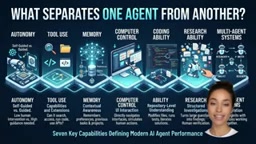
To assess the capability boundaries of an agent, consider five key dimensions:
- Autonomy: Some systems require constant instruction; others can complete dozens of steps with minimal intervention.
- Tool use: Can it search the web, access files, run code, call APIs, control a browser? The tools available define the ceiling of capability.
- Memory: An agent that remembers your preferences, past tasks, and context performs very differently from one that starts fresh every time.
- Computer control: Some agents can directly operate computer interfaces — seeing the screen, clicking buttons, typing text, navigating websites. This means AI no longer needs a dedicated API for every task; it can operate software the way a human would.
- Multi-agent systems: Rather than having one AI handle everything, multiple specialized agents can collaborate — one for research, one for writing, one for analysis, one for review — forming a kind of "digital team."
The "computer control" dimension technically corresponds to a capability known as "Computer Use," which Anthropic was among the first to introduce in Claude models in 2024. The underlying mechanism involves letting the AI "see" the screen via screenshots, then outputting mouse coordinates and keyboard commands to operate the interface — without requiring the software to provide a dedicated API. This means AI can theoretically operate any existing desktop or web application, much like a remote human operator. This capability dramatically expands an agent's range of applicability, but also introduces significant security concerns — such as "prompt injection attacks," where malicious text embedded in a webpage or file could trick the agent into performing unintended actions. As a result, defining permission boundaries when authorizing an agent to control a computer is a major focus in both research and product design.
Multi-agent systems in engineering practice typically rely on an "Orchestrator" agent that assigns tasks to various "sub-agents" and aggregates their results. This architecture enables parallel processing of complex tasks and significantly improves efficiency, though the coordination and information passing between agents itself introduces new failure points.
There's No Universal Agent: Choose for the Task
No single agent is optimal for everything. If you're writing code, a coding-focused agent is more appropriate; for research, a research-oriented system is more useful; for automation, an agent with broad tool access is the better choice; for a personal assistant, memory, integrations, and computer control become critical. The best agent depends entirely on the specific task.
From "Apps" to "Outcomes": A Fundamental Shift in Computing
One of the most important ideas here is that AI Agents may drive a shift from "apps" to "outcomes." Today, we open an application and figure out how to use it. In the future, we might simply tell an AI what we want to achieve, and the agent will decide which apps and tools are needed and orchestrate the entire workflow.
Traditional software gives you a tool; an AI Agent gives you a goal. You tell traditional software which button to press and which steps to follow. With an agent, you increasingly just state the result you want. This doesn't mean traditional software will disappear — rather, AI Agents may become the layer that connects people to all software. This could make agents one of the most significant developments in computing since the rise of the smartphone and the internet.
This transition is sometimes described in academic and industry circles as a leap from "tool-based AI" to "agentic AI." The deeper implication is that software's user interface (UI) may no longer be the core of human-computer interaction — instead becoming the underlying channel through which AI communicates with software. Some researchers call this architecture "AI-centric computing," in which users face only a single natural-language interface while all application orchestration is handled by AI decisions. The implications for the software industry are profound: if users no longer need to open apps directly, the competitive logic built around "open rates" and "UI design" faces a fundamental challenge, while foundational services offering reliable APIs and data interfaces may actually become more important.
Related articles

How Big Can Stars Really Get? The Physical Limits of the Largest Stars
Red supergiants are the largest stars by volume, with radii up to 2,000 times the Sun, engulfing the inner solar system. But there is no precise upper limit on stellar size—models predict up to 15,000 solar radii. The most massive blue stars are far smaller than red supergiants—biggest and heaviest are two different things.

Apple HomeView Smart Display Full Feature Breakdown: Wall-Mount or Desktop, $299
Apple launches HomeView, a $299 smart display with wall-mount and desktop options, 12MP camera for facial recognition, smart home control, music playback, and recipe step-by-step cooking. Full breakdown of watch faces, apps, privacy, and cooking integration.

Where Did the Promised New Studio Go? Craft Computing Answers After Five Years
Craft Computing's host responds to viewer questions: the new studio promised five years ago was shelved as construction costs soared from $30,000 to $75,000, and was replaced by a 168-square-foot garage conversion.