AI Agents Get to Work: So You Can Focus on What You Love

AI agents are shifting from replacing humans to liberating them — freeing people to focus on what they love.
This article unpacks a key narrative shift in AI agent discourse: the value of AI isn't replacing human labor, but absorbing repetitive tasks so people can redirect their energy toward creative, high-judgment work. Using Magnus Carlsen's involvement as a lens, the article traces chess's evolution from human-vs-AI competition to human-AI collaboration — a microcosm of the broader industry shift. The author remains clear-eyed, noting the original post is aspirational rather than a product announcement, and that hallucination, reliability, and controllability challenges mean the gap between vision and reality is still real.
AI Agents' New Vision: Freeing Up Human Energy to Focus on What Matters
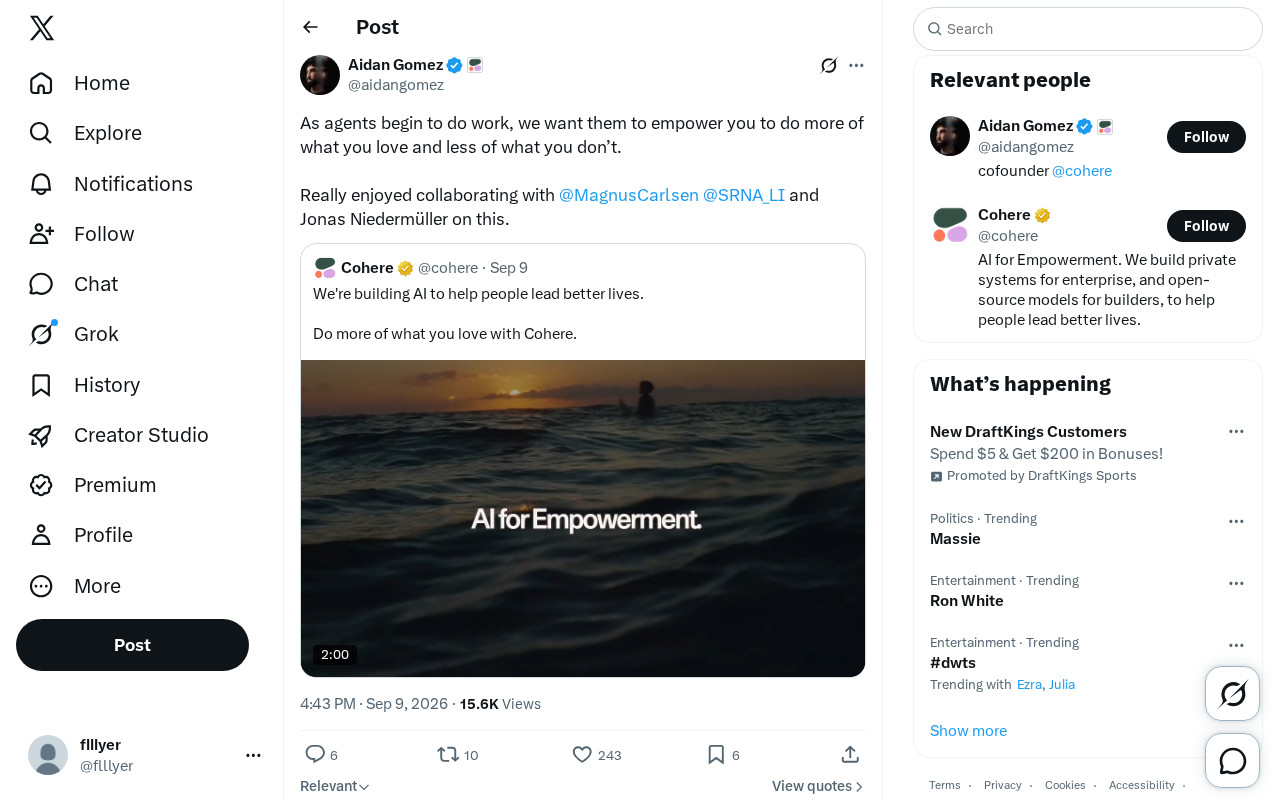
As AI agents gradually enter real-world work environments, the industry's definition of their value is shifting. A tweet from a tech professional captured the essence of this trend: when agents start taking on work, the real goal is to let people do more of what they love and less of what they don't.
Simple as it sounds, this touches on a key question in today's AI discourse — the point of AI isn't simply to replace human labor, but to redistribute human attention and energy. Repetitive, tedious tasks go to machines; creative, judgment-driven work stays with people.
What the Collaborators Signal
Notably, the tweet mentioned an unusual group of collaborators, including world chess champion Magnus Carlsen (@MagnusCarlsen). Chess has long been the classic arena for human intellect versus AI — so having one of its top practitioners weigh in on the agent conversation carries real symbolic weight.
From Deep Blue to AlphaZero, chess has been a proving ground for AI capability. Now that AI is shifting from "defeating humans" to "assisting humans," the involvement of someone like Carlsen — a pinnacle of human intellectual achievement — reflects a broader narrative shift: the relationship between AI and humans is no longer zero-sum competition, but complementary capability.
The arc from Deep Blue to AlphaZero is itself a history of evolving human-machine relations. When IBM's Deep Blue defeated Kasparov in 1997, the dominant framing was "machine beats human." When DeepMind's AlphaZero surpassed all existing chess engines through self-play in just a few hours in 2017, the reaction was awe at AI's autonomous learning. Yet within professional chess circles, "Advanced Chess" (also called Centaur Chess) — where human players work alongside AI analysis tools — had already existed for years, with human-AI pairs outperforming either alone. This practice predated the current agent wave by decades, already demonstrating the viability of human-machine collaboration in intellectual competition. Top players like Carlsen have spent their careers co-existing with AI, giving them an unusually grounded sense of where AI assistance adds value and where its limits lie — which may be precisely why their perspective matters here.
What "Do More of What You Love" Actually Means
Behind this core phrase is a design philosophy for AI agent products. The real-world value of agents typically plays out across several dimensions:
Automated Task Handling
Agents excel at workflows with clear rules and high repetition — information organization, scheduling, data processing, and similar tasks. Handing these off to agents frees people from the mundane.
Reallocation of Attention
Once low-value tasks are automated, human time and energy can flow toward work that demands creativity, emotional judgment, and strategic thinking — which is typically where the things people love to do live.
Collaboration, Not Replacement
The ideal agent doesn't replace a role — it becomes a work partner. Humans set goals and make key decisions; agents handle execution and amplify output.
The Gap Between Vision and Reality
It's worth being clear-eyed: this tweet is fundamentally an expression of aspiration, not a product launch or technical disclosure. Based on what's publicly available, we can't assess the specific outcomes of the collaboration, the technical implementation, or any timeline for delivery.
"Let you focus on what you love" is a compelling rallying cry — but whether it can be delivered depends on the actual accuracy, reliability, and controllability of these agents. Today's AI agents still face real challenges in complex tasks: errors, hallucinations, and unclear accountability. There's meaningful distance still to travel between the ideal and the real.
Among the technical challenges facing AI agents today, "hallucination" is particularly critical. Hallucination refers to large language models generating inaccurate or entirely fabricated information with high confidence, often without any self-awareness that it's happening. In single-turn conversations, hallucinations can be caught and corrected by humans. But when an agent autonomously executes multi-step tasks, errors from early steps can compound through subsequent ones, ultimately causing the entire task chain to fail — and the failure can be difficult to trace. Beyond that, agent "controllability" involves goal alignment — ensuring that an agent executing a task stays true to the user's actual intent, not just the literal instruction. These challenges mean that today's agents are best suited for low-risk, reversible tasks under human supervision. Fully autonomous handling of high-stakes workflows remains a significant distance away.
Closing Thoughts
This brief post represents a dominant strand of thinking in the AI industry right now: shifting emphasis from "what AI can do" to "what AI enables people to do." As agents genuinely begin participating in work, how we design them and how we define the human-machine division of labor will determine whether this technology becomes a burden or a liberation. As for what specific collaborative projects will actually deliver — that remains to be seen as more information becomes public.
Related articles

What Is Cursor? Core Differences Between This AI Coding Tool and Traditional IDEs
What is Cursor? This guide explains the AI-native code editor built on VS Code, how it compares to traditional IDEs, and its integration with Claude, DeepSeek, and Gemini.

Coze 3.0 Beginner's Guide: A Complete Overview of Agents and AI Applications
A beginner's guide to Coze 3.0: covering agents, AI applications, workflows, and plugins on ByteDance's AI platform, plus a comparison with Dify.
Setting Up the DeepSeek Harness Environment: A Complete Guide to Node.js Installation and Configuration
A beginner-friendly guide to setting up the DeepSeek Harness environment: Node.js installation, Add to PATH, redirecting npm global and cache directories, and configuring system environment variables.