AI Agents in Production: Real Pain Points and How to Address Them

AI Agents face four critical gaps moving from demo to production: reliability, observability, cost, and security.
This article explores the core challenges of deploying AI Agents in production, prompted by a real Reddit discussion. It argues that the gap between demo and production environments is widely underestimated — demos can cherry-pick inputs and tolerate failures, while production demands handle unpredictable users and real business costs. The four main pain points identified are: non-determinism causing reliability issues, difficulty debugging multi-step chains, cost and latency from multiple model calls, and security risks from autonomous Agent actions. Emerging strategies include constraining Agent autonomy, using LLM-specific observability tools, tiered model routing, and enforcing human-in-the-loop checkpoints for irreversible actions.
A Real Question from the Community
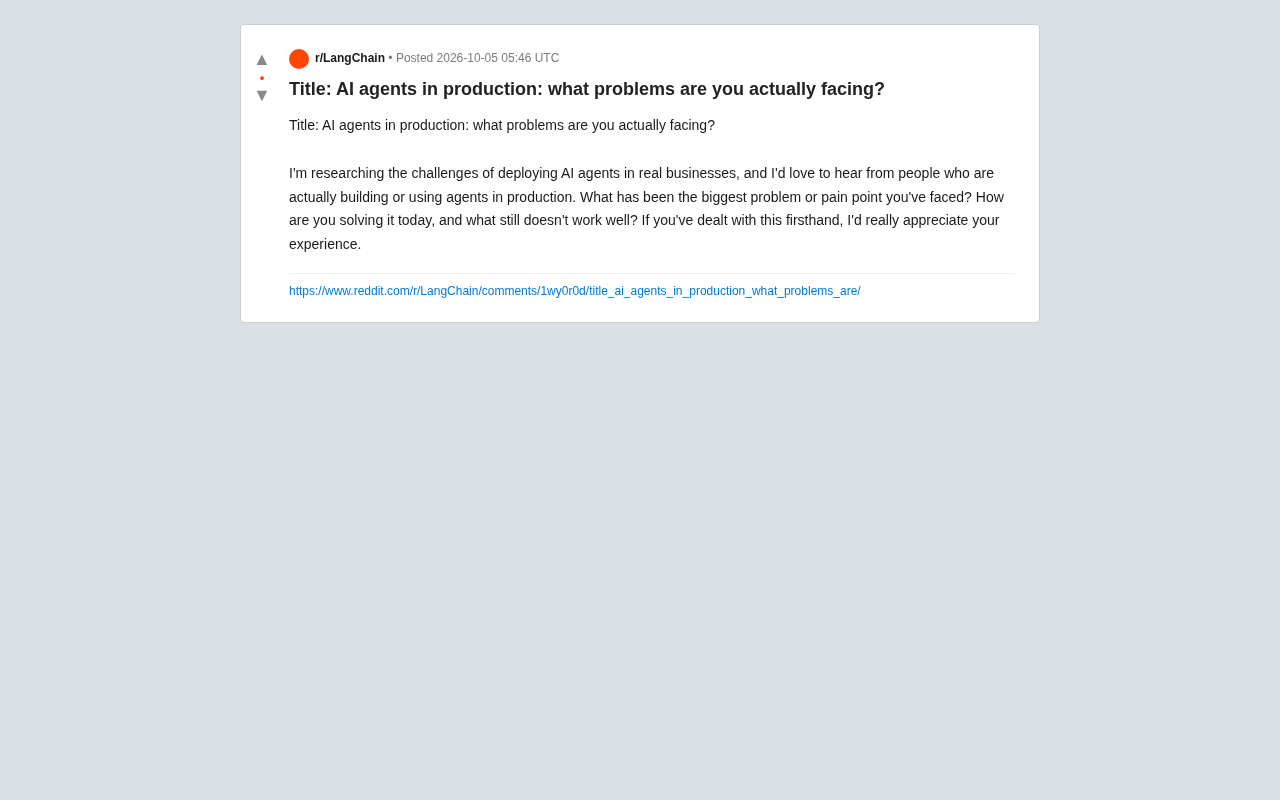
A developer on Reddit sparked a discussion about deploying AI Agents in production environments, cutting straight to the heart of the matter: When deploying AI Agents in real-world business settings, what are the biggest problems you've actually encountered? How are you handling them now? And what still isn't working well?
This question deserves attention because it steps outside the usual hype cycle of "impressive demos, disappointing deployments" and tries to gather firsthand experience from practitioners in the field. Over the past year or two, AI Agents have been heralded as the next frontier for large language model applications — but between proof-of-concept (PoC) and production, there's a gap that's routinely underestimated.
Why Production Is the Real Test for AI Agents
An Agent that smoothly completes tasks in a demo video faces an entirely different set of demands than one that must serve real users 24/7. Demo environments allow you to cherry-pick inputs, tolerate occasional failures, and have a developer ready to intervene. Production environments, on the other hand, mean unpredictable user inputs, unforgiving stability requirements, and real business costs when things go wrong.
This is precisely what the original poster focused on — they explicitly said they only wanted to hear from people "actually building or using Agents in production," not theoretical discussions. That hunger for real-world experience reflects a widespread industry frustration: everyone knows Agents have potential, but the people who have actually gotten them running reliably are far outnumbered by the people talking about them.
The Core Pain Points Practitioners Keep Running Into
While the original post was an open-ended question that hasn't yet produced a comprehensive set of answers, the consensus that keeps emerging across technical communities points to several recurring pain points.
Reliability and Unpredictability
Agents rely on large models for reasoning and decision-making, and large models are inherently stochastic. The same input can produce different outputs, and in a multi-step task, one error in any single step can bring the entire chain crashing down. In production, "works most of the time" simply isn't an acceptable reliability standard.
This problem is technically known as non-determinism. LLMs use sampling mechanisms to generate text, and even setting the temperature parameter to 0 to reduce randomness doesn't fully eliminate output drift — differences in model weight versions and server-side batching strategies can still cause outputs to shift. For single-turn Q&A, occasional variation is often tolerable. But Agents work by chaining multiple steps together, where the output of one step becomes the input of the next. Errors compound like a snowball rolling downhill — what reliability engineers call a cascading failure. For this reason, some teams insert "verification steps" at critical nodes, having the model self-check its previous output or introducing hard-coded validation rules that enforce data format and business constraints before proceeding to the next step.
Observability and Debugging Difficulties
When an Agent autonomously calls multiple tools, goes through dozens of reasoning steps, and then produces an incorrect result, it's often extremely difficult to pinpoint exactly where things went wrong. Without mature logging, tracing, and debugging tools, operating an Agent in production becomes a "black box" investigation.
Observability is a traditional software engineering concept measuring how well a system's internal state can be inferred from external outputs — typically implemented through three pillars: logs, metrics, and distributed traces. For conventional microservices, this ecosystem is well-established. But LLM Agents introduce new challenges: the "intermediate reasoning" at each model call isn't structured data — it's natural language, which is difficult for traditional monitoring tools to parse or alert on. Purpose-built observability tools for LLM applications (such as LangSmith, Langfuse, and Arize Phoenix) are trying to fill this gap. They record the complete prompt, model output, tool call parameters, and return values for every invocation, and visualize multi-step execution as a replayable tree structure. This helps developers reconstruct the Agent's "thought path" after the fact, making it possible to determine whether an error stemmed from faulty model reasoning or an unexpected return value from a tool call.
Cost and Latency
Complex Agents often require multiple rounds of model calls, and token consumption and response latency accumulate quickly. In high-frequency business scenarios, costs can become unsustainable, while latency directly degrades the user experience.
Boundary Control and Security
Agents have a degree of autonomous action capability — calling APIs, manipulating data, and so on. If an Agent goes out of control or is maliciously exploited, it can cause real harm. Establishing sensible permission boundaries and guardrails is a problem that must be solved before any production deployment.
Security risks for Agents are generally divided into two categories in the technical community. The first is prompt injection — where a malicious user crafts inputs that trick the Agent into performing actions outside its intended scope, such as bypassing access controls to read sensitive data. The second is runaway actions — where the Agent autonomously executes costly or irreversible operations without human intervention, such as bulk-deleting files, sending mass emails, or racking up unexpected API charges. The mainstream approach to both risks is the principle of least privilege: Agents are only granted the minimum set of tools and data access required to complete the current task. Critically, human-in-the-loop checkpoints are inserted before any irreversible action, ensuring that key decisions are never made entirely autonomously by the model.
Current Approaches and Strategies
In response to these pain points, the community has gradually converged on several practical directions.
For reliability, many teams adopt a strategy of "constraining Agent autonomy" — decomposing complex tasks into more controllable workflows, only giving the model freedom to make dynamic decisions where genuinely necessary, and using deterministic code logic as a safety net for everything else.
For observability, purpose-built tracing and evaluation tools for LLM applications are emerging, helping developers record inputs, outputs, tool calls, and decision rationale at every step so that debugging has a traceable path to follow.
For cost control, common approaches include routing tasks to appropriately-sized models based on complexity, caching repeated requests, and setting a maximum number of execution steps to prevent Agents from getting stuck in infinite loops.
What This Discussion Signals for the Industry
This seemingly ordinary help-seeking post actually reflects a pivotal shift the AI Agent industry is undergoing: moving from "can we build this?" to "can we run this reliably?" When more and more practitioners start seriously discussing production pain points rather than focusing on flashy demos, it signals that the field is maturing.
For teams evaluating or already investing in Agent development, this kind of candid, firsthand feedback is far more valuable than marketing materials. Acknowledging the problems and honestly confronting the gap between demo and production is, in fact, the very first step toward real deployment.
Note: This article is based on an open-ended community discussion. The original post was primarily a question-gathering exercise and has not yet produced definitive conclusions. The analysis of pain points and mitigation strategies draws partly on broader technical community consensus and is intended as a reference for readers.
Related articles

WorkBuddy Full Tutorial: Build an AI Office Automation Agent from Scratch
A complete WorkBuddy tutorial: installation, three working modes, multimodal picture book video practice, expert team agent building, and workflow configuration for low-cost AI office automation.

WorkBuddy Agent Complete Guide: From Beginner to Automation in 7 Days
Based on Bilibili's 256-episode WorkBuddy masterclass, this systematically breaks down Tencent's AI office workbench core capabilities: Agent principles, Skill encapsulation, cross-platform connectors, scheduled automation, knowledge bases, and zero-code development, with learning path recommendations.

8 AI Accounts, 7 Failed: An Honest Review of Using AI to Get Work Done
Only 1 of 8 AI-run Bilibili accounts succeeded. We break down the real difference between "performing AI" and "using AI to get work done."