AI Agents Need an Agile Manifesto: Redefining Agent Development from "Individuals and Interactions"

When AI Agents become the primary agents of delivery, the Agile Manifesto's four values need to be re-answered.
A Hacker News post 'Agile Manifesto for Agents' sparked discussion on the applicability of the traditional Agile Manifesto in the AI Agent context. The article notes that the Agile Manifesto assumes humans are the primary agents of delivery, but Agent autonomy, non-determinism, and multi-layered interactions change this premise. All four values require reinterpretation: interactions expand from human-human to human-Agent-tool networks; the 'working' standard must distinguish between single-pass rates and long-term stability; non-determinism amplifies both the value and risk of change, requiring traceable, rollback-capable change management. Actionable recommendations include incorporating Agent evaluation into iterations, managing prompts and tool configurations as first-class citizens, and explicitly defining human-in-the-loop boundaries.
A post titled "Agile Manifesto for Agents" appeared on Hacker News. With only 13 upvotes and 3 comments, it didn't generate much buzz—but the question it raises is well worth pondering: when the primary actors in software shift from "human teams" to "AI Agents," do the values in the traditional Agile Manifesto still hold up?
Why Agents Need Their Own "Manifesto"
The Agile Manifesto was born in the context of human developer collaboration. Its four values—individuals and interactions over processes and tools, working software over comprehensive documentation, customer collaboration over contract negotiation, and responding to change over following a plan—all assume that "humans" are the primary agents of delivery. The introduction of Agents changes this premise: developers no longer deal only with colleagues and customers, but also with an executor that makes autonomous decisions, calls tools, makes mistakes, and can "hallucinate."
What makes this post worth discussing is that it treats "Agent development" as an independent engineering paradigm rather than simply applying existing Agile frameworks. From this angle, re-examining those four values exposes several real pain points in current Agent engineering practice.
AI Agent refers to a software system capable of perceiving its environment, making autonomous decisions, and taking actions to achieve goals. Unlike traditional programs, Agents typically possess the ability to call external tools (such as search, computation, APIs), plan multi-step tasks, and adjust behavior based on feedback. In engineering practice, Agents often take the form of "large language model + prompts + toolset + memory/context management," and their behavior is non-deterministic—the same input may produce different outputs. This autonomy and non-determinism are the core differences between Agents and traditional software components, and the fundamental reason Agile practices need to be re-adapted.
Reinterpreting the Four Values in the Agent Context
Individuals and Interactions: From "Human-Human" to "Human-Agent-Tool"
In Agent systems, the boundaries of "interaction" are greatly expanded. Conversations between developers and Agents, tool calls between Agents and external tools, and collaboration between Agents themselves form a multi-layered interaction network. The post's title directly states "for Agents," hinting precisely at this expansion of interaction subjects.
This means teams need to rethink "who is interacting, what is being interacted with, and how to verify interaction results." The correctness of a working Agent system often depends not on how elegantly the code is written, but on whether the Agent can reliably complete tasks in real interaction chains—exactly the dimension that traditional Agile retrospectives rarely cover.
Working Software: How Should an Agent's "Working" Be Defined
Traditional Agile emphasizes "working software over comprehensive documentation," but in Agent scenarios, the standard for "working" becomes ambiguous. An Agent that performs well in a demo doesn't mean it remains reliable under edge conditions; a single successful call doesn't mean it won't accumulate errors in long-chain tasks.
The key divergence here is: Is an Agent's "working" measured by single-task pass rate or long-term operational stability? By human-evaluated satisfaction or quantifiable task completion? If this standard isn't aligned within the team, Agile iterations can easily become a cycle of "great demos every time, crash on release."
Hallucination refers to large language models generating content that appears plausible but is factually incorrect or unsupported. In Agent scenarios, hallucinations may manifest as calling non-existent tools, fabricating data, or misinterpreting user intent. Since Agents are often used for automated decision-making or information processing, hallucinations directly translate into task failures or error propagation. Therefore, when evaluating an Agent's "working" degree, hallucination rate must be a key metric. Common mitigation approaches include retrieval-augmented generation (RAG), tool-call constraints, output validation, and human review—but these approaches themselves also need to be incorporated into iterative evaluation.
Customer Collaboration and Responding to Change: Agents Make "Change" Come Faster
Agent behavior is influenced by multiple factors—prompts, toolsets, model versions, context management—and adjusting any one of them can change outputs. This creates an interesting tension: responding to change is the core of Agile, but when "change" comes from the Agent's own non-determinism, teams need not just rapid response but also traceable, rollback-capable change management.
In other words, Agents amplify the value of "responding to change" while also amplifying its risks. The original post doesn't elaborate on this layer, but it's an unavoidable issue when migrating the Agile Manifesto to the Agent domain.
Non-determinism refers to the property whereby the same input may produce different outputs across different runs. For Agents based on large language models, non-determinism stems from the randomness of model sampling, context length limits, fluctuations in tool-returned results, and more. This poses challenges for software engineering: traditional unit tests and regression tests assume reproducible outputs, whereas Agent behavior requires probabilistic evaluation (e.g., statistical pass rates over multiple runs). Therefore, teams need to establish traceable change records (prompt versions, model versions, tool configurations) and rollback-capable release mechanisms to manage the risks brought by non-determinism.
From Manifesto to Practice: What Agent Teams Can Learn
To put this "Agent Agile Manifesto" into practice, at least three directions are worth trying.
First, incorporate Agent evaluation into the iteration rhythm. Traditional sprint reviews focus on feature demonstrations; Agent teams should also regularly evaluate Agent performance on representative tasks and use these results as iteration inputs.
Second, manage prompts and tool configurations as first-class citizens. Like code, they affect delivery quality, yet they often sit outside version control and review processes.
Third, clarify the position of "human-in-the-loop." Which decisions must be made by humans and which can be delegated to Agents for autonomous execution—this boundary should be explicitly agreed upon at the team level, rather than defaulting to "as long as the Agent runs, it's fine."
Human-in-the-loop (HITL) refers to retaining human intervention and decision-making steps within automated processes. In Agent systems, HITL is typically used for high-risk decisions, exception handling, or quality review. Clarifying the position of human-in-the-loop means teams need to define: which tasks Agents can execute fully autonomously, which require human confirmation, and which must be human-led. This is not just a technical design issue but also involves accountability and compliance requirements. Explicitly incorporating HITL into Agile practices helps avoid blind automation under the assumption that "as long as the Agent runs, it's fine," ensuring the system delivers value within controllable bounds.
Summary
The discussion of "Agile Manifesto for Agents" on Hacker News may not have generated much heat, but the questions it raises have real value: an Agent is not just another tool—it changes the fundamental assumptions in software delivery about "who does the work, how completion is measured, and where change comes from." The original text of the Agile Manifesto may not need rewriting, but each of its values needs to be re-answered in the Agent context. For teams building Agent products, this re-answering is itself a valuable exercise in engineering alignment.
Note: This article is based on the title and public information of a Hacker News post. The original post's body content was not provided; some viewpoints are extended discussions based on the title's theme.
One-line Summary
When AI Agents become the primary agents of delivery, the four values of the Agile Manifesto need to be re-answered.
Paragraph Summary
A Hacker News post "Agile Manifesto for Agents" sparked discussion about the applicability of the traditional Agile Manifesto in the AI Agent context. The article notes that the Agile Manifesto assumes humans are the primary agents of delivery, but Agent autonomy, non-determinism, and multi-layered interactions change this premise. The four values—individuals and interactions, working software, customer collaboration, and responding to change—all need reinterpretation: interactions expand from human-human to human-Agent-tool networks; the "working" standard must distinguish between single-pass rates and long-term stability; non-determinism amplifies both the value and risk of change, requiring traceable, rollback-capable change management. Actionable recommendations include incorporating Agent evaluation into iterations, managing prompts and tool configurations as first-class citizens, and explicitly defining human-in-the-loop boundaries.
Related articles
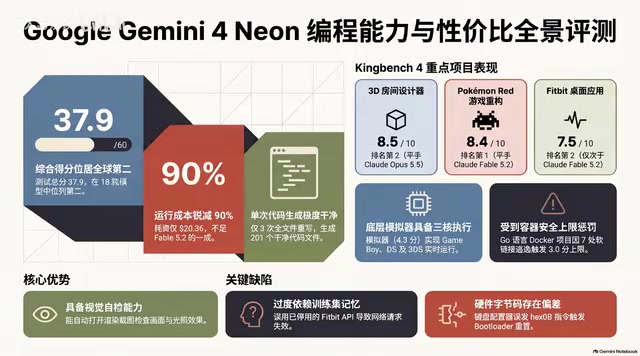
Gemini 4 Neon Hands-On: Value King or Confident Catastrophe?
Gemini 4 Neon review: 1M-token context, four thinking levels, 201 files in one KingBench4 pass at one-tenth Fable 5.2's cost—but it hallucinates fake data, leaves 7 symlink escapes, and bricks keyboards.

Google Gemini 4 Neon Hands-On: 6 3D Works That Impress and Fail
Hands-on with Google Gemini 4 Neon on a 3060 laptop: 6 3D works tested. Sunshower Fishing Harbor and mechanical keyboard impress; soft-body physics and faces fall short.

Gemini 4 Neo Web Novel Writing Test: Faint AI Flavor, Textured Dialogue
Bilibili creator's first-look review of Gemini 4 Neo for Chinese web novel writing: testing a Three Kingdoms transmigration opening with faint AI flavor, emotionally textured dialogue, and strong crisis building, plus comparison of 4A/4H/4C models and full workflow demos.