AI Agents That Actually Make Money: Real Use Cases Enterprises Are Willing to Pay For
Enterprises pay for AI agents that solve boring, repetitive tasks with clear ROI — not flashy all-in-one demos.
Sparked by a Reddit discussion, this article examines which AI agent use cases enterprises actually pay for versus those that stay stuck at the demo stage. The answer centers on three "boring but practical" high-frequency workflows: customer support ticket handling, data entry and process automation, and content generation assistance. These win because their ROI is quantifiable and risk is manageable. The article recommends founders go deep on vertical industry pain points rather than chasing general-purpose agents, and advises enterprises to start with proven use cases before expanding toward broader automation.
From Demo Hype to Business Reality
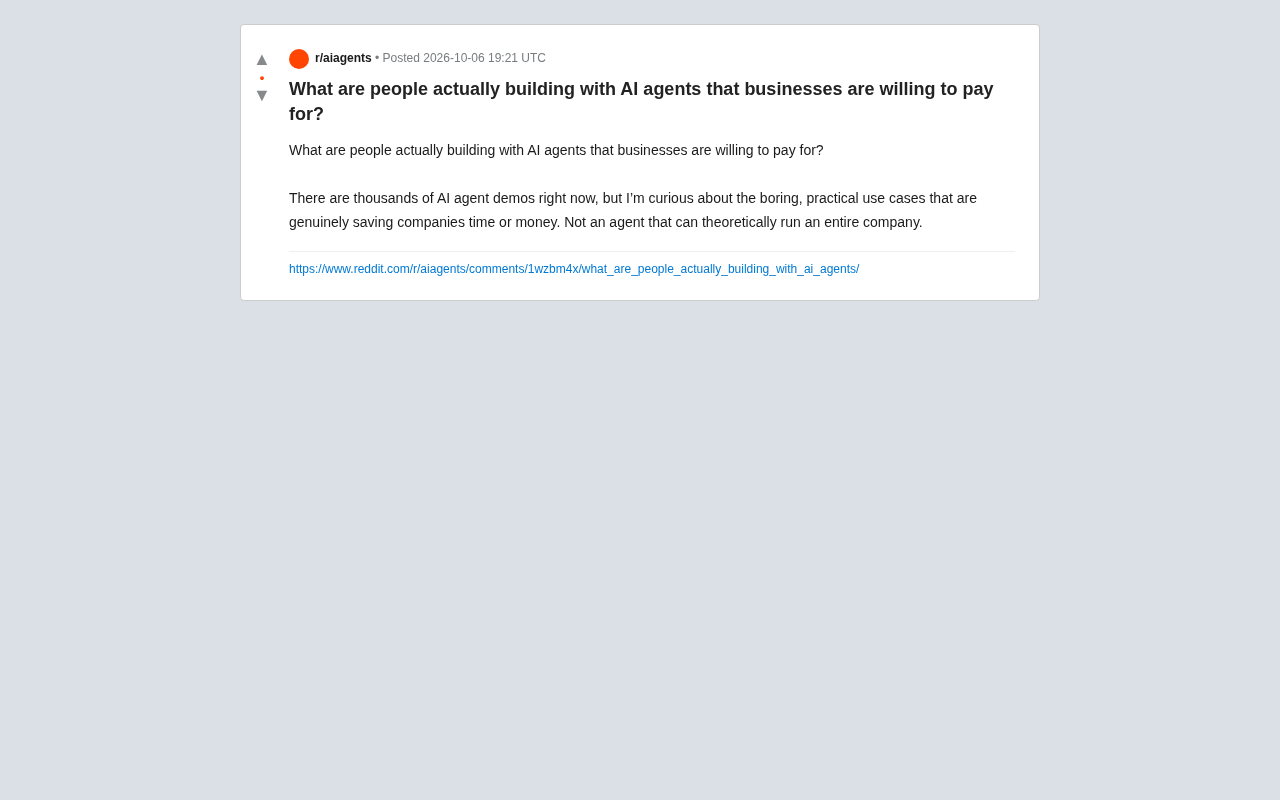
AI agent demos are everywhere right now — someone's showing off an agent that writes code autonomously, someone else is demoing an "all-in-one assistant" that supposedly runs an entire company single-handedly. But a discussion in the Reddit community cut right through the hype: the question that really matters isn't "what can AI agents theoretically do?" — it's "what AI agents are enterprises actually willing to pay for?"
This question hits on the core tension in the industry. Flashy proof-of-concept demos are a dime a dozen, but the "boring yet practical" use cases that genuinely save companies time and money — and generate sustained willingness to pay — are the real litmus test for commercial value.

The "Boring But Profitable" Use Cases
From what we're seeing across the industry, the AI agents that actually get enterprises to open their wallets aren't the ones with grand narratives about "running an entire company." They're the ones laser-focused on specific, repetitive, high-frequency business tasks. These scenarios tend to share a few common traits.
Customer Support and Ticket Handling
Customer service is one of the most mature deployment areas for AI agents. Agents can automatically classify tickets, search knowledge bases, generate initial responses, and even directly resolve common requests (like refund inquiries or account resets). The business logic for paying is straightforward: every ticket handled without human intervention is a quantifiable cost saving. The goal isn't to "fully replace" human agents — it's to handle 80% of repetitive inquiries and leave the complex cases for people.
Data Entry and Process Automation
A huge amount of back-office work at enterprises still relies on humans manually moving data between systems — extracting invoice details from emails, entering form data into a CRM, organizing sales leads, and so on. AI agents with document understanding capabilities can automate these tedious but necessary tasks. The ROI on these scenarios is extremely easy to calculate, which is exactly why enterprises are most willing to pay for them.
ROI (Return on Investment) plays a central role in AI agent purchasing decisions. The calculation framework typically covers two sides: the cost side accounts for subscription or deployment fees, integration development costs, and maintenance overhead; the benefit side tallies the labor hours replaced (converted to salary savings), business gains from faster processes, and rework losses reduced by lower error rates. Data entry scenarios have the most straightforward ROI calculation because task volume is precisely measurable (e.g., number of invoices processed per month), labor costs are transparent, and agent accuracy can be quantified through sampling audits. By contrast, applications that promise to "improve creative quality" or "optimize strategic decisions" are difficult to anchor to concrete numbers — which explains why enterprise willingness to pay for those use cases tends to be much lower.
Content Generation and Marketing Assistance
From drafting product descriptions and marketing emails, to summarizing meeting notes and compiling market research, AI agents play the role of a "first-draft generator" in the content production pipeline. The goal isn't a perfect final product — it's freeing humans from the pain of starting from scratch and dramatically compressing content production cycles.
The Logic Behind Enterprise Willingness to Pay
Why do some agents command real fees while others stay stuck at the demo stage? The core answer comes down to the measurability and reliability of the value delivered.
For an enterprise to pay, they need to be able to run the numbers: how many person-hours does this agent save per month, or how much incremental revenue does it generate? Agents that try to "end-to-end run a company" struggle to commercialize precisely because their value is vague, the cost of failure is high, and reliability can't be guaranteed.
By contrast, agents focused on a single workflow are far easier to trust. Their task boundaries are clearly defined, the impact of errors is contained, and humans can step in at critical checkpoints (Human-in-the-loop). This positioning as "augmentation" rather than "full replacement" is, in fact, the most pragmatic and deployable business model at this stage of the technology.
Human-in-the-loop refers to maintaining human review and intervention mechanisms at critical decision points within an automated workflow. This design isn't a concession to technical limitations — it's a rational choice given the current reliability boundaries of AI systems. In practice, agents handle high-frequency, low-risk standardized tasks, while automatically triggering human review when confidence is low, transaction values are significant, or anomalous patterns are detected. The commercial significance of this architecture is that it keeps the cost of AI mistakes within an acceptable range, while allowing enterprises to build trust in the system incrementally. As data accumulates and models improve, the proportion requiring human intervention can gradually decrease, creating a positive feedback loop. For enterprise decision-makers, Human-in-the-loop isn't a temporary stopgap — it's a long-term governance mechanism for mitigating the risk of "automation gone wrong."
Key Takeaways for Founders and Enterprises
This discussion has real practical implications for both AI founders and enterprise decision-makers.
For founders: Rather than chasing the grand vision of a "general-purpose agent," it pays to go deep on specific pain points within a vertical industry. Finding tasks that are "boring, repetitive, and done every single day" tends to offer better commercial prospects than an impressive all-capable demo. The real moat comes from deep understanding of industry workflows, not from the model itself.
For enterprises: When adopting AI agents, prioritize use cases with clear ROI and manageable risk rather than immediately pursuing full automation. Start by validating value in mature areas like customer service and data processing, then expand gradually — that's the prudent path forward.
At the end of the day, the commercial value of an AI agent doesn't depend on "how impressive a thing it can do" — it depends on "how reliably it can solve real problems at scale." The enterprises willing to pay for these solutions have never been looking for magic. They're looking for dependable, quantifiable efficiency gains.
Related articles

iPhone Duo Review Controversy: Why Apple's First Foldable Is Said to 'Should Be Called an iPad'
The Vergecast debates the iPhone Duo review controversy: is a 7 fair? Why are apps struggling? Why critics say it 'should be called an iPad'? We unpack Apple's first foldable's positioning mismatch and first-gen compromises, plus AI security flaws and agentic shopping.

Meta vs. Publishers: The AI Data Battle Over Terms of Service Changes and the Future of the Internet
Meta changed its business account terms to allow AI training on linked website data, sparking backlash from publishers and creators. Industry groups demanded negotiations, forcing Meta to remove 'training' wording and delay the effective date. The dispute reveals the deeper battle over data authorization and the future of the internet in the AI era.

When Outside Xbox Meets Blood on the Clocktower: A Legion Match in Minecraft
Outside Xbox guests Ellen and Mike play Minecraft Blood on the Clocktower in a Legion game. How can three good players fight an evil majority amid information noise? This article breaks down Legion mechanics, information-role mind games, and the endgame reversal.