AI and a 17-Million-Line Lean Proof: Has the Riemann Hypothesis Been Machine-Verified?
AI generates a 17M-line Lean proof; the machine verifies the Riemann Hypothesis in a day, but humans don't yet understand it.
The article covers the AI-assisted proof of the Riemann Hypothesis. It reviews the math: nontrivial zeros of the ζ function on the critical line determine prime distribution error. It explains the conjecture's importance and misconceptions (it doesn't break RSA). On November 20, Anthropic mathematician Levent Alpoge and Claude released 17M lines of Lean code claiming to prove the Riemann Hypothesis and its generalization. Lean community certified it the next day. Mathematicians are shocked but note machine verification isn't understanding; peer review and two years of scrutiny haven't started, and the million-dollar prize isn't triggered. It ends asking: if no one understands it, is it solved?
The most famous unsolved problem in mathematics—the Riemann Hypothesis—has recently been thrown into turmoil by a machine proof spanning 17 million lines, generated with AI involvement. The proof was certified as correct by the Lean community within a single day, yet mathematicians face an awkward situation: the machine says it's right, but almost no one can read why.
From Primes to the ζ Function: What the Riemann Hypothesis Actually Says
To understand this controversy, we must start with primes. Primes are numbers divisible only by 1 and themselves—2, 3, 5, 7, 11, 13, and so on. They are the "atoms" of the integers, and every integer factors uniquely into a product of primes. But the positions where primes appear seem utterly irregular; no simple formula predicts where the next prime will be.
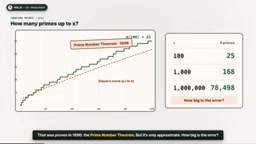
Mathematicians reframed the question: how many primes are there up to a given value? As a teenager, Gauss noticed that as the value grows, the prime count falls along a smooth curve. This pattern was proved in 1896 as the Prime Number Theorem. But the Prime Number Theorem is only an approximation—how large is the error? In 1859, the German mathematician Riemann provided the key tool in a paper of fewer than 10 pages: the ζ function.
The ζ function was originally an infinite series—"take the reciprocal of each integer and add them up"—and Euler discovered it equals a product involving only primes. Riemann extended the domain to complex numbers, turning the ζ function into a mapping on the plane, with points where it takes the value zero, called "zeros." The zeros at negative even integers are trivial; the truly interesting ones are the nontrivial zeros. They are known to all lie within a critical strip of width 1, and when Riemann hand-calculated the first few zeros, he found they fell exactly on the middle line of the strip—the line with real part 1/2. This is the Riemann Hypothesis: all nontrivial zeros lie on this critical line.
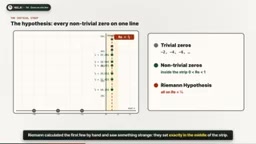
What does this have to do with primes? Each zero corresponds to a wave, and superposing them corrects the smooth curve into the staircase of prime counts. All zeros lying on the same line means each wave has the same amplitude—no wave runs out of control—and the error in the prime count is suppressed as much as possible. In one sentence: primes appear random but are in fact distributed with extreme order.
Analytic continuation of the ζ function: The original text mentions that "Riemann extended the domain to complex numbers," an operation known mathematically as analytic continuation. The originally defined series ∑n^{-s} converges only when the real part in the complex plane is greater than 1, but through analytic continuation, the ζ function can be uniquely extended to the entire complex plane (except for a simple pole at s=1). The extended function satisfies a functional equation and reveals the trivial zeros at negative even integers. It is precisely this extension that makes the study of nontrivial zeros possible and forms the basis of the statement of the Riemann Hypothesis. Without analytic continuation, the ζ function would be undefined within the critical strip, and the conjecture could not even be stated.
Why It Is the Holy Grail of Mathematics
In 1900, Hilbert proposed 23 problems, with the Riemann Hypothesis ranked eighth. In 2000, the Clay Mathematics Institute listed it as one of seven Millennium Prize Problems, with a one-million-dollar bounty. Computers have checked over ten trillion zeros, and every single one lies on the line. But mathematically, ten trillion does not equal a proof—there are infinitely many zeros, and a single one off the line would bring the conjecture down.
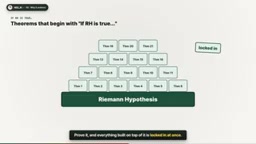
More critically, a vast number of theorems take "if the Riemann Hypothesis holds" as a premise. Once the conjecture is proved, all these theorems unlock simultaneously; if it is disproved, they collapse with it. A common misconception is that proving the Riemann Hypothesis would break internet encryption. In reality, RSA relies on the difficulty of factoring large integers, and a proof of the Riemann Hypothesis does not provide a method for factoring large integers.
RSA encryption and the Riemann Hypothesis: The security of RSA public-key encryption is based on the difficulty of factoring large integers: given the product of two large primes, factoring them is infeasible in practice. The Riemann Hypothesis describes the fine-grained error in the distribution of primes; even if proved, it would not provide an efficient algorithm for factoring large integers. In fact, the Prime Number Theorem (already proved) already gives the macroscopic law of prime distribution, and the Riemann Hypothesis only provides precise control of its error. Therefore, proving the Riemann Hypothesis would not shake the foundations of RSA; what could actually break RSA is Shor's algorithm on a quantum computer, which has nothing to do with the Riemann Hypothesis.
November 20: A Four-Page AI-Assisted Announcement and 17 Million Lines of Code
On November 20, Anthropic mathematician Levent Alpoge published a four-page note on his personal website, opening with: working with Claude, he believes he has discovered a proof of the Riemann Hypothesis. The proof is not a readable paper but code written in the Lean proof checker, spanning 17 million lines. He also claims the same method can prove the Generalized Riemann Hypothesis. Written in natural language, it would exceed 250,000 pages, so only the code has been released. Alpoge admits he does not fully grasp all the mathematics in the proof.
The timing also invites speculation: on November 19, Anthropic had just listed on Nasdaq. Alpoge himself acknowledged that this timing might be viewed cynically.
The Lean proof checker and Mathlib: Lean is an interactive theorem prover based on dependent type theory, allowing users to write mathematical statements as formal propositions and construct proof terms step by step. The computer kernel checks line by line whether each step of reasoning follows logical rules; any omission or error causes compilation to fail. Mathlib is Lean's mathematics library, maintained by the community, containing a massive collection of formalized mathematical definitions and theorems (including the precise statement of the Riemann Hypothesis). Seventeen million lines of code means every step of the proof is broken down into machine-verifiable basic inferences, at a scale far beyond what humans can read line by line. The core of machine certification is: checking whether the code compiles, whether the theorem statement matches the Riemann Hypothesis as defined in Mathlib, and whether the proof actually derives that statement.
One-Day Certification by the Lean Community: How the Machine Checks a 17-Million-Line Proof
Who checks a 17-million-line proof? The answer is Lean. Lean mechanically checks each step of logic, rejecting the proof if a single step is missing. On November 21—the very next day—the Lean and Mathlib communities issued a joint statement concluding they were "fully confident that the proof is correct." They verified four things: whether the statement matches the Riemann Hypothesis already in Mathlib; whether the code compiles; whether the theorem proved matches that statement; and whether it passes multiple independent checkers. Work that would take human reviewers years was completed by the machine in a day. This is the fundamental difference from all previous amateur claims.
The Shock Among Mathematicians and Unresolved Questions
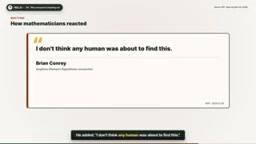
The reaction was explosive. Brian Conrey, who has studied the conjecture for decades, called it a major moment in human history and said, "I don't think any human was about to find it." Terence Tao said the proof appears to draw on the full power of the Langlands program and arithmetic geometry, that digesting it will take time, but that at least this time there is a living author to talk to.
According to Agence France-Presse, hours later a Stanford postdoc also independently submitted a proof, with details not yet public.
So is the Riemann Hypothesis solved? Far from it. The machine check gives us strong evidence that it is true, but no one can explain why it is true. For mathematicians, a proof is not a stamp of approval but understanding. A human-readable proof, peer review, and mathematicians digesting the new ideas within it may take years. The Clay Institute's rules require a peer-reviewed paper published first, followed by two years of scrutiny—and at present there isn't even a journal paper, so the prize clock hasn't even started.
A more fundamental question remains open: if a machine verified it but no one understands it, have we really solved it? Perhaps we are entering an era where we get the answer first and slowly figure out the reason later.
The Clay Mathematics Institute's Millennium Prize rules: According to the Clay Mathematics Institute's regulations, winning the one-million-dollar prize requires two conditions: first, the proof must be published in a peer-reviewed mathematics journal; second, after publication, it must undergo at least two years of broad scrutiny confirming it is correct. This rule is intended to ensure the reliability of the proof and community understanding. Currently, Alpoge's proof has only been released as Lean code, has not been written up as a readable paper, and has not entered the journal review process. Therefore, even if machine verification passes, the prize clock is far from starting. The rules emphasize that "understanding" and "acceptance" are indispensable parts of a mathematical proof, not merely logical correctness.
One-line Summary
AI generates a 17-million-line Lean proof; the machine certifies the Riemann Hypothesis in a day, but humans don't yet understand it.
Paragraph Summary
The article centers on the event of an AI-assisted proof of the Riemann Hypothesis. It first reviews the mathematical background: the nontrivial zeros of the ζ function lie on the critical line, determining the error in prime distribution. It then introduces the conjecture's importance and common misconceptions (it does not break RSA). Next, it details how on November 20, Anthropic mathematician Levent Alpoge and Claude released 17 million lines of Lean code claiming to prove the Riemann Hypothesis and the Generalized Riemann Hypothesis. The Lean community certified the code as correct the next day—unlike previous amateur claims. Mathematicians reacted with shock but noted that machine verification is not human understanding; peer review and two years of scrutiny have not begun, and the million-dollar prize has not been triggered. It ends with a fundamental question: if a machine verifies it but no one understands it, does that count as solved?
Related articles

ChatGPT Plus Subscription Pitfall Guide: Go/Plus/Pro Tier Comparison and Quick Activation
A complete ChatGPT Plus subscription guide based on a Bilibili tutorial: from registering an account, comparing Go/Plus/Pro tiers, to the practical steps for quickly completing your subscription.

GPT-6.2 Sol/Astra Released! A Step-by-Step ChatGPT Plus Subscription Guide and Tier Comparison
GPT-6.2 Sol/Astra is out—here's a ChatGPT Plus subscription guide: register an account, compare Go/Plus/Pro tiers, and subscribe in a minute.

Comparing Three Channels for Subscribing to GPT Plus in China: Is Website Top-Up the Easiest?
How to subscribe to GPT Plus in China? This article compares website top-up, credit card, and mobile top-up channels—process, cost, and risk—with steps and tips to help you choose wisely.