AI and Claude Team Up to Crack the Riemann Hypothesis? Million-Line Lean4 Machine-Verified Proof Sparks Debate
Video claims Claude-assisted Riemann Hypothesis proof passed Lean4 machine checking, but human readability and academic recognition remain missing.
A YouTube video claims a Claude-assisted Riemann Hypothesis proof has been machine-checked by Lean4, taking the form of ~17 million lines of Lean code verified step by step. The impact lies not in AI "solving" the problem but in a new paradigm: verifiability gives AI an immediate, objective feedback loop, enabling large-scale trial-and-error. Yet no human-readable manuscript exists, and the Clay Institute's prize requires formal publication and a two-year recognition period—conditions far from met.
Event Recap: An Explosive Claim from a YouTube Video
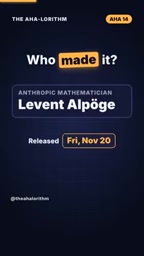
Recently, a YouTube video dropped a bombshell on the mathematics and AI communities: the Riemann Hypothesis—an unsolved problem that has stood for 167 years with a million-dollar bounty—has reportedly been conquered by a proof built with the help of Claude and verified by the Lean4 theorem prover.
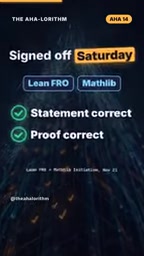
The video claims that Anthropic mathematician Levent Alperje released this result on Friday, November 20. In his words: "Claude far outpaced me as we approached the finish line." The next day, the Lean and MathLib teams signed off: both the statement and the proof are correct.
The core impact of this news isn't "AI solved a hard problem"—it's the form of the proof: roughly 17 million lines of Lean code, with every logical step verified by computer.
Machine-Verifiable Proofs: From "Answer" to "Trustworthy Answer"
Traditional mathematical proofs rely on peer review, with human readers judging correctness through logical reasoning. This event demonstrates a new path: write the proof as code and let the machine serve as the ultimate judge.
As an interactive theorem prover, Lean4 requires every step of derivation to strictly follow formal logical rules. This means that if the code passes checking, the proof is logically airtight—at least within its formalized framework. The video highlights a key insight: "When a machine can check AI's work the way it tests code, you can let it run much further." This precisely explains why Claude could "far outpace" its human collaborator in the later stages of the proof: machine verification provides an immediate, objective feedback loop, allowing the AI to trial-and-error at scale without worrying about the bottleneck of human review.
For the fields of AI programming and AI applications, this offers an important paradigm: verifiability is the key that unlocks AI autonomy.
Interactive Theorem Prover (ITP) is a class of software tools in which users write mathematical definitions, theorem statements, and proof steps in a formal language, and the system checks in real time whether each derivation step conforms to the underlying logical rules. Unlike automated theorem provers, ITPs emphasize human-machine collaboration: humans provide proof strategies and key lemmas, while the machine handles tedious logical verification. Lean4 is a representative ITP led by Leonardo de Moura at Microsoft Research; its foundation in Dependent Type Theory allows mathematical propositions to be encoded as types, with proofs being terms of that type—a proof is deemed correct if it passes type checking. This Curry-Howard correspondence of "propositions as types, proofs as programs" is the key to understanding why Lean4 can serve as a mathematical judge.
MathLib is the mathematics library for Lean4, collaboratively maintained by the global open-source community, with the goal of formalizing mathematical knowledge from undergraduate to research level. In recent years, MathLib has come to contain hundreds of thousands of theorems and definitions, covering major branches such as algebra, analysis, topology, and number theory. However, formal proofs of major conjectures often require large numbers of new definitions and lemmas; whether and how these incremental additions are accepted into MathLib directly affects the community visibility and reusability of the proof. The significance of "the Lean and MathLib teams signed off" in the video is that not only did the code pass Lean4's type checking, but its statements are consistent with existing definitions in MathLib, avoiding formalization traps of the "bait-and-switch" kind.
The Missing Piece: Humans Still Can't Read This Proof
However, the video also candidly points out the "catch": there is currently no human-readable proof manuscript.
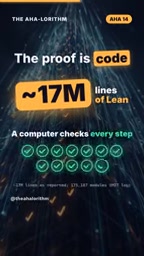
Seventeen million lines of Lean code is an astronomical figure for any human mathematician. Without natural-language exposition, other mathematicians cannot understand the proof's ideas, structure, or mathematical insights. This raises a deeper question: does a machine-verified proof that no one understands count as genuine mathematical knowledge?
Moreover, the Clay Mathematics Institute's million-dollar prize requires formal publication and a two-year period of academic recognition. The video explicitly states that the current state is far from meeting these conditions.
The rules of the Clay Mathematics Institute's Millennium Prize Problems require that a solution be formally published in a peer-reviewed mathematics journal and, after publication, undergo two years of broad academic scrutiny and recognition before the million-dollar prize can be awarded. This design is intended to filter out errors and controversial results—history is full of cases claiming to solve major conjectures that were later disproven. For machine-generated proofs, the existing rules do not clarify what form of "publication" is acceptable: does 17 million lines of Lean code constitute a publishable mathematics paper? Can a formal verification report replace traditional peer review? These institutional gaps are the non-technical reason why the current state falls far short of the prize conditions.
The Boundaries of Trust: Should We Believe Machine Verification?
The video closes with an open question: "Would you trust a proof that no human has read yet?"
This question strikes at the core of the philosophy of mathematics. On one hand, Lean4's checking is formal and reproducible, in theory more reliable than human review; on the other hand, formalization itself depends on the definitions and axioms of the MathLib library—"correctness" within any formal system is relative to that system. More importantly, the value of mathematics lies not only in the truth of a proposition but also in the structures and connections the proof reveals—and these precisely require human understanding and interpretation.
"Correctness" within a formal system is relative correctness: Lean4's checking conclusions depend on the consistency of its underlying logical system (dependent type theory) and on the accuracy of definitions and axioms in MathLib. If the axiomatic system itself contains contradictions (although the consistency of type theory has not been proven, and Gödel's incompleteness theorems show that any sufficiently strong system cannot prove its own consistency internally), or if some key definition in MathLib subtly deviates from the mathematical community's standard understanding, then "machine verification passed" does not automatically equal "mathematical truth." Furthermore, formal verification guarantees that the derivation "from axioms to theorem" is valid, not that the theorem statement itself captures the mathematical proposition the researcher intended to express—the latter requires human interpretation to confirm.
What This Means for AI and the Open-Source Tooling Ecosystem
Setting aside the controversy over whether the Riemann Hypothesis itself has been "solved," this event offers several concrete lessons for the AI community:
First, formal verification is becoming a new yardstick for AI capability. Similar to code testing, Lean4 provides an automatically checkable standard of correctness for AI-generated mathematical reasoning. This closed loop of "AI generation + machine verification" may expand AI's reasoning frontier more efficiently than purely human review.
Second, the open-source toolchain is critical infrastructure. As open-source projects, Lean4 and MathLib provided the underlying support for this milestone. The confirmation step by the Lean and MathLib teams in the video also highlights the credibility role of the open-source community in verifying AI results.
Third, human readability remains essential. No matter how correct a proof is, if it cannot be translated into a human-understandable narrative, its value within the mathematical community is hard to realize. In the future, dedicated "proof translation" work may be needed—converting formal code into mathematical papers.
Fourth, cautious optimism. The video itself ends with a question rather than a declaration of victory. Until the Clay Institute formally recognizes it, this remains an astonishing claim awaiting verification. For readers following frontier research, this is both a signal worth tracking and a public lesson on the tension between "machine verifiability" and "human understanding."
One-line Summary
A video claims that a Claude-assisted Riemann Hypothesis proof passed Lean4 machine checking, but human readability and academic recognition remain missing.
Paragraph Summary
A YouTube video claims that a Riemann Hypothesis proof built with Claude's help has passed machine checking by the Lean4 theorem prover, existing as roughly 17 million lines of Lean code with every step verified by computer. The core impact of this news is not that AI "solved" a hard problem, but that it demonstrates a new paradigm: verifiability gives AI an immediate, objective feedback loop, enabling large-scale trial-and-error and allowing it to "far outpace" its human collaborator in the later stages of the proof. However, there is currently no human-readable proof manuscript, so mathematicians cannot understand the proof's ideas and insights; the Clay Mathematics Institute's million-dollar prize also requires formal publication and a two-year recognition period, which the current state is far from satisfying. The event thus raises deep questions: whether a machine-verified but ununderstood proof constitutes genuine mathematical knowledge, and where the boundaries of "correctness" within a formal system lie. For the AI community, it highlights multiple lessons: formal verification as a new yardstick for AI capability, open-source toolchains as infrastructure, and "proof translation" as a future necessity.
Related articles

ChatGPT Plus Subscription Pitfall Guide: Go/Plus/Pro Tier Comparison and Quick Activation
A complete ChatGPT Plus subscription guide based on a Bilibili tutorial: from registering an account, comparing Go/Plus/Pro tiers, to the practical steps for quickly completing your subscription.

GPT-6.2 Sol/Astra Released! A Step-by-Step ChatGPT Plus Subscription Guide and Tier Comparison
GPT-6.2 Sol/Astra is out—here's a ChatGPT Plus subscription guide: register an account, compare Go/Plus/Pro tiers, and subscribe in a minute.

Comparing Three Channels for Subscribing to GPT Plus in China: Is Website Top-Up the Easiest?
How to subscribe to GPT Plus in China? This article compares website top-up, credit card, and mobile top-up channels—process, cost, and risk—with steps and tips to help you choose wisely.