AI and Mathematics at a New Inflection Point: Daniel Litt's Deep Reflections
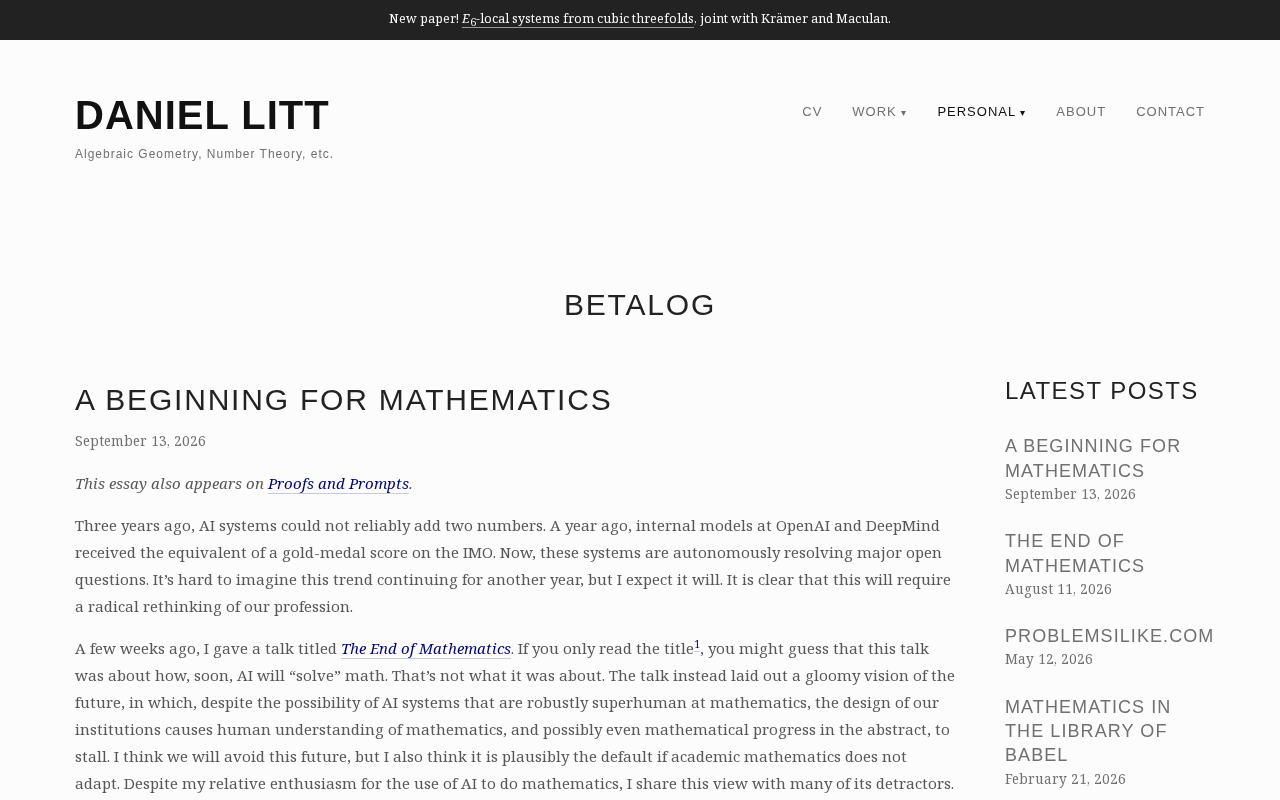
Daniel Litt explores how AI and formal proofs may open a new era of human-machine collaborative mathematics.
Algebraic geometer Daniel Litt's blog post "A Beginning for Mathematics" sparked intense discussion on Hacker News, centering on the proposition that as formal proof tools like Lean mature and generative AI reasoning improves, mathematical research stands at the entrance of structural change. The post envisions a potential closed loop: AI generates candidate proofs, formal systems verify correctness, and humans focus on posing meaningful questions and building conceptual frameworks. Litt's trademark caution — acknowledging AI's real value while clearly marking its limits on truly original problems — leads to a deeper conclusion: as verification costs approach zero, the ability to judge which problems are worth pursuing becomes the mathematician's most irreplaceable competitive edge.
A Mathematical Essay That Sparked Widespread Discussion
Mathematician Daniel Litt published a post on his personal blog titled A Beginning for Mathematics, which quickly garnered over 223 points and 120 comments on Hacker News. As a scholar active in algebraic geometry who has consistently engaged with topics at the intersection of AI and mathematics, Litt has a knack for touching the most sensitive nerves in both the academic and tech communities.
The reason this article generated such broad discussion is that it explores a rapidly evolving proposition: as large language models and automated reasoning systems begin to demonstrate the ability to solve complex mathematical problems, what kind of turning point is this ancient discipline now facing? The word "beginning" in the title carries a strong implication — this is not an ending, but potentially the seedling of an entirely new research paradigm.
Note: Since this article is compiled from RSS summary information, readers who want the full argumentative details should visit Daniel Litt's original blog. The analysis below draws on the discussion activity in the Hacker News community and the general background of this topic.
Why This Topic Resonated with the Tech Community
The relationship between mathematics and AI has been a sustained focal point for some time. From the growing adoption of formal proof tools like Lean, to AI systems achieving breakthroughs on competition-level math problems, the debate over whether machines can truly "do mathematics" has never quieted.
Daniel Litt himself is known for his measured assessments of AI's mathematical capabilities. He neither blindly assumes AI will soon replace mathematicians, nor dismisses these tools as valueless. This middle-ground position is precisely what tends to generate the deepest discussions — it forces readers to grapple with what mathematical research is fundamentally about: Is it the craft of symbol manipulation, or a process of conceptual creation and intuitive insight?
The sheer volume of 120 comments on Hacker News demonstrates that this issue struck a chord with a wide range of practitioners. Programmers, researchers, and math enthusiasts alike are asking the same question: if reasoning can be automated, where does the unique value of humans in mathematics ultimately lie?
Lean is an interactive theorem prover developed primarily by Microsoft Research, and is a flagship example of "formal mathematics" tooling. It requires mathematicians to translate proof steps into a rigorous, computer-verifiable language, where every derivation must conform to the rules of an underlying type system. Around 2022, mathematicians such as Kevin Buzzard drove the "Mathlib" project, which incorporated a large body of modern mathematical theorems into Lean's formalization library, accelerating the tool's transition from a niche research interest to the mainstream. The significance of formal proof lies in completely eliminating the ambiguity of "social proof" — the correctness of a traditional math paper depends on human judgment through peer review, whereas a formal system provides machine-level certainty. This is precisely why it has become a key piece of infrastructure for AI-assisted mathematical research: once a proof can be machine-verified, AI-generated candidate proofs have a reliable quality-filtering mechanism.
What Does "A Beginning" Actually Mean?
Naming an article "A Beginning for Mathematics" implies a judgment about a paradigm shift. Historically, mathematics has undergone several tool-driven transformations — from calculators to computer algebra systems, and now to formal proof assistants. Each evolution in tooling did not diminish mathematics; it expanded its frontiers.
From this perspective, the "beginning" Litt refers to may point toward a new form of human-machine collaborative mathematics: AI handles the tedious work of verification, search, and candidate generation, while humans focus on asking meaningful questions, building conceptual frameworks, and judging the deeper significance of results. This division of labor is not replacement — it is a redefinition of what mathematical work consists of.
The Dual Wave of Formalization and Automation
Two forces are currently driving this transformation. The first is the maturation of formal proof, which allows mathematical arguments to be rigorously checked by computer, eliminating the hard-to-detect errors that can slip through traditional human peer review. The second is generative AI's advances in natural language and symbolic reasoning, enabling machines to begin "proposing" ideas rather than merely "verifying" them.
In theory, combining the two can create a closed loop: AI generates candidate proofs, formal systems verify their correctness, and humans assess their value and guide the next steps of exploration. This is precisely why many believe mathematical research is on the verge of a structural transformation.
This "closed loop" vision already has a number of early implementations in the research community. DeepMind's AlphaProof system demonstrated a complete pipeline at the 2024 International Mathematical Olympiad (IMO) — translating natural language problems into Lean formulations and then solving them via reinforcement learning. OpenAI is also exploring deep integration between large language models and the Lean verifier. However, these systems currently excel primarily within the domain of competition mathematics (olympiad-level mathematics), which is characterized by clearly bounded problems and a relatively constrained solution space. Problems at the research frontier often have unknown correct formulations in the first place, which means every stage of the automated pipeline — from problem formalization, to candidate generation, to value assessment — faces far greater uncertainty than competition math. This is the technical root cause of the vast gap between "solving known problem types" and "pioneering new fields."
Academic Divisions and Cautious Optimism
It is worth noting that the community discussion was far from uniformly optimistic. Many commenters pointed out that current AI performance in mathematics remains highly dependent on the coverage of training data, and that the capability boundary of machines remains obvious when facing truly original problems that require paradigm-level breakthroughs.
The core appeal of mathematics lies in discovering previously unseen connections — and that is precisely what pattern-matching systems find hardest to achieve. The value of frontline mathematicians like Litt is that they can judge from an insider's perspective which advances are substantive and which are merely surface-level improvements to performance metrics.
This caution does not mean rejecting AI's potential. Rather, it is a reminder to distinguish between the enormous gulf that separates "solving known types of problems" from "pioneering new areas of mathematics."
Implications for Practitioners
For readers interested in the intersection of AI and scientific research, this widely discussed article offers several directions worth considering.
Mathematicians need to re-examine their skill sets; the ability to collaborate with formal tools and AI assistants will gradually become a foundational competency. At the same time, the value of asking good questions and engaging in conceptual thinking will actually be amplified by technological progress — when verification becomes cheap, the ability to judge whether a problem is worth studying becomes the scarcer skill.
For AI researchers, mathematics is an excellent benchmark for testing reasoning capabilities, because it has clear right-or-wrong standards yet demands profound creativity. The process of tackling difficult mathematical problems often feeds back into the design of general-purpose reasoning systems.
Whether mathematics has truly arrived at a new "beginning" remains for time to reveal. But one thing is certain: this conversation about the boundary between human intellect and machine capability has only just begun.
Related articles
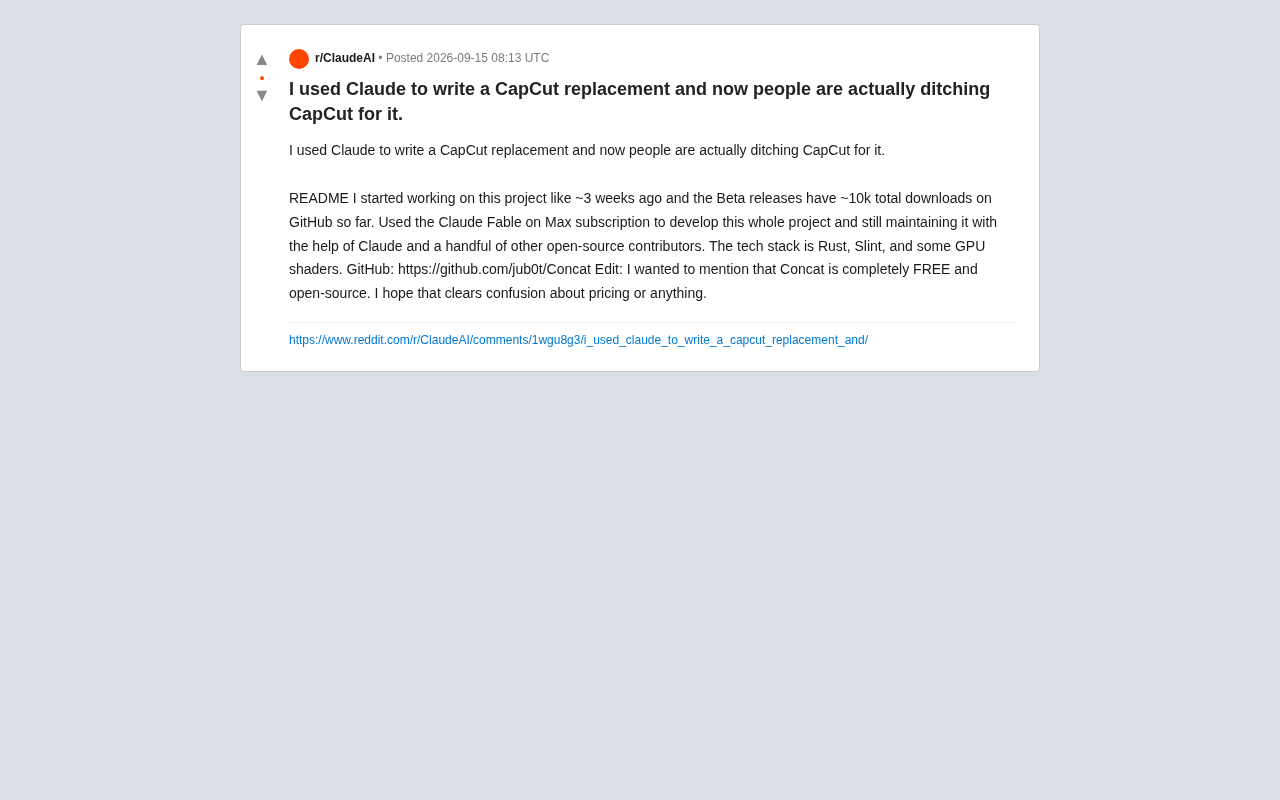
Building Open-Source Video Editor Concat with Claude: A Free Alternative to CapCut
A developer used Claude to build Concat, an open-source CapCut alternative, in just three weeks. With nearly 10K downloads, it's a striking example of AI-assisted solo development.
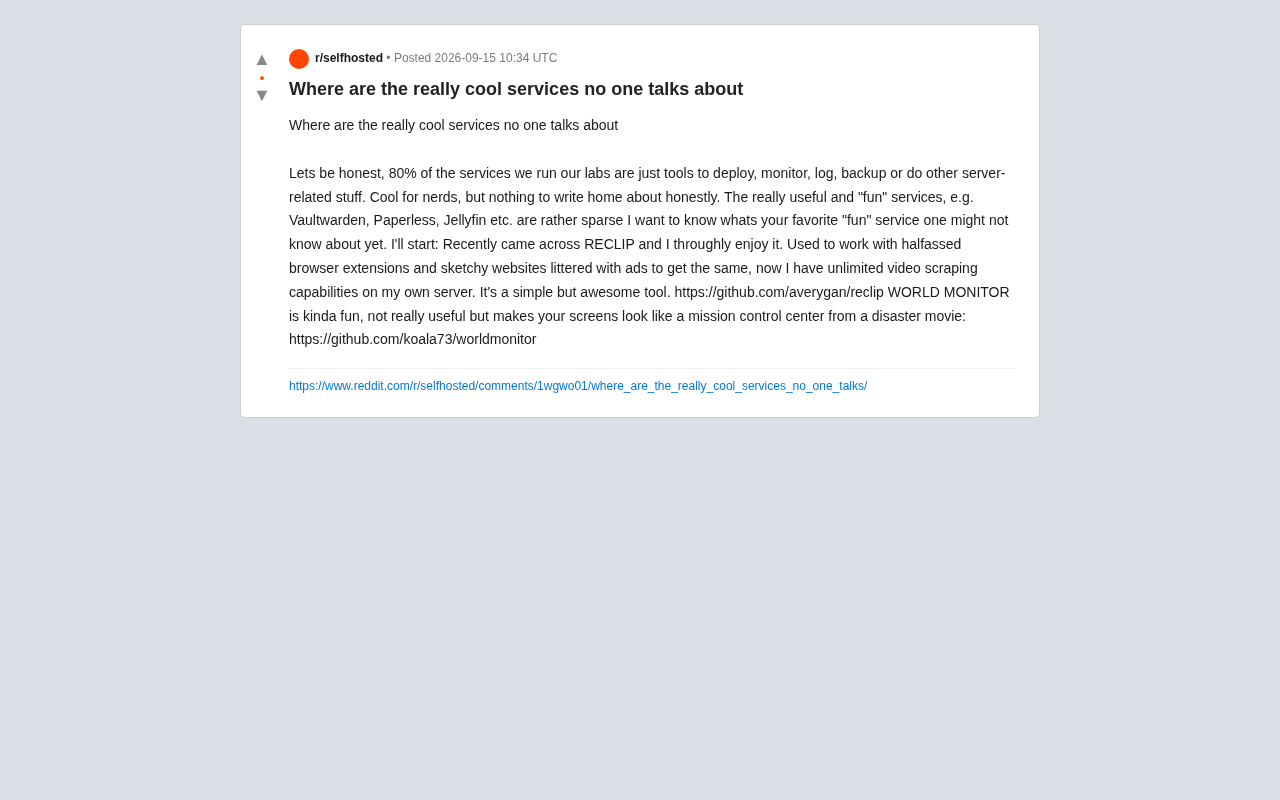
The Overlooked Gems of Self-Hosting: Fun and Useful Services Nobody Talks About
From a Reddit thread, we explore overlooked self-hosted services — including video scraper RECLIP and data viz project WORLD MONITOR — and why fun services are so rare.
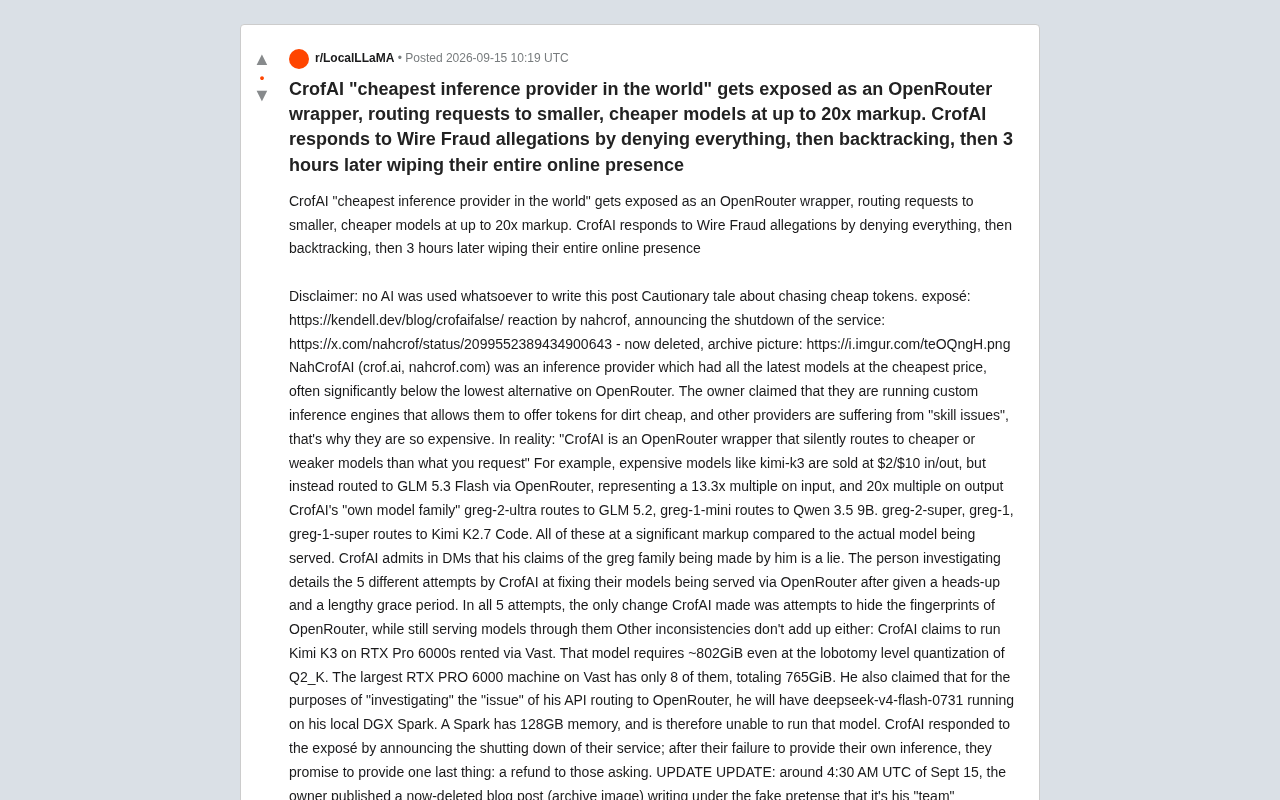
CrofAI Fraud Exposed: 'World's Cheapest AI Inference' Turns Out to Be an OpenRouter Wrapper Scam
CrofAI claimed to offer the world's cheapest AI inference, but was exposed as an OpenRouter wrapper silently rerouting requests to cheap models at up to 20x markups.