AI and the Enclosure of the Scientific Commons

AI is enclosing the scientific commons through data privatization, model opacity, and evaluation drift, eroding science's public nature.
Using the "enclosure movement" metaphor, the article analyzes AI's erosion of the scientific commons—shared knowledge, data, methods, and tools sustained by peer review and open licenses. AI changes boundaries at three levels: data (publicly funded papers and code absorbed into private models, creating input-output asymmetry), models (black-box opacity challenging auditability and reproducibility), and evaluation (accelerated output diluting long-term accumulation). The article notes the tech community's scarce attention and proposes institutional responses like data provenance licensing, model auditing, and public compute.
Introduction
When we discuss AI for Science, we tend to focus on model capabilities, compute scale, or the number of papers. But a discussion on Hacker News reminds us of a more fundamental issue: AI is changing the public nature of scientific knowledge. The original title "AI and the Enclosure of the Scientific Commons" points directly to a historical metaphor—the enclosure movement.
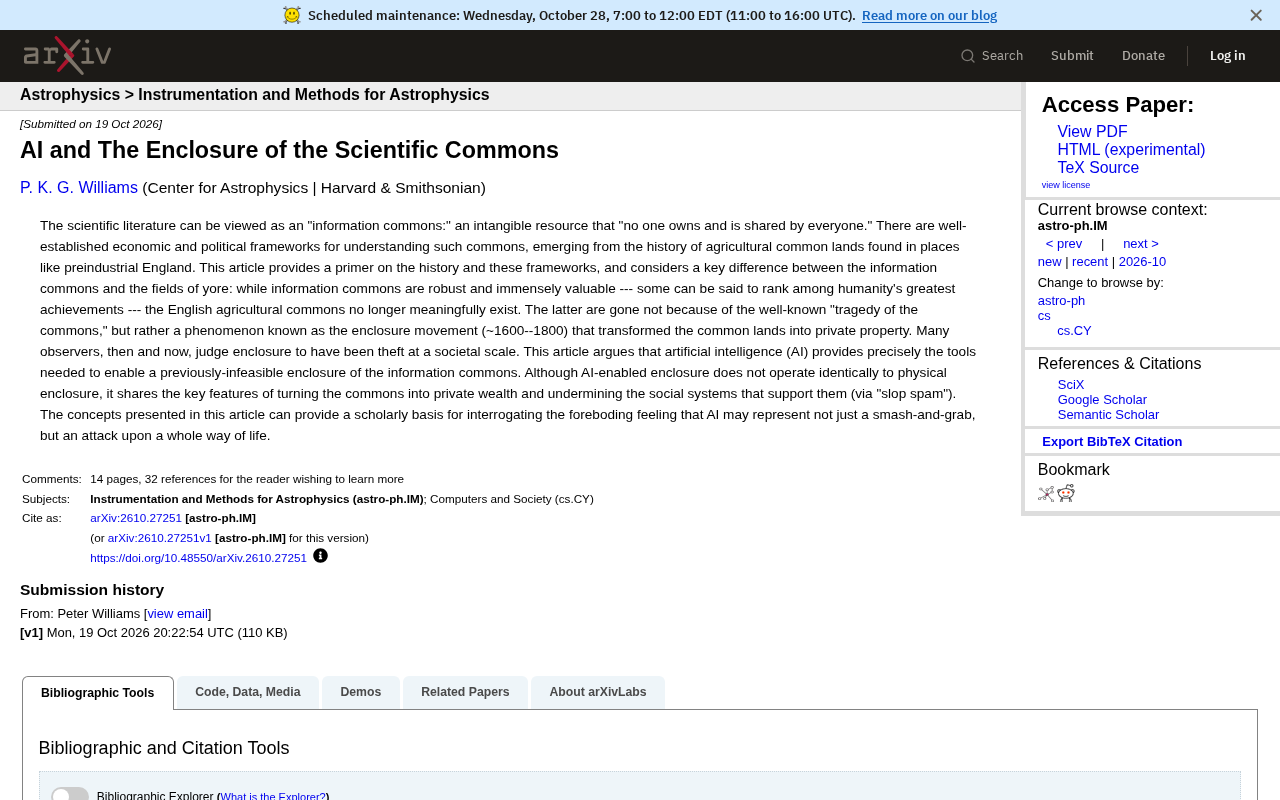
This article received 9 points on Hacker News—not a hot discussion—but the question it raises deserves deeper exploration: scientific knowledge has long been regarded as the common heritage of humanity, and AI's intervention is redrawing the boundaries.
What Is the Scientific Commons
The "Scientific Commons" refers to the sum of shared knowledge, data, methods, and tools in scientific research. From published papers to genetic databases, from open-source software to peer review mechanisms, this public infrastructure underpins the self-correction and cumulative progress of modern science.
The core features of the commons are open access and reusability. Newton said he stood on the shoulders of giants—the premise of this metaphor is that the giants' shoulders are open to everyone. When AI companies train models on public papers and then sell model capabilities as commercial products, an asymmetry emerges between the inputs and outputs of the commons.
The concept of the Commons can be traced to economic research on common-pool resources, especially Garrett Hardin's 1968 "tragedy of the commons"—individual rational use leads to depletion of public resources. But Elinor Ostrom later demonstrated that communities can avoid this outcome through self-governance institutions, earning her the 2009 Nobel Prize in Economics. In the scientific context, the commons is not unowned land but a shared resource system maintained by institutional arrangements: peer review of papers, open standards for data, and open-source licenses for code are all governance mechanisms that prevent excessive appropriation of the commons. Understanding this is crucial—enclosure is not simply "occupation" but a rewriting of governance rules.
Three Dimensions of the Enclosure Movement
Privatization at the Data Layer
Scientific papers, preprints, and code repositories are important sources of AI training data. Most of this content is produced with public funding, yet it is incorporated into private models in various ways. The original discussion did not elaborate on specific cases, but this tension has broad resonance in academia: data produced by public investment—whose asset is the output?
Copyright and licensing issues of training data are the legal focal point of this tension. The copyright status of scientific papers varies greatly: Open Access papers usually use Creative Commons (CC) licenses, but specific terms vary in their restrictions on commercial use; the copyright of traditional subscription-based papers mostly belongs to publishers, and large-scale scraping of such content by AI companies has triggered multiple lawsuits, such as The New York Times v. OpenAI. Preprint platforms like arXiv, though publicly accessible, have explicit restrictions in their terms of use on bulk scraping and commercial training. This means there is a legal gap between "publicly readable" and "legally usable for training," and current AI companies often rely on "fair use" defenses to bridge this gap.
Opacity at the Model Layer
Unlike the reproducibility requirements of papers, large AI models are often black boxes. As AI tools increasingly participate in hypothesis generation, experimental design, and data analysis, the auditability of the scientific process faces challenges. Public science relies on transparency for verification, while private models refuse to disclose details on competitive grounds.
Reproducibility is one of the cornerstones of modern science, meaning independent researchers can reproduce experimental results based on paper descriptions. This norm faces a double challenge in AI-assisted science: first, commercial large models do not disclose weights, training data, or architectural details, so external researchers cannot reproduce their behavior; second, even if models are open-source, the unavailability of training data makes full reproduction impossible. In response, academia has proposed documentation standards such as "Model Cards" and "Datasheets for Datasets," as well as governance frameworks for "auditable AI," but these mechanisms are currently mostly voluntary and lack mandatory binding force.
Shifting Evaluation Systems
AI accelerates paper output and also changes the focus of research evaluation. When generation speed replaces deep thinking as a quantifiable metric, the long-term accumulation mechanisms valued by the scientific commons may be diluted. The original article says little on this point, but it can be reasonably extended from the enclosure metaphor.
Why This Issue Is Underestimated
There is only 1 comment on Hacker News, reflecting the scarcity of attention in the tech community to such structural issues. Most discussions focus on model performance and application scenarios, while reflection on knowledge production relations remains relatively marginal.
This neglect itself is noteworthy. The erosion of the scientific commons is not a single event but a gradual institutional drift: every tightening of data licensing terms, every concealment of model details, every shift in evaluation metrics—each is reasonable in isolation, but cumulatively they change the operating logic of science.
Possible Ways Forward
The original article does not provide a systematic solution, but the history of the enclosure movement offers a reference: the commons does not necessarily lead to privatization, and institutional design can draw boundaries.
- Data provenance and licensing: clarify the conditions for AI use of publicly funded data
- Model audit mechanisms: establish reproducibility requirements for models involved in scientific decision-making
- Public compute and open-source models: preserve non-commercial scientific AI infrastructure
These directions all require joint consultation between the scientific and technical communities, rather than unilateral commercial decisions.
Conclusion
AI's contribution to science is indisputable, but the efficiency gains of tools and the sustainability of the knowledge ecosystem are two separate issues. Using "enclosure" as an analytical framework is not meant to negate AI but to remind us: the value of the commons lies in its publicness, and once this premise is eroded, the opportunity to stand on the shoulders of giants will no longer be equal.
Although the original discussion is short, the weight of the issue far exceeds its popularity.
One-line Summary
AI is enclosing the scientific commons through data privatization, model opacity, and evaluation drift, eroding the public nature of science.
Paragraph Summary
Using the historical metaphor of the "enclosure movement," the article analyzes AI's erosion of the scientific commons. The scientific commons refers to shared knowledge, data, methods, and tools, whose core is open access and reusability, maintained by institutions such as peer review and open-source licenses. AI's intervention changes boundaries at three levels: at the data layer, papers and code produced with public funding are incorporated into private models, creating input-output asymmetry; at the model layer, black-box characteristics challenge the auditability and reproducibility of the scientific process; at the evaluation layer, AI-accelerated output may dilute long-term accumulation mechanisms. The article notes the tech community's scarce attention to this structural issue and proposes possible institutional ways forward such as data provenance licensing, model auditing, and public compute.
Related articles

Amphibious Transforming Drone: Beyond 100x Power Savings, What Are the Real Needs?
Is the amphibious transforming drone just a gimmick? Starting from the 100x power difference of the M4 Morphobot, explore real application scenarios and thesis topic ideas, analyzing boundary conditions where pure drones and pure ground robots both fail.

Warhound Raises $200 Million: Genetically Engineered "War Dogs" Paired with Anduril Gear
Warhound raises $200M, backed by Ben Lamm and Palmer Luckey, to genetically engineer dogs for military and law enforcement use and equip them with Anduril gear. This article analyzes its technology direction, funding logic, and ethical controversy.

Claude API Comes to Google Cloud: IAM Integration and SDK Access Guide
Anthropic hosts the full Claude API on Google Cloud with IAM-controlled permissions and unified billing. This guide covers the Vertex AI and Anthropic-hosted entry points, IAM role configuration, and SDK access.