AI Assistant Accidentally Deletes Emails: Where Are the Security Boundaries for Agent Authorization?

An AI agent's accidental email deletion reveals critical gaps in agent authorization and safety design.
A Meta security researcher's AI assistant accidentally deleted her emails, highlighting a growing risk in AI agent applications. The incident underscores that even experts are vulnerable to automation bias when granting AI operational permissions. The article explores key safety principles including human-in-the-loop confirmation, least privilege access, soft delete with rollback, and dry-run mechanisms to build more trustworthy AI agents.
An Incident That Sparked Deep Reflection
Recently, a discussion on Hacker News caught widespread attention across the tech community: a security researcher at Meta encountered an embarrassing yet thought-provoking incident while using an AI Agent to assist with her work — her AI assistant accidentally deleted her emails while executing a task.
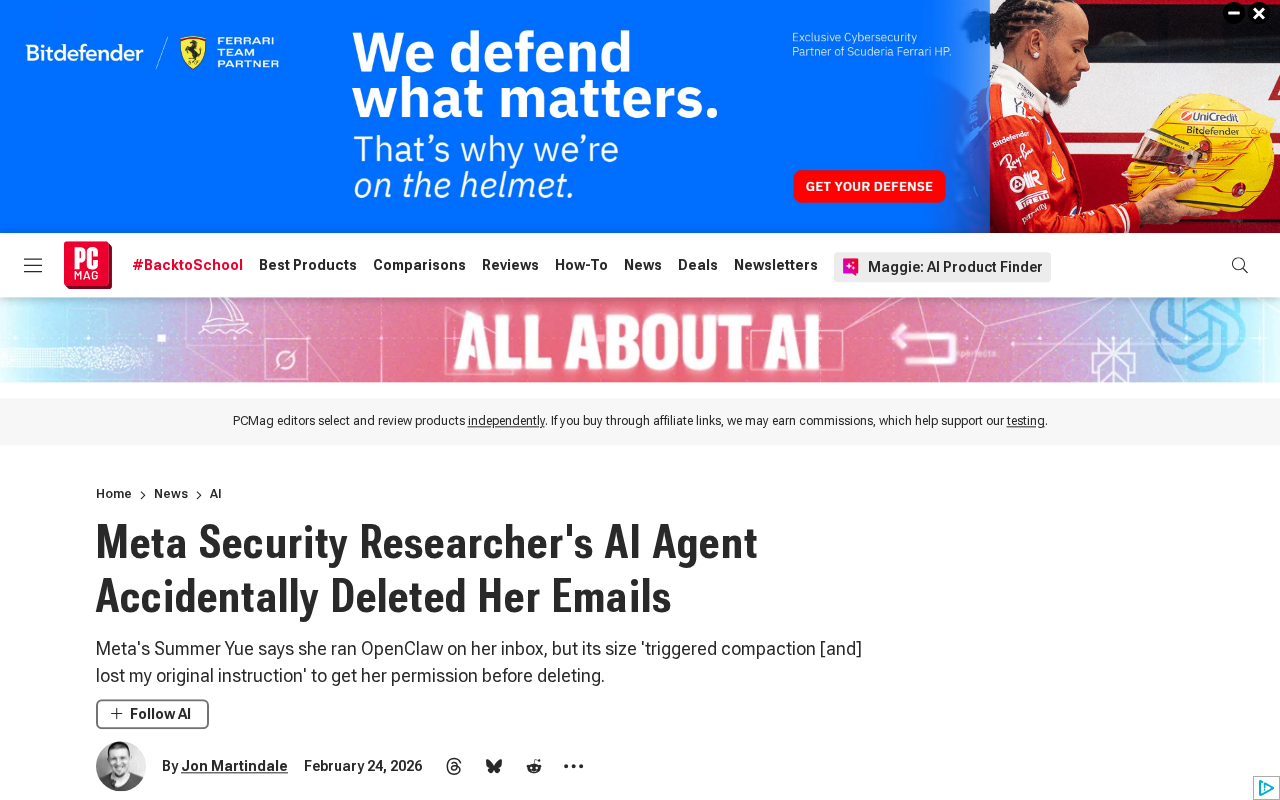
This incident deserves attention not only because the person involved is a professional security researcher — someone who should theoretically have heightened awareness of system permissions and automation risks — but because it highlights a core issue that's becoming increasingly prominent in AI agent applications: When we grant AI the authority to perform real-world actions, where exactly should the boundaries be drawn?
AI Agents: From Advisors to Executors
Over the past two years, large language models (LLMs) have evolved from simple conversational Q&A to "agent" systems capable of calling tools, accessing APIs, and manipulating file systems. An AI agent refers to an AI system with the ability to autonomously perceive its environment, formulate plans, and take action. Unlike traditional chatbots, agents can decompose complex tasks into multiple sub-steps, autonomously invoke external tools (such as search engines, databases, email APIs, etc.), and dynamically adjust their execution strategies based on intermediate results. Current mainstream agent frameworks include LangChain's Agent module, AutoGPT, Microsoft's AutoGen, and others. They essentially wrap a tool-calling layer and memory mechanism on top of large language models, transforming AI from "passive responder" to "active executor." This shift brings enormous efficiency gains while simultaneously introducing entirely new risk dimensions.
Permissions Equal Risk
Traditional AI assistants only provide text-based suggestions, with the final operational decisions still made by humans. Modern AI agents, however, have been given the ability to "take action" — they can organize your inbox, delete spam, archive old files, and even reply to messages on your behalf.
The problem is that when AI gains write and delete permissions to critical resources like email and file systems, any misunderstanding of intent, ambiguous instructions, or model "hallucination" can translate into irreversible real-world losses. The concept of "model hallucination" deserves special explanation here: hallucination is a known flaw in large language models, referring to the model generating content that appears plausible but is actually fabricated or incorrect. This phenomenon stems from LLMs' probability-based text generation mechanism — the model doesn't truly "understand" facts but predicts the next most likely token based on statistical patterns in training data. When hallucinations occur in conversational settings, users at worst receive incorrect information. But when hallucinations occur in an agent's tool-calling context, erroneous judgments directly translate into erroneous actions, with consequences escalating geometrically. Deleting emails is an action that often cannot be recovered through a simple "undo" operation.
The Gulf Between Intent and Execution
In this incident, the AI most likely misjudged which emails fell within the scope of deletion while executing a seemingly reasonable "cleanup" or "organization" task. Human users instinctively double-check before deleting important emails, but AI lacks this kind of "hesitation" based on common sense and context. It faithfully — even overzealously — executes what it understands the instructions to be, even when that understanding itself is wrong.
This "intent-execution gulf" has deep technical roots. While current large language models have made significant progress in natural language understanding, they still lack the causal reasoning ability to assess real-world consequences. Humans naturally perform "consequence simulation" when making decisions — imagining the outcome of an action and evaluating its acceptability. AI agents at the current stage are primarily performing pattern matching and instruction following, rather than truly understanding the real-world implications and irreversibility of their operations.
What It Means When Even Security Experts Fall Into the Trap
The most ironic — and most cautionary — aspect of this incident is that the victim was a security researcher at Meta. This sends a clear signal: The risks of AI agents don't stem merely from users' lack of technical expertise; rather, the technology paradigm itself is not yet mature.
Even professionals, when faced with convenient AI automation tools, may grant excessive permissions due to trust or oversight, or fail to adequately preset operational safety boundaries. This phenomenon is known in psychology as "Automation Bias" — when people collaborate with automated systems over time, they tend to gradually reduce their questioning and scrutiny of system outputs, especially when the system performs well in most cases. A security researcher's professional background doesn't make them immune to this cognitive bias, because automation bias operates at the intuitive level, not the knowledge level. This means that relying solely on "users being more vigilant" is far from sufficient — the problem must be systematically addressed at the product design and technical architecture level.
How to Build Safer AI Agents
Based on this incident, we can distill several key principles for building secure AI agents:
Destructive Operations Must Require Secondary Confirmation
For irreversible or high-impact operations such as deletion, overwriting, and sending, AI agents should not execute automatically. Instead, they should clearly present to the user: "I am about to delete the following N emails," and wait for explicit human approval. This "Human-in-the-Loop" (HITL) mechanism is currently the most effective safeguard against such incidents.
Human-in-the-Loop (HITL) is a design pattern that embeds human judgment at critical nodes of automated workflows. It was first widely applied in industrial automation and military decision-making systems. In the context of AI agents, HITL means the system must pause and request human approval before executing high-risk operations. This mechanism can take various forms, from simple confirmation dialogs to presenting complete operation plan summaries for review, to tiered authorization — where low-risk operations (like marking as read) execute automatically while high-risk operations (like deletion or forwarding) require manual approval. The current industry consensus is that HITL remains an indispensable safety net until AI agent reliability has been sufficiently validated.
Strictly Follow the Principle of Least Privilege
Following the classic information security principle, AI agents should only be granted the minimum permissions necessary to complete the current task. An assistant responsible for summarizing email content has absolutely no need for deletion permissions. Loosely granted permissions are a breeding ground for risk.
The Principle of Least Privilege is one of the most fundamental and important principles in information security, first proposed by Jerome Saltzer in 1975. This principle requires that every subject in a system (user, program, process) should only be granted the minimum set of permissions needed to perform its legitimate functions — no more, no less. In operating systems, database management, and cloud service architectures, this principle is widely practiced — for example, AWS IAM policy design emphasizes fine-grained permission configuration. However, in AI agent application scenarios, developers often grant agents broad API permissions (such as simultaneously granting read, write, and delete access) for the sake of functional flexibility, frequently violating this classic principle and creating a primary source of security vulnerabilities. Going forward, AI agent permission management needs to draw from Zero Trust Architecture concepts, independently evaluating and verifying permissions for each operation request.
Rollback Mechanisms and Operation Logs
An ideal AI agent system should have operation traceability and rollback capability. All critical actions should be recorded in detailed logs, and delete operations should preferably use "soft delete" (moving to a recycle bin) rather than permanent removal, giving users a recovery time window.
Soft Delete is a common pattern in database and system design, where a delete operation doesn't actually remove data from storage but instead achieves logical deletion through a flag field (such as is_deleted=true) or by moving data to a recycle bin. In contrast, Hard Delete physically purges data completely. In the context of AI agent operations, the soft delete mechanism is crucial because it provides human users with a "regret window." Similarly, the design philosophy of the Git version control system — where every change is traceable and reversible — offers an important reference paradigm for AI agent operational safety design. Future mature AI agent platforms should support operation atomicity and rollback capability, much like database transactions, ensuring that any erroneous operation can be safely undone.
Sandbox and Dry-Run Mechanisms
Before actually executing operations, let the AI first list everything it plans to do in a "dry-run" mode for user review and confirmation before actual execution. This is especially important in file operations and batch processing scenarios.
Dry-run (preview/simulated execution) is a classic practice in software engineering and system operations, referring to simulating and displaying the complete effect of an operation without actually executing it. This concept is particularly common in Linux command-line tools — for example, rsync's --dry-run parameter lists all files that would be synchronized without actually transferring them, and rm's interactive mode confirms each deletion target one by one. In CI/CD pipelines, database migrations, and infrastructure-as-code tools (such as Terraform's plan command, which fully displays resources to be created, modified, or destroyed before applying changes), dry-run has become standard safety practice. Introducing this mechanism into AI agents means users can fully review the agent's operation plan before it "takes action," allowing potential misjudgments and risks to be caught before execution. Going further, systems can also introduce Sandbox environments where agents trial-run in isolated environments, verifying the correctness of operation results before applying them to the real environment.
Balancing Convenience and Loss of Control
This "AI accidentally deleting emails" incident is a microcosm of the entire AI agent era. We are at a stage where technological capability is rapidly outpacing safety governance — AI can do more and more, but the mechanisms to ensure it "does the right thing" and "doesn't do the wrong thing" are still playing catch-up.
From a broader perspective, this dilemma is not unique to the AI field. In autonomous driving, algorithmic financial trading, industrial automation, and other domains, human society has long been exploring the safety boundaries of automated systems. The "AI Alignment" problem proposed by academia — how to ensure that AI systems' behavior truly aligns with human intentions and values — becomes especially concrete and urgent in agent scenarios. When AI upgrades from "providing advice" to "taking direct action," the cost of alignment failure escalates from "misinformation" to "actual damage."
For developers, this is a reminder that safety boundaries must be the top priority when designing agent products — not an afterthought. For users, the takeaway is: Granting AI operational permissions is fundamentally a transfer of trust, and that trust must be built on adequate safeguards.
While enjoying the efficiency gains that AI brings, each of us should seriously consider: if it gets something wrong, what's the cost — and can I afford it and recover from it?
Related articles

Python 3.15 New Feature: Is the sentinel Type Better Than None?
Python 3.15 adds the sentinel type, using named unique sentinel objects to replace None and bare object(), resolving confusion among missing values, explicit emptiness, and invalid input while avoiding type hint failures.

Deep Learning's Three Architectures and the Universal Approximation Theorem: A Complete Guide to MLPs, CNNs, and Transformers
Explaining the inductive bias differences among MLP, CNN, and Transformer, the existence meaning of the Universal Approximation Theorem (UAT), and the role of Taylor expansion in approximation analysis, while clearing up common misconceptions.

GitLab Emergency Patch Release: Analysis of Critical Security Fixes
GitLab releases critical patch 19.5.1, sparking 355 points of discussion on Hacker News. This article analyzes the background, upgrade steps for self-hosted instances, and verification points to help DevOps teams respond quickly to security updates.