AI Assistant Muse Hands-On: From Picking Tea to Generating Anime Art
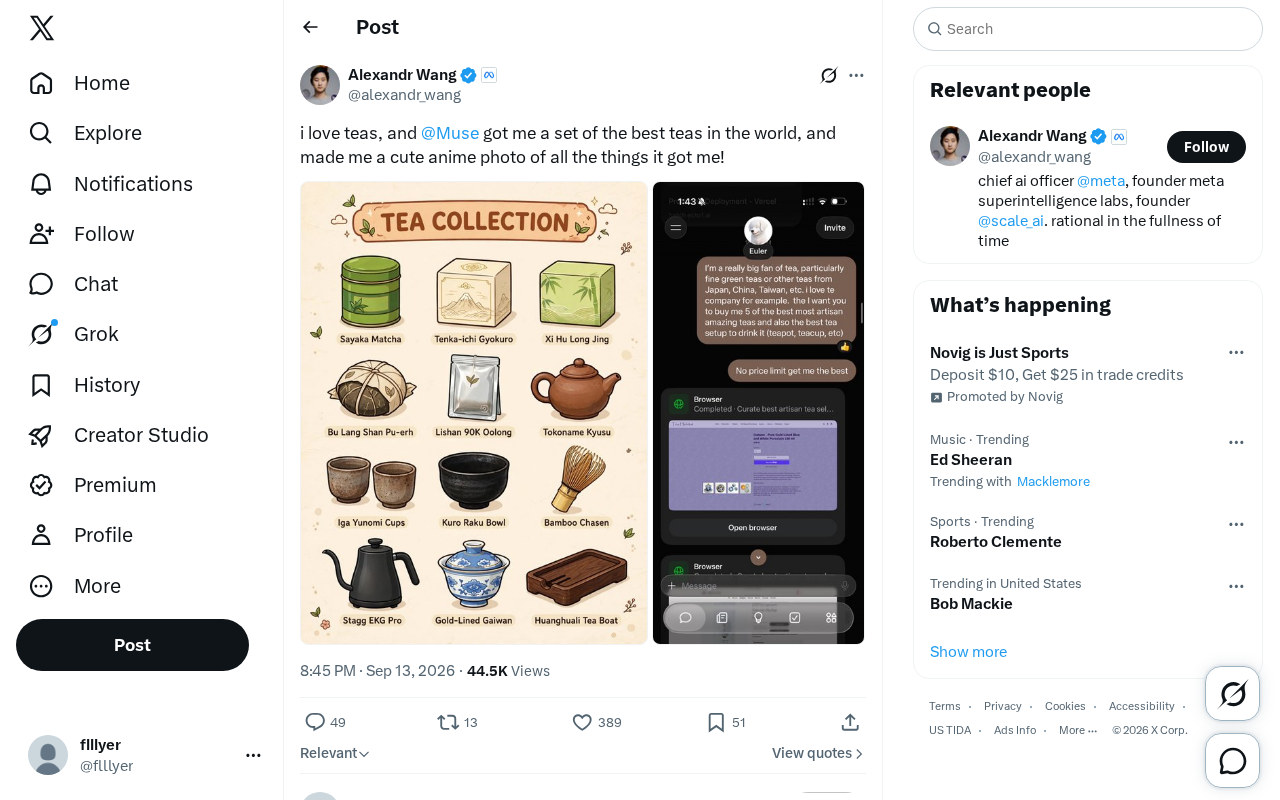
AI assistant Muse chains personalized tea recommendations with anime image generation in a single seamless workflow.
A user shared their experience with AI assistant Muse completing both a tea product recommendation and an anime-style image generation in one flow — reflecting a broader trend of AI assistants evolving from single-task tools into task-chaining service platforms. Muse proactively curated tea based on user preferences and then rendered the results as visual content, blending utility with entertainment to boost engagement. While the case lowers the barrier for everyday users by consolidating search, shopping, and creation into one assistant, the article cautions that a single positive review can't represent overall product quality — recommendation accuracy, content consistency, and data privacy all warrant closer scrutiny.
The AI Personalization Trend Behind a Single Tweet
A user recently shared their experience with AI assistant Muse on social media: Muse not only selected a tea set on their behalf, but also generated an anime-style illustration of the purchased items. What looks like a casual post actually reflects a broader shift — AI assistants are evolving from simple information tools into comprehensive assistants capable of personalized recommendations and creative content generation.
In the past, AI tools were largely limited to individual tasks: answering questions, generating text, or producing images — but rarely in combination. In this case, Muse accomplished two things at once: selecting a product based on user preferences, and generating matching visual content around the result. This "task chaining" model is one of the key battlegrounds in today's AI assistant competition.
Integrating Recommendation and Creation
The user mentioned they "like tea," and Muse used that to curate a tea set. This step demonstrates personalized recommendation — the AI needs to understand user preferences and make selections accordingly. Compared to traditional keyword search, this kind of proactive curation is much closer to how a human assistant would operate.
What's even more interesting is the second step: Muse took the selected items and rendered them as an anime-style image. This means the AI doesn't just deliver a result and stop there — it also presents that result in a visually engaging, entertaining way, adding emotional value to the interaction. Combining utility with delight is a well-established strategy for driving user retention.
It's worth noting that this was a brief personal post from a single user, with no technical details disclosed about Muse's recommendation algorithms or image generation models. Any assessment of its capabilities is therefore based on the user experience, not technical verification.
Task Chaining is a key concept in modern AI assistant architecture. It refers to linking multiple independent capability modules in sequence, so that the output of one step automatically becomes the input for the next — a fundamental departure from the "single-turn Q&A" model of early AI tools. Implementing task chains typically relies on two types of technical foundations: first, large language models with tool-calling capabilities (such as GPT or Claude series models that support Function Calling), which can dynamically invoke external APIs for search, shopping, image generation, and more during a conversation; second, multimodal models capable of cross-modal processing — handling both text and images within the same inference pipeline. The workflow Muse demonstrated here — "understand preferences → select product → generate image" — is a classic three-step task chain, and its technical complexity far exceeds completing any one of those steps in isolation.
The Potential of Personalized AI Assistants
This kind of experience points to a possible direction for AI assistants: packaging recommendation, decision-making, and content creation into a seamless service flow. For everyday users, this lowers the barrier to entry — instead of separately invoking search, shopping, and image generation tools, a single assistant can close the loop from need to outcome.
That said, a single positive user post can't represent a product's overall performance. Recommendation accuracy, consistency of generated content quality, and how underlying data privacy is handled are all important factors to examine when evaluating products like this.
For readers following AI applications, the value of this post lies in the concrete use-case example it offers — a window into how AI assistants are beginning to weave themselves into the details of everyday life.
Before large language models entered the picture, personalized recommendation systems relied primarily on two algorithmic approaches: Collaborative Filtering, which infers preferences based on the behavior of similar users, and Content-Based Filtering, which matches item attributes to a user's history. Integrating large models into the recommendation pipeline allows systems to directly understand user intent through natural language, rather than relying on implicit signals like click-through rates — which theoretically helps handle "cold start" scenarios where a new user has little data history. However, the data privacy risks of such systems also increase accordingly. To deliver precise personalization, these models need to continuously accumulate user preference data. How to strike the right balance between personalization effectiveness and data minimization principles remains an open question, with no unified best practices established across the industry yet.
Related articles
Xi Jinping Proposes Open Source AI Cooperation Zone Among BRICS Nations
Xi Jinping proposed an open source AI cooperation zone at the BRICS summit. Analyzing the strategic intent, open source rationale, and global AI governance implications.
Swift-Qwen3.8-27B: 58% Fewer Thinking Tokens, Nearly 2x Faster Inference
UkisAI open-sources Swift-Qwen3.8-27B, cutting thinking tokens by 58% and boosting inference speed 1.95x via overthinking token penalties and on-policy distillation — with under 1% accuracy loss.
Netflix Partners with Sega: Crazy Taxi Movie and New Sonic Animated Series on the Way
Netflix announces three Sega game adaptations: a Crazy Taxi movie, a new Sonic animated series with edge, and a live-action film based on RGG Studio's Stranger Than Heaven.