Say Goodbye to AI Influencer Faces: A Complete Guide to Creating Visual Assets for AI Comic Dramas from Scratch

Use visual assets instead of complex prompts to lock in consistency of AI comic drama characters and scenes.
The article introduces the second episode of Bilibili creator "AI Explorer Wangmu"'s zero-basics AI comic drama full-process series. The core idea is: prompts tell the AI what to do, visual assets tell the AI what to keep consistent. Character design has three steps—script first to define the character setting, visual references to improve recognizability, and injecting a sense of a real person to add realistic texture; then an asset sheet layout with facial close-ups on top and full-body costume images below replaces the traditional four-view sheet to solve insufficient facial detail. Prop design emphasizes that weapons should be simple rather than complex, since complex structures easily distort in difficult fight scenes. Scene design uses a nine-grid to lock down spatial layout: the first eight images define appearance, and the last clarifies spatial relationships. Finally, a cinematic color palette unifies color direction, and an asset annotation list marks each image's name, purpose, and key features, providing stable reference for subsequent video generation.
The biggest headache in AI comic drama creation is when a character changes clothes and plot, yet the face stays the same—repeatedly telling the AI to "make it prettier" still yields the same cookie-cutter influencer face. In the second episode of his zero-basics AI comic drama full-process series, Bilibili creator "AI Explorer Wangmu" uses ready-made skills in Doubao Work to break down a complete methodology from character design to scene assets. The core idea is just one sentence: prompts tell the AI what to do, visual assets tell the AI what to keep consistent.
Character Design: Three Methods to Escape "Gacha-Style" Face Generation
Many beginners start by asking AI to generate a beautiful ancient-style woman, but the result often has only looks and no personality. The creator's first step should be to let the AI act as a "casting director."
Method 1: Script First
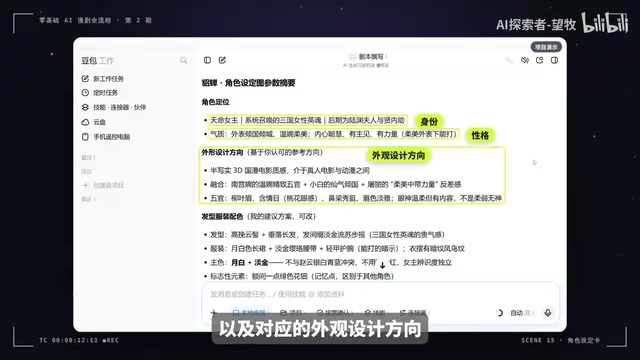
Open Doubao Work, invoke the short drama creation skill, upload the story setting manual completed in the previous episode or your own script, and let the AI analyze the female lead Diaochan to produce a character setting card. The AI extracts the character's identity, personality, and corresponding appearance design direction—for example, this Diaochan appears gentle and soft on the outside, yet is intelligent and opinionated inside, and also has combat abilities. Then invoke the creative design skill to generate a first version of the image based on the character card. The character is no longer a randomly generated pretty face, but one with a script-based foundation.
Method 2: Use References as Strategy
Matching the character setting does not mean matching public aesthetics. The initially generated Diaochan had regular features but lacked recognizability. At this point, you can ask Doubao Work to search for visual references, or directly upload images you like and extract design features such as face shape, eyebrows and eyes, and ornaments; you can also use the "three proportions and five eyes" rule as an aid—vertically divide the face into three parts, and horizontally divide it roughly into five eye widths, helping the AI understand facial proportions more concretely. Take the face shape from one image, the eyebrows and eyes from another, and the nose and mouth from a third, then invoke the creative design skill to redesign based on the character setting. Be careful to borrow features rather than directly copy an existing character. The adjusted Diaochan is clearly more distinctive.
Three proportions and five eyes is a classic rule about facial proportions in traditional Chinese figure painting. "Three proportions" means dividing the length of the face vertically into three equal parts: from the hairline to the brow bone is the upper proportion, from the brow bone to the base of the nose is the middle proportion, and from the base of the nose to the chin is the lower proportion; "five eyes" means the width of the face is roughly equal to five eye lengths, with one eye width between the two eyes and one eye width each from the outer eye corner to the hairline. This proportion is not an absolute standard, but it helps the AI understand the concrete meaning of "regular features" and avoid generating faces with distorted proportions or excessive exaggeration. Introducing this concept in prompts or reference analysis can give the AI clearer constraints on facial structure, so that when borrowing from reference images it can more accurately adjust details such as eye spacing and middle-proportion length.
Method 3: Inject a Sense of a Real Person
Looking good does not equal being real. Many AI characters are exquisite but resemble plastic mannequins, lacking real texture. At this point, you can directly invoke the creative design skill and ask it to keep the original face while adding natural skin texture, hair strand layers, and clothing wrinkles. If the result is too rough, prompt: "Keep the refined feel; do not add stains or damage."
A sense of a real person comes not only from skin, but also from whether the styling and makeup match the identity. The creator found a clothing reference image they liked—hairstyle and head ornaments, a blue gauze dress, and white stockings and shoes—and gave the original Diaochan and the reference image together to the creative design skill, keeping the original face while redesigning the clothing, hairstyle, and accessories. The character's overall aura changed completely. First settle on a satisfying face, then refine the styling through reference images—this is the approach the UP host strongly recommends.
Character Asset Sheet: Solving the Consistency Problem
The character is settled; next is consistency. Traditional four-view sheets (upper-body close-up plus front, side, and back full-body shots), as well as later detail images, share a common problem: the character's face is too small, providing limited facial detail.
A more recommended approach is the asset sheet layout: place high-definition front and side facial close-ups at the top, and front, side, and back full-body costume images at the bottom. The top provides facial feature reference, while the bottom provides body proportions, clothing, and accessories; both types of information are clearer. Upload the final costume photo and invoke the creative design skill to generate a character asset sheet in this layout. If emotional performance is needed later, you can additionally generate a 16-grid expression sheet to better control expressions.
Four-view sheets are a commonly used reference image format in character design, usually containing the character's front, side, back, and three-quarter side full-body views, sometimes plus a head close-up. Their advantage is showing both the overall silhouette and clothing structure, making it easier to maintain multi-angle consistency during modeling or drawing. But in AI generation scenarios, the face occupies a very small proportion of the full-body image in a four-view sheet, making it difficult for the AI to extract enough facial feature detail, which can cause the face shape to drift when generating close-ups later. Therefore, the "asset sheet layout" proposed in the article places high-definition facial close-ups and full-body costume images in separate upper and lower zones, essentially redistributing the information density of the four-view sheet so that facial reference and body reference each serve their own purpose.
Prop Design: Weapons Are Not Necessarily Better the More Complex They Are
Weapons are also important visual assets. Give the character setting card and final costume photo to the creative design skill, and let it design a dedicated weapon based on the character's identity and combat characteristics. If you have a shape you like, you can also upload a reference image.
Here is a key technique: weapons are not necessarily better the more complex they are. Especially in difficult fight scenes, complex structures are more prone to distortion and detail chaos. The creator ultimately chose a long sword whose color scheme matches Diaochan's costume and whose structure is relatively clear. After settling on the shape, have the AI generate front, side, and partial detail images to lock in the proportions and decorative patterns of the hilt, guard, and blade. Later weapon close-ups and fight shots then have a unified reference basis.
Scene Design: A Nine-Grid Locks Down the Spatial Layout
Scenes also need consistent assets. Many people generate only one beautiful large image, and as soon as the camera angle changes, the building positions may change.
First ask Doubao Work to organize the scene requirements, then invoke the creative design skill to generate the main scene; if unsatisfied, upload reference images and continue adjusting. Once the main scene is settled, generate a scene nine-grid: the first eight images show different camera positions such as the front, reverse angle, left and right sides, entrance, overhead view, and partial close-ups. The most important is the last spatial layout image, used to clarify the positional relationships among the palace entrance, roads, and battle area. The first eight images tell the AI what the scene looks like; the last image tells the AI how the space is laid out.
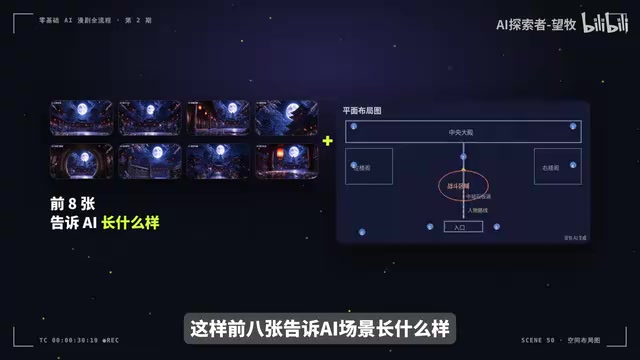
Reverse angle shot is a common term in film and television production, referring to a camera position opposite to the previous shot, usually used in dialogue scenes to alternately present both parties' perspectives, or to shoot the subject from behind to show the environment they face. In scene assets for AI comic dramas, generating reverse-angle images helps the AI understand what the same space looks like from different orientations, avoiding background elements being flipped left-right or building positions being disordered when switching shots. In the nine-grid, the reverse-angle image works with the front image to effectively establish a set of spatial coordinate references for the AI, so that when subsequent storyboard frames are generated, the scene structure remains consistent regardless of which direction the shot is taken from.
Cinematic Color Palette and Asset Annotation
The entire set of visual assets also needs a unified color direction. Give the script, characters, and scene images to Doubao Work, and ask it to act as a film colorist to extract seven core colors, labeling color values and usage scenarios. If you like a particular film style, you can also upload multiple reference images and let the AI extract common color patterns, then generate a cinematic color palette asset image.
After all images are ready, there is one final step: asset annotation. Upload the characters, weapons, scenes, and color palette together to Doubao Work, and organize an asset list indicating each image's name, purpose, and key features that must remain unchanged. This way, when generating videos later, you will know which image to use and what information to reference.
Visual Assets Are the Consistency Foundation of Comic Dramas
After going through the entire process, you will find that what truly matters is not writing complex prompts, but designing visual assets clearly in advance. From character setting cards, asset sheet layouts, and weapon detail images to scene nine-grids, layout images, and cinematic color palettes, every type of asset answers the same question: what should the AI keep consistent. This methodology applies to any AI video creator—once the four dimensions of character, prop, scene, and color are locked down, camera cuts and fight performances have a stable reference basis. The UP host also previews that in the next episode, he will use today's Diaochan design to challenge a difficult AI fight video and truly bring the character to life.
One-line Summary
Use visual assets rather than complex prompts to lock in consistency of AI comic drama characters and scenes.
Paragraph Summary
The article introduces the second episode of Bilibili creator "AI Explorer Wangmu"'s zero-basics AI comic drama full-process series. The core idea is: prompts tell the AI what to do, visual assets tell the AI what to keep consistent. Character design has three steps—script first to define the character setting, visual references to improve recognizability, and injecting a sense of a real person to add realistic texture; then an asset sheet layout with "facial close-ups on top and full-body costume images below" replaces the traditional four-view sheet to solve the problem of insufficient facial detail. Prop design emphasizes that weapons should be simple rather than complex, since complex structures easily distort in difficult fight scenes. Scene design uses a nine-grid to lock down spatial layout: the first eight images define appearance, and the last clarifies spatial relationships. Finally, a cinematic color palette unifies color direction, and an asset annotation list marks each image's name, purpose, and key features, providing stable reference for subsequent video generation.
Related articles
Mistral Large 4 Open-Sources a Trillion Parameters, Microsoft Offers Voluntary Severance to 60,000 Employees
Mistral Large 4 open-sources a trillion-parameter multimodal model with a coding agent score of 48; SanDisk earnings show AI inference reshaping NAND demand; Google Gemini adds in-app file editing, OpenAI raises Codex quotas, and Microsoft offers voluntary severance to 60,000 employees.
Mistral Large 4 Opens Its Weights: AI Morning Brief Roundup of Models and Ecosystem Trends
Mistral Large 4 opens its weights, a 1-trillion-parameter MoE architecture that can run locally on MacStudio; Meta's test-generation technology enters production; top tax benchmark pass rate only 10.8%; Canadian government takes a stake in Cohere; Doubao Work opens third-party model calls. This AI Morning Brief rounds up model, ecosystem, capital, and policy developments.

Mistral Large 4 Goes Open Source: A 1T-Parameter European Qwen Challenging DeepSeek
Mistral Large 4 is now open source: 1T total parameters, 52B activated, focused on coding and cybersecurity, with ~610G NVFP4 weights. We analyze its comparison with DeepSeek V4 Flash, API pricing, demo realism, and local deployment value.