AI-Assisted Programming in Practice: Using ChatGPT and Copilot to Boost Data Science Development Efficiency

AI programming assistants are freeing data scientists from boilerplate code, shifting them toward design and review.
The article discusses how AI programming assistants are changing data science development workflows, centered on a Reddit user's call to "stop typing boilerplate and start designing with AI." The core idea is to use ChatGPT and GitHub Copilot in layers: ChatGPT handles early-stage solution design, method recommendations, and code explanation, while Copilot handles real-time completion within the editor for high-frequency patterns such as pandas, matplotlib, and scikit-learn. The article emphasizes optimizing workflows rather than relying entirely on generation, requiring sufficient context and code review, especially vigilance against AI hallucinations in data cleaning and feature engineering. For learners, AI lowers the coding barrier but raises the requirements for problem decomposition and critical judgment.
From Manual Coding to AI Collaboration: The Transformation of Data Science Workflows
The development process for data science projects is undergoing a quiet efficiency revolution. Traditionally, data scientists have had to spend a great deal of time writing repetitive boilerplate code—data loading, cleaning, visualization templates, and model training loops. A Reddit user, sharing their data science learning path, put it bluntly: "Stop typing boilerplate and start designing with AI." This statement captures the core of the current paradigm shift: AI programming assistants are freeing developers from mechanical labor.
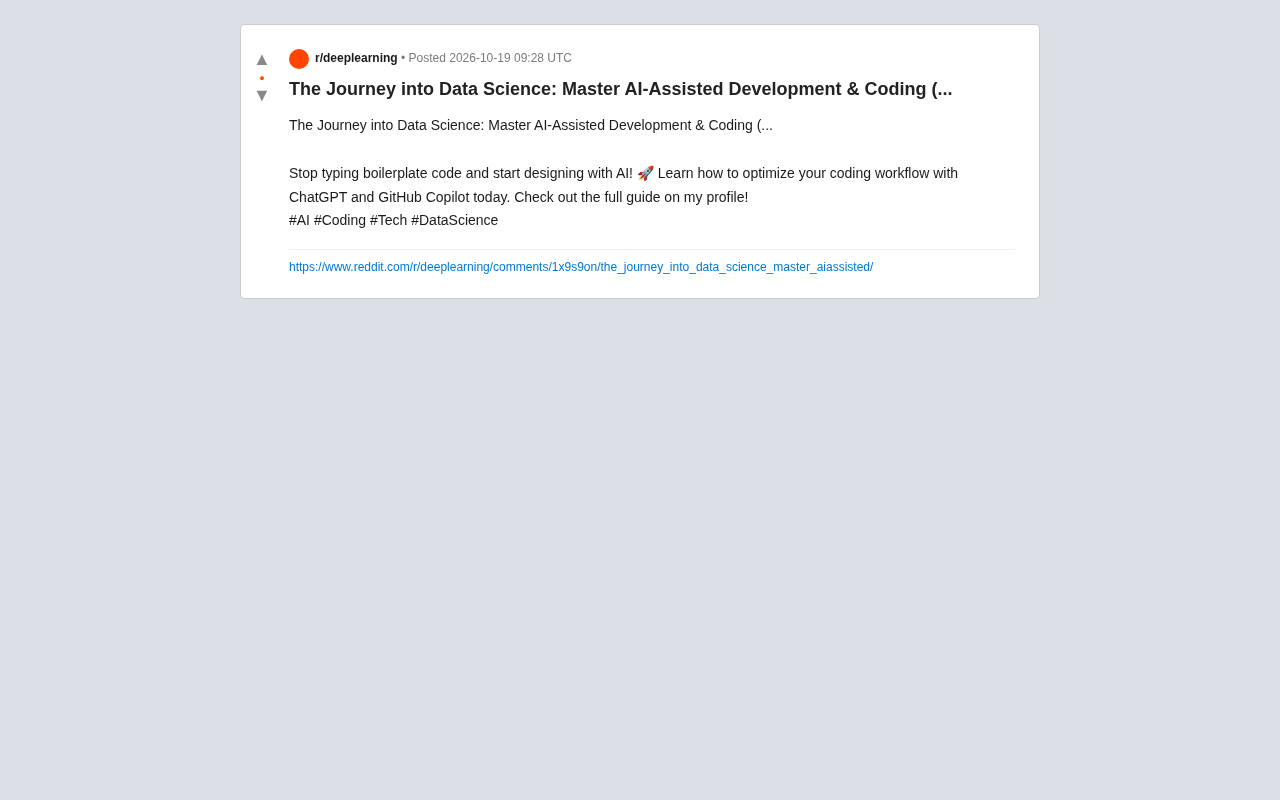
According to the Reddit post, properly configuring ChatGPT and GitHub Copilot can significantly optimize coding workflows. Although the original post is fairly brief and mainly serves as an entry point directing readers to a complete guide on the author's personal homepage, the direction it advocates aligns with common practice in the developer community today: positioning AI as a collaborative partner rather than a simple code completion tool.
The Division of Labor Between ChatGPT and GitHub Copilot in Data Science
ChatGPT: Solution Design and Code Explanation
ChatGPT's value in the data science workflow is mainly reflected in the early design stage. When facing an unfamiliar dataset or modeling task, developers can describe their requirements in natural language and have ChatGPT generate a preliminary analysis framework, recommend appropriate statistical methods, or even explain how complex algorithms work. This approach is particularly well suited to data science practitioners in the learning stage—the original Reddit post sets "Master AI-Assisted Development" as a learning goal, implying that AI-assisted capability itself has become part of the data science skill stack.
The "hallucination" of large AI models refers to the model generating content that appears plausible but is in fact incorrect or nonexistent. In programming scenarios, this typically manifests as calling nonexistent library functions, fabricating mismatched parameter names, or providing API usage incompatible with the current library version. The data science field is especially prone to triggering such problems, because libraries such as pandas and scikit-learn iterate frequently and their interfaces change often. Practical ways to reduce the impact of hallucinations include: specifying library names and version numbers in prompts, asking the AI to provide a verifiable minimal example, test-running the generated code on a small sample first, and cross-checking key calls against official documentation. Treating AI output as a draft to be reviewed rather than a final answer is the basic mindset for controlling the cost of hallucinations.
GitHub Copilot: Inline Completion and Pattern Recognition
Copilot's advantage lies in real-time completion within the editor. For high-frequency patterns such as pandas data operations, matplotlib plotting, and scikit-learn model pipelines, Copilot can quickly generate usable code based on context. The combination of the two forms a layered collaboration: ChatGPT is responsible for "thinking through what to do," while Copilot is responsible for "writing it out quickly."
The inline completion capability of Copilot-style tools depends on the "context window"—that is, the range of code the editor can read when generating suggestions, usually including the current file contents, comments and function signatures near the cursor, and in some configurations other files in the same project. The more sufficient the context, the better the completion results align with project conventions; conversely, if the context lacks data field names, type definitions, or existing code style, the model can only guess based on general patterns and is likely to produce code that does not match the actual data structure. Therefore, in actual use, keeping variable names clear, writing input/output descriptions above functions, and placing key data structure definitions in prominent positions can all significantly improve completion hit rates. This also explains why "providing sufficient context" is regarded as one of the core practices for optimizing workflows.
Practical Points for Optimizing AI-Assisted Coding Workflows
The original post emphasizes "optimizing the coding workflow" rather than simply relying on AI-generated code. Combined with common community practices, several key points deserve attention: provide the AI with sufficient context (data schema, library versions, business constraints); maintain a habit of reviewing generated code, especially in data cleaning and feature engineering; and templatize repetitive tasks so that AI completion has a stable starting point to follow. These practices can reduce the debugging costs caused by AI "hallucinations."
Implications for Data Science Learners
The original Reddit post positions AI-assisted development as a core capability in the data science journey, and this perspective deserves attention. For beginners, AI tools lower the barrier to writing usable code, but they also bring new requirements: stronger code review skills, clearer problem decomposition skills, and the habit of maintaining critical judgment toward AI output. Tools are evolving, and learning priorities should adjust accordingly.
One-line Summary
AI programming assistants are freeing data scientists from boilerplate code and shifting them toward design and review.
Paragraph Summary
The article centers on a Reddit user's call to "stop typing boilerplate and start designing with AI," and discusses how AI programming assistants are changing the data science development process. The core idea is to use ChatGPT and GitHub Copilot in layers: ChatGPT handles early-stage solution design, method recommendations, and code explanation, while Copilot handles real-time completion within the editor, dealing with high-frequency patterns such as pandas, matplotlib, and scikit-learn. The article emphasizes optimizing workflows rather than relying entirely on generation, requiring sufficient context and maintaining code review, especially being alert to AI hallucinations in data cleaning and feature engineering. For learners, AI lowers the coding barrier but raises the requirements for problem decomposition and critical judgment.
Related articles

Amphibious Transforming Drone: Beyond 100x Power Savings, What Are the Real Needs?
Is the amphibious transforming drone just a gimmick? Starting from the 100x power difference of the M4 Morphobot, explore real application scenarios and thesis topic ideas, analyzing boundary conditions where pure drones and pure ground robots both fail.

Warhound Raises $200 Million: Genetically Engineered "War Dogs" Paired with Anduril Gear
Warhound raises $200M, backed by Ben Lamm and Palmer Luckey, to genetically engineer dogs for military and law enforcement use and equip them with Anduril gear. This article analyzes its technology direction, funding logic, and ethical controversy.

Claude API Comes to Google Cloud: IAM Integration and SDK Access Guide
Anthropic hosts the full Claude API on Google Cloud with IAM-controlled permissions and unified billing. This guide covers the Vertex AI and Anthropic-hosted entry points, IAM role configuration, and SDK access.