AI-Assisted Vulnerability Hunting for Beginners: From Login Page Identification to Password Brute-Forcing

Beginner's breakdown of SRC vulnerability hunting: frontend/backend login pages and weak password cracking explained.
Using an academic system and a forum as examples, this article explains the key difference between frontend login addresses (for regular users) and backend login addresses (for admins), and how that privilege gap determines the severity of weak password vulnerabilities. A compromised backend can allow attackers to plant web shells and seize full server control. In the SRC submission ecosystem, weak password vulnerability ratings correlate with data sensitivity and exploitability. The article also covers AI tools for efficiency gains and stresses that all testing must be authorized.
AI-Assisted Vulnerability Hunting for Beginners: From Login Page Identification to Password Brute-Forcing
Within the cybersecurity space, SRC (Security Response Center) vulnerability hunting is attracting growing interest from tech enthusiasts. Based on practical teaching content from a Bilibili creator, this article breaks down one foundational yet high-value skill in vulnerability hunting — weak password cracking — to help complete beginners understand the underlying logic and real-world significance.
What Is a Password Cracking Vulnerability
This practical skill goes by another, more straightforward name: password brute-forcing. As the name suggests, it involves trying large numbers of possible password combinations to break into a target account's login credentials.
To perform password cracking, you first need to find a login entry point. This introduces a key conceptual distinction: frontend login addresses vs. backend login addresses. A frontend login address is one that any user can access, while a backend login address is only accessible to privileged users (such as administrators).
This difference in access level directly determines the severity rating and submission value of any discovered vulnerability.
In practice, password brute-forcing typically relies on Dictionary Attacks rather than pure exhaustive enumeration. A dictionary attack uses a pre-compiled list of common passwords (e.g., 123456, admin, password) combined with automated tools (Burp Suite, Hydra, ffuf, etc.) to send batch requests to the login endpoint. Compared to purely random enumeration, dictionary attacks offer better speed and success rates — because in the real world, a large number of users genuinely use these high-frequency weak passwords. Some tools also support rule-based mutations, such as automatically appending years or special characters to common words, further expanding coverage. Whether an attack succeeds depends on whether the target system enforces rate limiting (e.g., CAPTCHAs, IP banning, account lockout) — these protective measures are also key items to evaluate during security testing.
The Difference Between Frontend and Backend Login Addresses
Using a common academic management system as an example makes the distinction immediately clear:
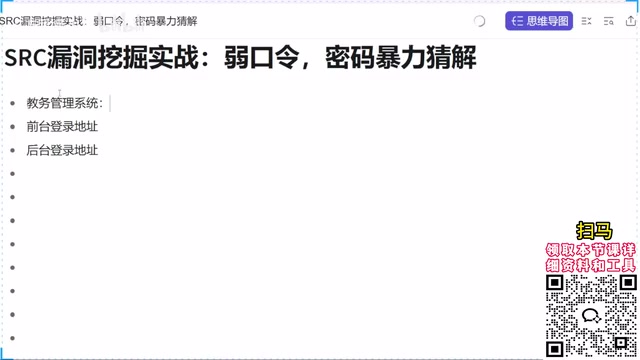
- Frontend login address: Open to students, who can log in to check grades, select courses, etc.
- Backend login address: Hidden from students, accessible only to teachers or administrators for scheduling classes, modifying grades, etc.
In a real-world case, the login flow for a vulnerability-hunting discussion forum illustrates this distinction well. The first address you see after clicking "Login" is member.php — clearly a frontend login address. Any user can log in through it and, after authentication, is redirected back to the frontend to browse content, post, and comment like a regular user.
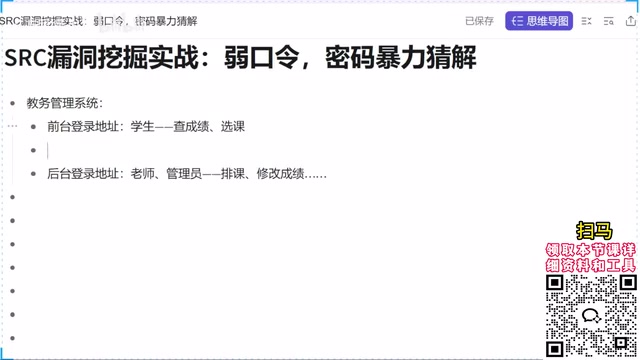
Deep within the site, however, there's another entry point invisible to regular users — typically located in the "Admin Center" section, with an address like admin.php. This is a classic backend login address.
Why Backend Access Is a Primary Target for Attackers
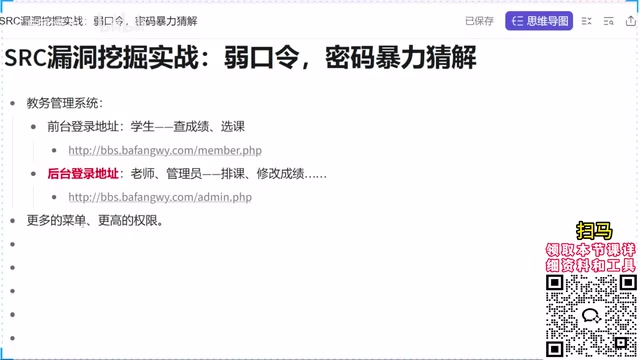
Once logged in through the backend, you can access full user management, forum settings, and more. These features are completely inaccessible to regular users, and it's precisely this elevated privilege level that makes the backend a core target for attackers.
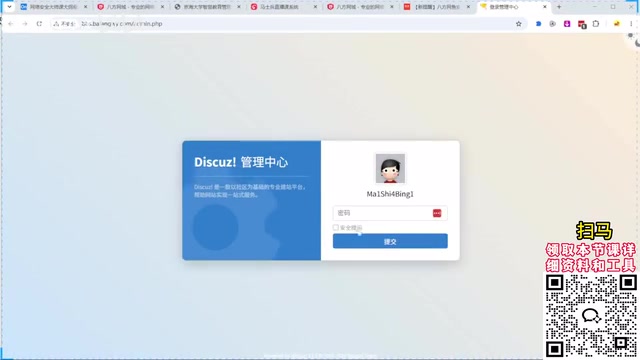
A more extensive menu and higher permissions mean that once an attacker gains access, the range of actions they can take far exceeds what's possible from the frontend. For example, an attacker might exploit the backend's file upload feature to upload a web shell, thereby taking control of the entire server.
It's important to emphasize: the purpose of this education is not to encourage actually exploiting a cracked admin password, but to highlight a serious security reality — if an administrator uses an overly simple password that gets cracked, the resulting damage can be catastrophic.
Malicious files planted by attackers through a backend upload feature are commonly known as WebShells. A WebShell is essentially a script (typically a PHP, ASP, or JSP file) that allows remote command execution via HTTP requests. Once successfully uploaded, an attacker only needs to visit the file's URL in a browser to gain an interactive command execution interface — from which they can read server files, create backdoor accounts, pivot through the internal network, or even hold enterprise data for ransom. Because the WebShell attack chain is so complete, a backend file upload feature combined with a weak password often constitutes a Critical-severity vulnerability under SRC rating systems. Even if a system has no obvious SQL injection or XSS vulnerabilities, a single weak-password backend can render all other security measures meaningless.
Assessing the Value of Weak Password Vulnerabilities
The submission value of a weak password vulnerability is directly tied to the scale of the target system's data and its sensitivity.
When a system holds a large volume of highly sensitive data, the consequences of the backend being compromised via a weak password are devastating. This is why, in SRC vulnerability submissions, weak password vulnerabilities targeting high-privilege backends often receive high ratings and rewards.
For beginners, understanding this logical chain is crucial:
- Locate the backend login address →
- Identify weak password risks →
- Assess data sensitivity →
- Determine vulnerability value.
SRC (Security Response Center) platforms are vulnerability collection and reward systems established by domestic internet companies, allowing external security researchers to submit vulnerabilities within an authorized scope in exchange for points or monetary rewards. Common SRC platforms include Alibaba Cloud Xianzhī, Tencent Security Response Center, and Vulbox. Each platform has its own vulnerability rating standards, generally divided into five tiers: Critical → High → Medium → Low → Informational. Weak password vulnerability ratings typically depend on three dimensions: ① the privilege level of the compromised account (admin backend > regular user frontend); ② the sensitivity of data held by the system (financial, medical, and government data are higher priority); ③ whether the vulnerability has an exploitable chain (e.g., combining with upload functionality for direct GetShell). Understanding the rating logic helps researchers make more targeted decisions when selecting targets and writing reports.
Advice for Complete Beginners
Vulnerability hunting is not mystical — it's built on a clear understanding of system architecture and permission models. The frontend/backend distinction and weak password concepts unpacked in this article are the starting point for the entire vulnerability hunting knowledge system.
Using AI tools for automated vulnerability hunting can significantly boost efficiency in areas like information gathering, dictionary generation, and batch testing — but the underlying principles still require human understanding. Mastering these fundamentals will help you avoid unnecessary detours in real-world practice.
A critical reminder: All security testing must be conducted within an authorized scope. Unauthorized password cracking and system intrusion are illegal. The goal of learning security techniques should be defensive improvement and compliant vulnerability submission — not attacking others.
Related articles

Amphibious Transforming Drone: Beyond 100x Power Savings, What Are the Real Needs?
Is the amphibious transforming drone just a gimmick? Starting from the 100x power difference of the M4 Morphobot, explore real application scenarios and thesis topic ideas, analyzing boundary conditions where pure drones and pure ground robots both fail.

Warhound Raises $200 Million: Genetically Engineered "War Dogs" Paired with Anduril Gear
Warhound raises $200M, backed by Ben Lamm and Palmer Luckey, to genetically engineer dogs for military and law enforcement use and equip them with Anduril gear. This article analyzes its technology direction, funding logic, and ethical controversy.

Claude API Comes to Google Cloud: IAM Integration and SDK Access Guide
Anthropic hosts the full Claude API on Google Cloud with IAM-controlled permissions and unified billing. This guide covers the Vertex AI and Anthropic-hosted entry points, IAM role configuration, and SDK access.