AI Auto-Reply Pitfalls: Add a Human Approval Gate to Protect Your Brand

Always insert a human approval gate between AI-generated drafts and customer sends to prevent unreviewed messages from going out.
Based on a workflow demonstration, this article explains why a human approval gate is essential between AI-generated customer service replies and actual delivery. The core logic: LLMs produce fluent text but can't assess business compliance or communication sensitivity, so reviewers must verify recipient, content, tone, consent, and next actions before approving. By defaulting the "approved" flag to false, the system refuses to send without explicit authorization. The gate can be implemented via approval forms, Slack/Teams, or CRM tasks—protecting brand reputation while generating a traceable audit record.
Why AI Customer Service Replies Must Have an Approval Gate
Letting AI send replies directly to customers seems efficient, but it hides real risks. A single automated message with the wrong tone, incorrect information, or sent without customer consent can instantly damage your brand's reputation. A workflow demonstration on YouTube highlights a critical design principle: between an AI-generated draft and an actual send, you must insert a human approval gate.
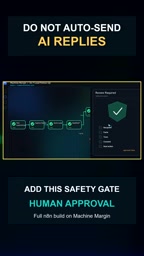
This gate is described as "the most important node" in the entire workflow. Its purpose is straightforward — once a draft is generated, it doesn't flow out automatically. Instead, it pauses in a "review required" state until a human steps in to verify it before anything moves forward.
What Human Review Actually Checks
According to the demonstration, reviewers must confirm several key dimensions before approving a message:
- Recipient: Ensure the message is going to the right person, avoiding misdirected communications;
- Content and channel: Verify what's actually being sent and how;
- Tone: Assess whether the wording fits the brand's voice and is appropriate for the situation;
- Customer consent: Confirm that communication permission has been obtained;
- Next action: Clarify what follow-up steps should be triggered after this message.
These checks target the areas where AI most commonly falls short. Large language models excel at generating fluent text, but they can't genuinely assess business context, compliance requirements, or communication sensitivity — human review is precisely what fills that gap.
Using an "Approved" Flag to Block Automatic Sending
One design detail in the demonstration is worth highlighting: the approved flag is deliberately set to false. This means the workflow cannot "pretend" a message has been reviewed — without an explicit approval signal, the send step remains firmly locked.
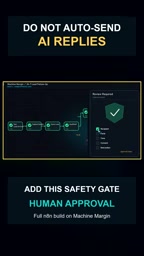
This "deny by default" design philosophy is especially important in automated systems. It grounds security in explicit authorization rather than relying on default pass-through behavior. In other words, the system would rather send nothing at all than act without human confirmation.
"Deny by default" is a classic principle in information security, contrasted with "allow by default." In permission system design, the former requires that an operation be explicitly declared as permitted; otherwise it is blocked entirely. The latter only blocks what is explicitly forbidden. Applying this principle to automated workflows means the system's "fail-safe" direction is to stop rather than continue — even if the process encounters an error, the approval node is bypassed, or a variable state is ambiguous, the outcome is that no message goes out, not that it quietly slips through. This stands in sharp contrast to traditional approval flows where "auto-approve on timeout" is common — a practice that introduces hard-to-track compliance risks in automated scenarios.
How to Implement This Gate in Real Projects
The demonstration is a proof of concept, but in practice this approval gate can be connected to a range of ready-made tools. The original content outlines several typical approaches:
- Approval forms: Allow reviewers to approve or reject with a single click through a form;
- Slack / Microsoft Teams: Push pending messages to a team collaboration platform for in-context handling;
- CRM tasks: Track approvals as tasks within your customer relationship management system.
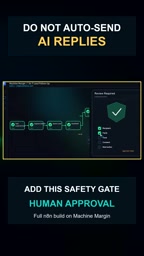
Regardless of which approach you choose, the core rule stays the same: only an explicit approval unlocks the send step. This ensures humans always remain in the critical decision loop (human-in-the-loop).
The Dual Value of This Gate
This single control point delivers two distinct benefits. On one hand, it protects your brand — preventing AI from sending messages unsupervised that could trigger customer complaints or compliance issues. On the other hand, it provides an audit trail: when something goes wrong, you can clearly trace back who approved which message and when.
For any team incorporating AI into customer communications, this is a low-cost, high-return design pattern. It requires no complex technology, yet strikes a balance between the efficiency of automation and human accountability. As AI capabilities grow ever more powerful, the question of "should we let it press send on its own?" almost always has one answer — add a gate, and let a human confirm.
Audit trails carry real legal and compliance significance in customer communication contexts. Data privacy regulations such as the GDPR and CCPA, as well as anti-spam laws governing telemarketing and email marketing (such as CAN-SPAM in the US), all require businesses to demonstrate that they obtained explicit user consent at a specific point in time and can reproduce the actual communication record. An approval log with timestamps, operator information, and message content snapshots isn't just an internal quality control tool — it's critical evidence when responding to regulatory inquiries or customer complaints. The human approval gate itself is a key node in that evidentiary chain.
Related articles

Meta Muse Wonder Launch: What It Means for Meta's Return to the Frontier AI Race
Meta releases Muse Wonder and WonderFull, benchmarks reach the frontier, community feedback is polarized. An in-depth look at Meta's return to the frontier AI race, its personal agent strategy, and Zuckerberg's different path.

Apple Home Smart Home Lineup Leaked: LG and Schneider Team Up, UWB Door Lock on Board
Apple Home ecosystem gains new LG and Schneider devices: UWB smart lock with proximity unlock, 2.5K dual-camera doorbell, privacy indoor camera, and AirPods-like seamless pairing.

OpenAI Employee Arrested for Planting Surveillance Device: AI Used to Catch the Mole
An OpenAI employee was arrested by the FBI for planting a sophisticated recording device in the office, and OpenAI used its own AI model to trace the device and identify the suspect. The incident exposes internal security threats at AI companies, while OpenAI claims no models or weights were leaked.