AI Automation Wearing You Down? The Underestimated Maintenance Cost
AI automation maintenance costs are often underestimated; the reasonable positioning today is human-machine collaboration, not full automation.
Starting from a Reddit complaint, this article explores the most real contradiction in AI automation deployment: getting workflows to run is easy, but keeping them running consistently requires significant investment. Fragility stems from probabilistic AI outputs and frequent external dependency changes, with errors amplifying in multi-step processes. Maintenance costs fall into three levels—debugging, monitoring, and adaptation—and community feedback shows fully unmanned AI workflows are nearly nonexistent, with human oversight essential. The article proposes pragmatic approaches like reducing automation granularity, retaining human review nodes, and designing structured constraints for outputs, emphasizing that expectation management matters more than tool selection—maintenance time should be explicitly factored into costs when adopting automation.
When Automation Becomes the New Repetitive Work
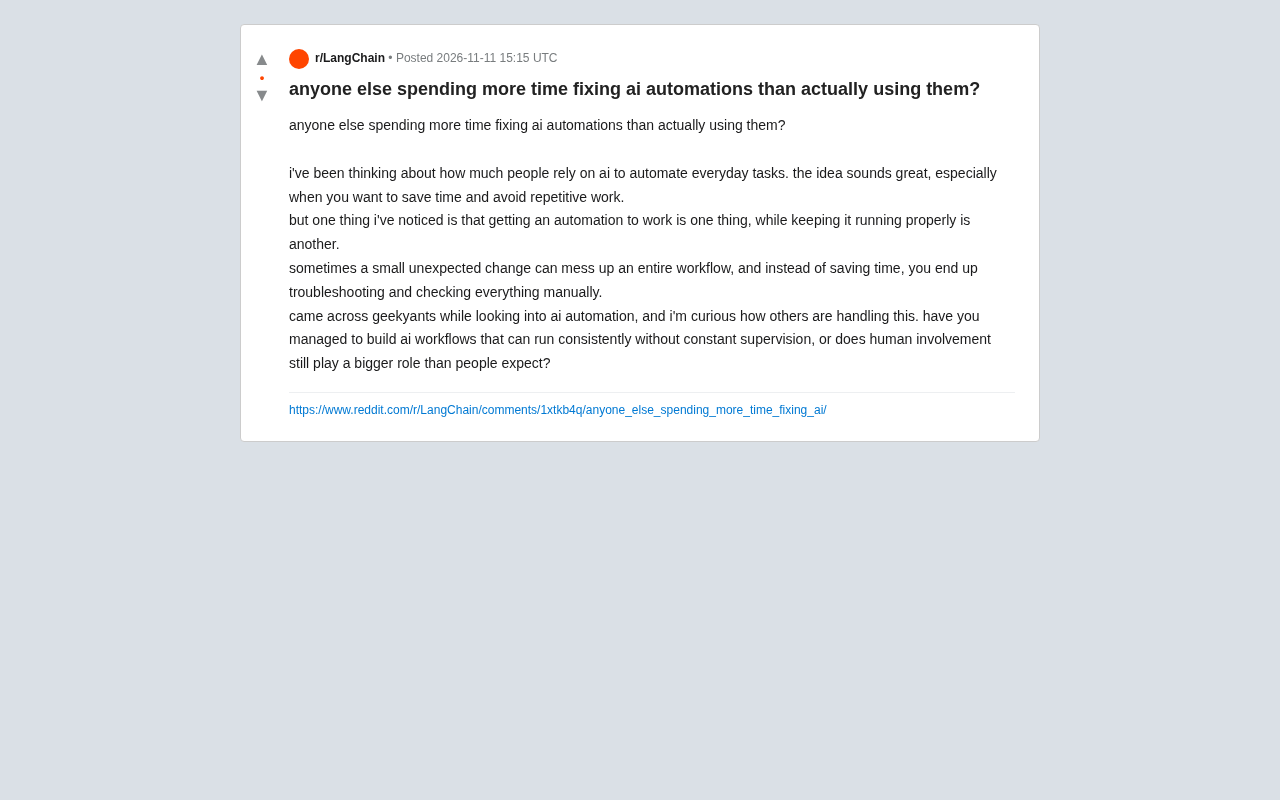
In a Reddit tech discussion forum, one user posed a question that struck a chord: "Does anyone else feel like they spend more time fixing their AI automation than actually using it?" This seemingly simple complaint touches on the most real contradiction in the current deployment of AI workflows—getting automation to run is one thing, but keeping it running consistently is another. The original poster noted that sometimes a tiny, unexpected change can throw an entire workflow into disarray. What was meant to save time ends up trapping you in a cycle of troubleshooting and manual checks. This observation is no isolated case; in multiple AI automation communities, similar complaints surface repeatedly, forming a consensus issue worth taking seriously.
Where Fragility Comes From
The fragility of automated processes often stems from the coupling between AI and non-AI components. Traditional script automation relies on deterministic logic—same input, predictable output. AI models, however, are probabilistic; outputs can drift due to context, minor prompt adjustments, or changes in upstream data. When this drift occurs in multi-step workflows, errors amplify at each stage. According to feedback from multiple practitioners in the discussion, the most common failure points include: data format mismatches caused by interface changes, third-party service rate limiting or authentication expiration, and unexpected changes in model output structure. None of these can be solved by "one-time setup"—they are operational issues requiring continuous monitoring and iteration.
Human Oversight Remains Essential
The core question raised in the original post is: has anyone actually built an AI workflow that runs stably without continuous oversight? Based on community feedback, the answer leans pessimistic. Most acknowledge that, at least at this stage, the degree of human involvement is far higher than marketing suggests. Some compare AI automation to "a system that needs regular checkups" rather than "a set-it-and-forget-it tool." This perception gap is precisely the root of frustration many teams feel after investing in automation—the expectation was time savings, but the reality is spending time in a different way.
The difference between probabilistic output and deterministic logic: In traditional programming, the same input yields the same result at every execution path, which allows automated processes to be formally verified and exhaustively tested. AI components like large language models, however, fundamentally generate output based on probability distributions—even with identical input, they may return different results under different temperature parameters, context lengths, or random seeds. This non-determinism means the traditional "unit test—assert fixed output" model is difficult to apply directly. Test cases need to shift from "exact match" to "semantic equivalence" or "structural compliance" judgments—this is one of the technical roots of the sharp increase in operational complexity for AI workflows.
Human-in-the-Loop (HITL): This concept originates from the fields of human-computer interaction and automated control, referring to retaining human judgment or confirmation at key nodes in automated processes. In AI workflows, HITL typically manifests as: setting up human approval gates for high-risk model-generated outputs (such as outbound emails or financially impactful decisions); manually labeling low-confidence results and feeding them back to improve the model; and having humans decide whether to proceed after anomaly alerts are triggered. The design goal of HITL is not to have people "watch everything" but to introduce cost-controlled human intervention at key decision points, intercepting unrecoverable errors before they enter downstream processes—thereby balancing efficiency and reliability.
Three Sources of Maintenance Cost
The maintenance burden repeatedly mentioned in the discussion can be summarized into three levels. First is debugging cost: when a workflow fails, determining whether it's a model issue, data issue, or integration issue often requires cross-tool troubleshooting. Second is monitoring cost: to catch problems early, teams must build additional logging, alerting, and regression testing—and maintaining this infrastructure itself becomes new work. Third is adaptation cost: once external APIs, model versions, or business rules change, automated processes need corresponding adjustments. The original poster mentioned encountering Geekyants while researching AI automation solutions but was more concerned with how peers cope with these ongoing burdens rather than the tool's setup capabilities.
Special challenges of regression testing in AI systems: Traditional software regression testing relies on comparing fixed inputs with expected outputs, but AI component outputs are probabilistic and often presented in natural language or semi-structured forms, making pass/fail judgments based on exact equality impossible. Common alternatives in practice include: using semantic similarity thresholds, JSON Schema validation, rule engine assertions, and other "soft assertion" methods to judge whether output is acceptable; and establishing golden datasets for regular batch runs, observing pass rate trends rather than single results. While effective, these approaches require continuous investment to build and maintain the golden datasets themselves, and when model versions are upgraded, historical benchmarks may need recalibration—this is one reason monitoring costs remain high.
Pragmatic Approaches
Despite the widespread problems, some practices repeatedly mentioned in the community have emerged. First, reduce automation granularity—break long chains into short, independently verifiable segments to limit the impact of single points of failure. Second, retain human review nodes—set checkpoints before key outputs enter downstream processes rather than pursuing fully unmanned pipelines. Third, design structured constraints and validation rules for AI outputs so anomalies surface early. These practices aren't new, but they collectively point to one judgment: at the current stage, the reasonable positioning of AI automation is "human-machine collaborative workflow" rather than "a black box that replaces humans."
Expectation Management Matters More Than Tool Selection
The discussion ultimately lands on a more fundamental issue—expectation management. When vendors and content creators emphasize "setup in minutes" and "no code required," it's easy to overlook the subsequent operational investment. Multiple discussion participants suggested that when evaluating whether to adopt AI automation, maintenance time should be explicitly factored into costs, with iteration budget reserved. In other words, the problem isn't that AI automation is bad—it's that people often only calculate setup costs while underestimating the cost of keeping it running. Acknowledging this is the only way to let automation truly return to its original purpose of "saving time" rather than becoming new repetitive work.
One-line Summary
AI automation maintenance costs are often underestimated; the reasonable positioning today is human-machine collaboration, not full automation.
Paragraph Summary
Starting from a complaint in a Reddit community, this article explores the most real contradiction in AI automation deployment: getting workflows to run is easy, but keeping them running consistently requires significant investment. The author points out that fragility stems from the probabilistic output of AI components and frequent changes in external dependencies, with errors amplifying at each stage in multi-step processes. Maintenance costs can be summarized into three levels—debugging, monitoring, and adaptation—and community feedback shows that fully unmanned AI workflows are nearly nonexistent, with human oversight remaining essential. The article accordingly proposes pragmatic approaches such as reducing automation granularity, retaining human review nodes, and designing structured constraints for outputs, emphasizing that expectation management matters more than tool selection—maintenance time should be explicitly factored into costs when adopting automation, otherwise the original intent of "saving time" becomes new repetitive work.
Related articles

Gemini 4 Carbon Hands-On: Clear Progress, But Still Not the Go-To for Coding
In-depth review of Gemini 4 Carbon: hallucination rate drops from 36% to 18%, cybersecurity shines, but slow speed, opaque caching, and unreliable code analysis remain.
Anthropic IPO Roadshow Revealed: Multi-Chip Strategy and AI Self-Improvement
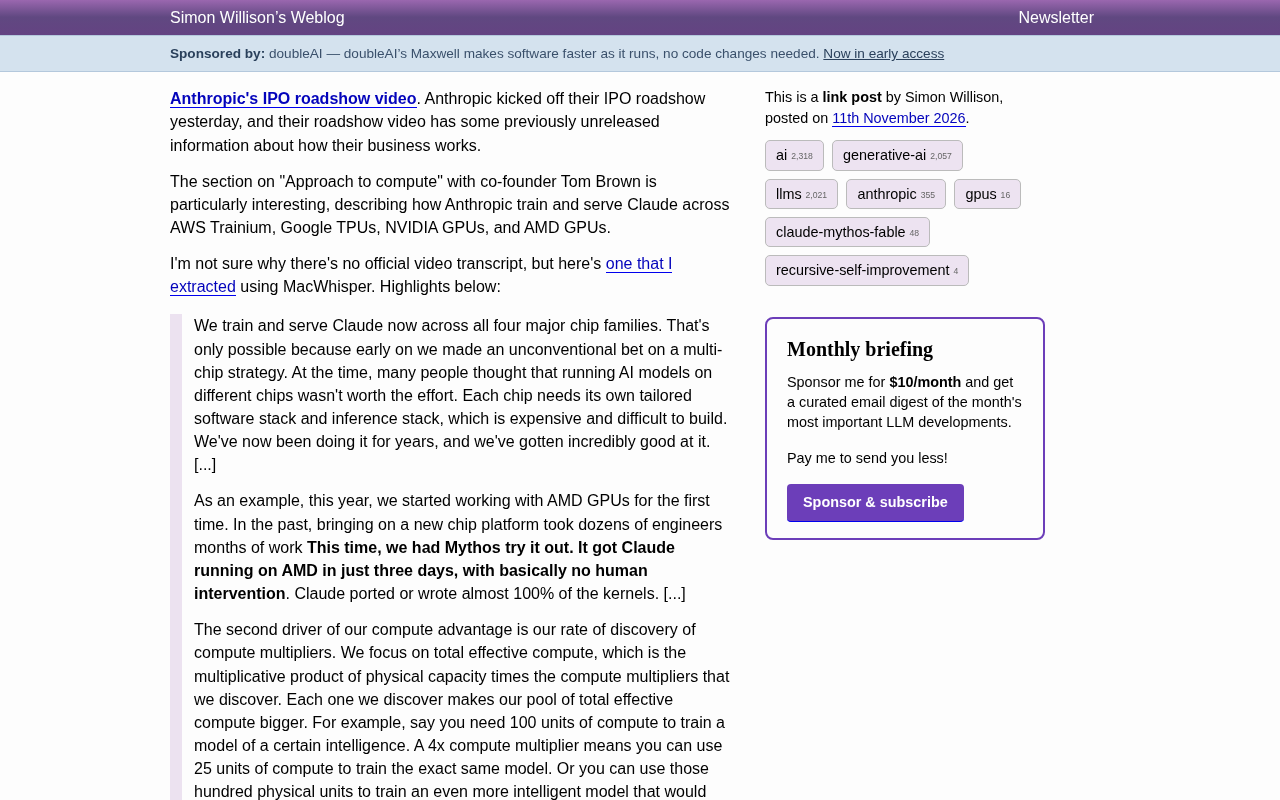
Anthropic's IPO roadshow video reveals its multi-chip strategy: Claude is trained across AWS, Google, NVIDIA, and AMD chips, and Mythos completed AMD adaptation in three days. Co-founder Tom Brown also discussed compute multipliers and recursive self-improvement, letting AI autonomously discover compute optimization solutions.

Marktechpost Launches GPU Leaderboard and Deployment Tool Extension
Marktechpost launches a GPU Leaderboard and the Deploy It Chrome extension—the former aggregates GPU performance comparisons under AI workloads, the latter attempts to simplify model deployment in the browser. This article reviews both tools' positioning, information gaps, and practical value for developers.