AI Builds Its Own Console: Plain English Request, New Feature Live in an Hour

AI agents built, tested, and shipped a console from a plain-language request in roughly one hour.
A Bilibili creator demonstrated AI agents completing a full development cycle — from natural language requirements to a live feature console — in about one hour. Multiple agents collaborated throughout: a development agent built the feature, five testing agents cross-validated it, and an independent reviewer agent caught and fixed a UI label issue before autonomous deployment. The system was fully visible, with humans able to take over and hand back control at any point. The demo highlights AI's evolution from code-generation tool to autonomous development collaborator, with multi-agent division of labor seen as a key path toward reliable autonomous software engineering.
When AI Starts Building Its Own Tools
The traditional software development pipeline is long: requirements, design, coding, testing, review, deployment — with human involvement at every stage. A recent demo broke that convention. A Bilibili creator showed an AI agent autonomously building a console from a plain-language request to a live feature, all within roughly one hour.
What makes this especially intriguing is that the console itself was built by the AI's own agents. As the creator put it: "This console was made by its own agents." AI is no longer just a passive code generator executing instructions — it's starting to build its own working environment and toolchain.
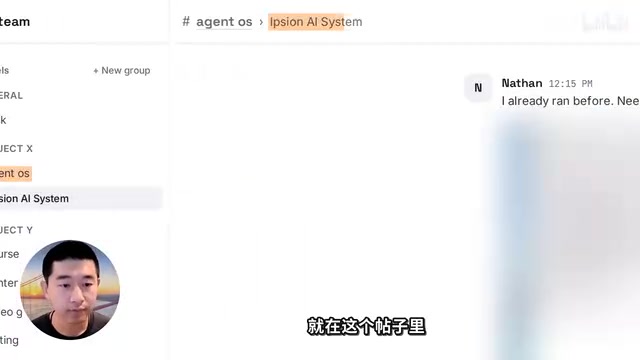
One-Sentence Requirement, One-Hour Delivery
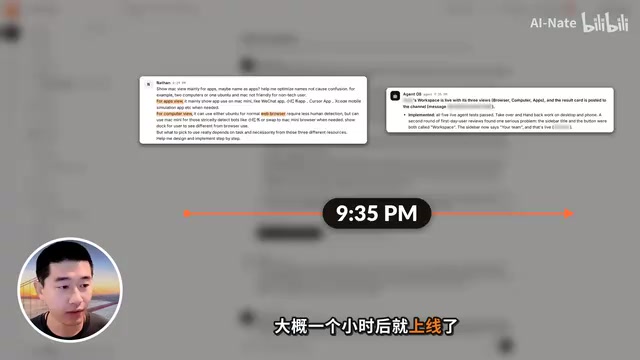
The starting point was almost casual — the creator simply "asked in plain language for a workspace, browser, and desktop app," with no precise technical specs or detailed product documentation. Just a few sentences of everyday language.
About an hour later, the feature was live. That timeframe is worth thinking about. In traditional team workflows, a feature module covering a workspace, browser view, and desktop application typically takes days or even weeks to go from requirements sign-off to deployment. The AI agents compressed that cycle down to the hour scale.
Delivery quality was validated too: "All five agents passed testing." This means the AI didn't just complete the development — it included automated testing, using multiple agents to cross-verify functionality, rather than simply generating code and calling it done.
Full Visibility: Every Step Out in the Open
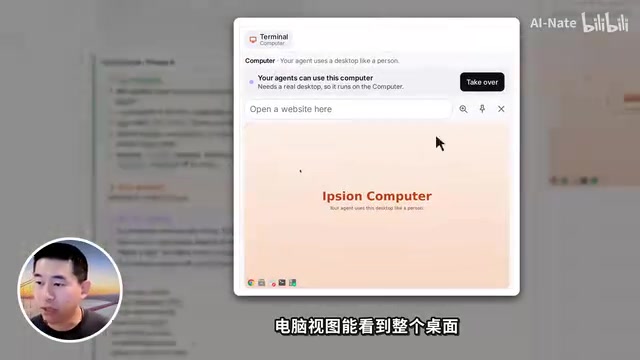
The black box has always been one of the most unsettling aspects of AI applications — you don't know what it actually did. This demo made a deliberate design choice around transparency: "The workspace is right next to the chat, and every step is visible."
The creator could observe the AI's actions in real time alongside the chat interface, and "the computer view shows the entire desktop" — essentially a glass window into the AI's workbench. This visualization isn't just for show; it addresses the trust problem in human-AI collaboration. When you can see every step the AI takes, taking over and correcting course becomes operationally feasible.

Human-AI Relay: Take Over Anytime, Hand Back Anytime
One of the most practical aspects of this system is that it preserves a channel for human intervention. The creator described it as: "I take over for a bit and then hand it back." At any point during execution, the human can take control, handle whatever's needed, and then return control to the AI to continue.
This "relay-style" collaboration model is more true to real-world workflows than either full automation or full manual operation. It acknowledges the limits of AI capability — some judgment calls still belong to humans — without sacrificing the efficiency gains from automation. Control flows smoothly between human and AI rather than being an all-or-nothing switch.
Self-Review: AI Gets Its Own "Quality Inspector"
The most telling sign of this system's maturity is its built-in review mechanism. According to the creator: "Its own reviewer flagged a label that was easy to misread, and it fixed it and shipped directly."
Several layers are worth unpacking here. First, the AI system has a dedicated internal "reviewer" role specifically responsible for catching errors. Second, what the reviewer found was "a label that was easy to misread" — exactly the kind of detail that can slip through human code review. Third, after catching the issue, the AI autonomously made the fix and shipped directly, closing the loop from detection to resolution.
This self-review mechanism essentially internalizes the code review and QA stages of software engineering into the AI system itself. Rather than relying on external human oversight for quality control, it uses a separate agent to play the role of critic.
In multi-agent systems, the "reviewer" role is typically implemented as an independent Agent instance, isolated from the code-generating Agent. This separation avoids confirmation bias — the tendency for a model that generated code to also believe its own output is correct. The approach draws on the software engineering concept of the four-eyes principle: any critical change should be reviewed by a second party who wasn't involved in implementing it. In AI systems, that "second party" is replaced by another agent that receives only the output and acceptance criteria — not knowledge of the generation process — enabling it to more objectively identify logic flaws, UI label ambiguities, missing edge cases, and similar issues. This is the underlying motivation behind the "Critic Agent" or "Reviewer Agent" roles now common in mainstream multi-agent frameworks like AutoGen and CrewAI.
What This Points Toward
Taken together, this demo sketches out a picture that's beginning to take shape: AI agents with a complete capability chain — autonomous tool-building, self-testing, self-review, and autonomous deployment — while the human role steps back from "executor" to "requirements owner" and "supervisor."
The creator's summary was blunt: "Next time I want something, I just say it, and it builds and ships it itself." Behind that statement is a shift in interaction paradigm — from writing code to stating requirements, from operating software to describing intent.
Of course, demos like this tend to show the ideal path. Real production environments bring plenty of additional challenges: requirement ambiguity, complex logic, security boundaries, and more. A single-source demo also needs broader real-world validation before its stability can be assumed. But the direction is clear: AI is evolving from "a tool that helps you write code" into "a collaborator that can independently take on development tasks," and the multi-agent division of labor — development, testing, review — may be the critical step toward reliable autonomous development.
The multi-agent architecture underlying this demo is commonly referred to as "Agentic AI" or an "AI Agent System." Its core distinction from earlier single-turn Q&A AI lies in the fact that agents maintain persistent task goals, can invoke external tools (file systems, browsers, terminals, etc.), and can decompose large tasks into subtasks for recursive execution. The division of labor among development, testing, and review agents is essentially a "mapping" of responsibilities that traditionally belonged to different roles in a software development process onto different types of agents, forming an automatically flowing virtual pipeline. This paradigm is still in its early stages. Key challenges include context window limitations in long-running tasks, consistency guarantees in inter-agent communication, and robustness when facing ambiguous requirements. The industry remains divided on timelines for "Fully Autonomous Software Engineering," but multi-agent division of labor is widely considered one of the most promising paths forward.
Related articles

Amphibious Transforming Drone: Beyond 100x Power Savings, What Are the Real Needs?
Is the amphibious transforming drone just a gimmick? Starting from the 100x power difference of the M4 Morphobot, explore real application scenarios and thesis topic ideas, analyzing boundary conditions where pure drones and pure ground robots both fail.

Warhound Raises $200 Million: Genetically Engineered "War Dogs" Paired with Anduril Gear
Warhound raises $200M, backed by Ben Lamm and Palmer Luckey, to genetically engineer dogs for military and law enforcement use and equip them with Anduril gear. This article analyzes its technology direction, funding logic, and ethical controversy.

Claude API Comes to Google Cloud: IAM Integration and SDK Access Guide
Anthropic hosts the full Claude API on Google Cloud with IAM-controlled permissions and unified billing. This guide covers the Vertex AI and Anthropic-hosted entry points, IAM role configuration, and SDK access.