AI Built Me an Android Notes App: With a Built-in Thinking Partner

A Reddit user built a native Android notes app with a built-in thinking partner using AI, exploring how notes can move from storage to thinking.
A Reddit user used the AI building tool Hark Pro to develop a native Android notes app with Kotlin and Jetpack Compose, aiming to break through the limitation of Samsung Notes "only storing, not thinking." The app includes a built-in AI thinking partner, with core features including a connection engine that discovers note associations across months and generates a knowledge graph, an idea development module that offers operations such as expand/investigate/challenge/reframe/synthesize and promises not to overwrite the original text, and semantic search that retrieves by meaning with source links. The article views this as an example of AI moving from general-purpose assistants to specialized partners deeply embedded in personal workflows, while noting that as a personal work, the project's generality and public availability remain to be tested, but it validates the feasibility of "AI as both builder and thinking partner."
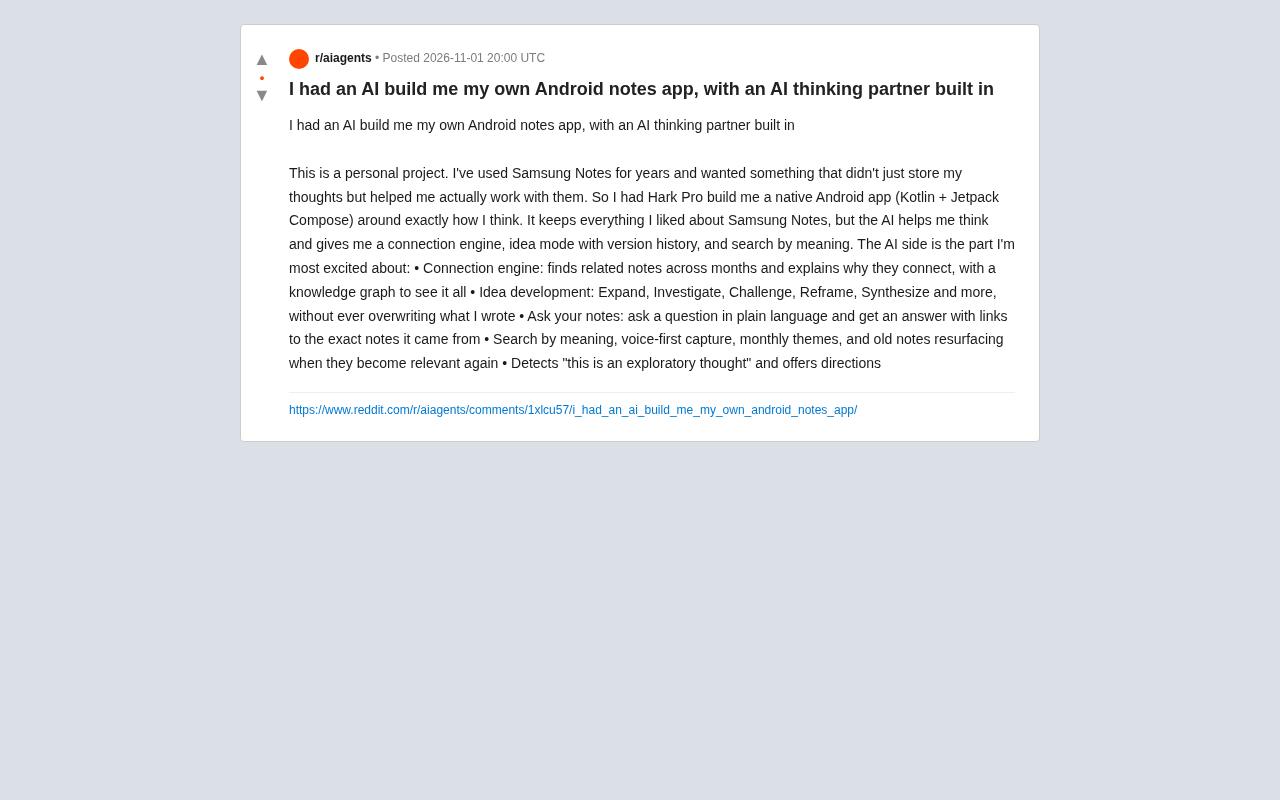
A Reddit user shared his personal project: with the help of the AI tool Hark Pro, he developed a native Android notes app using Kotlin and Jetpack Compose. The app not only retains the practical features of Samsung Notes but also includes a built-in "AI thinking partner," attempting to shift notes from passive storage to active assistance with thinking.
From Storage to Thinking: How AI Intervenes in the Note-Taking Process
According to the user, he used Samsung Notes for many years but always felt the tool was only responsible for "storing," not "thinking." So he used AI to generate this app, with its core logic designed around his personal thinking habits. The AI-side features include a connection engine, idea development, semantic search, and more, with the goal of making the note system an extension of thinking.
This attempt reflects a trend in AI applications: moving from general-purpose assistants to specialized partners deeply embedded in personal workflows.
Connection Engine: Giving Old Notes New Value
The feature the developer is most excited about is the "connection engine." It can find related notes across months and explain why they are related, while presenting them in the form of a knowledge graph. This solves a pain point of traditional note-taking apps: the more notes you have, the easier they are to forget. By automatically establishing associations, old notes can be reactivated in new contexts.
The user also mentioned the feature where "old notes resurface when they become relevant," further reinforcing the fluidity of notes.
Idea Development: AI Collaboration That Does Not Overwrite the Original Text
The "Idea Development" module provides operations such as Expand, Investigate, Challenge, Reframe, and Synthesize. The key design is that AI never overwrites what the user has written. This means AI acts as a thinking partner rather than a ghostwriter, and the user retains control over the original ideas.
This "no overwrite" principle is rare among AI writing tools, yet it is crucial for personal knowledge management—it protects the original trajectory of thought.
Semantic Search and Voice-First: More Natural Interaction
The app supports searching by meaning rather than relying solely on keyword matching. Users can ask questions in natural language and receive answers with links to the source notes. In addition, features such as voice-first capture and monthly themes lower the barrier to recording. The app can also detect "this is an exploratory idea" and proactively offer directions for thinking.
Semantic search relies on embedding technology: the system converts each note and the user's query into high-dimensional vectors and determines semantic relevance by calculating the cosine similarity between vectors, so even if the user's wording does not exactly match the original note text, relevant content can still be retrieved. Traditional keyword search is based on literal matching and tends to fail when encountering synonymous expressions or conceptual shifts. In personal note-taking scenarios, the value of semantic search is especially prominent—users often cannot remember the exact wording but do remember the gist. The further feature of "answers with source links" usually combines retrieval-augmented generation (RAG): relevant note fragments are first retrieved, then handed to a large language model to organize the answer, thereby reducing fabrication by the model.
A knowledge graph is a way of organizing information in a "node-edge" structure, where nodes represent concepts, notes, or entities, and edges represent the relationships between them. Unlike folder-based or tag-based hierarchical management, a knowledge graph allows the same node to have multiple association paths, making it better suited to presenting implicit connections across time and topics. In note-taking apps, systems usually rely on semantic similarity, entity extraction, or large-model reasoning to automatically infer associations between notes and generate edges, without the user needing to maintain them manually. The cost is that association quality depends on model judgment and may produce noise, which is why the interpretability design of "explaining why they are related" matters—it allows users to review and reject unreasonable connections.
The AI Programming Paradigm Behind a Personal Project
This case demonstrates a typical use of AI programming tools: non-professional developers using AI to generate a complete app. The user did not disclose the specific development time or amount of code, but clearly used Hark Pro as the building tool, with a tech stack of Kotlin + Jetpack Compose, which is native Android development.
From an industry perspective, such projects validate the feasibility of "AI as builder" while also exposing limitations: the app is currently a personal project, with no public release or open-source plan in sight. Its feature design is highly tailored to the developer's own thinking habits, and its generality remains to be tested.
However, it provides a valuable reference: when AI can both build an app and serve as a thinking partner within the app, the possibilities of personal software are being redefined.
Kotlin is a statically typed language led by JetBrains and was announced by Google in 2019 as the preferred language for Android development; Jetpack Compose is a declarative UI framework launched by Google, in which developers describe interface state with Kotlin functions and the framework automatically recomposes and refreshes when state changes, replacing the traditional model of XML layouts plus imperative view updates. This combination reduces the amount of UI code and also makes it easier for AI-generated code to maintain structural consistency—the model only needs to produce composable functions rather than complex view-binding logic, which is one reason such AI-assisted projects often adopt this tech stack.
One-line Summary
A Reddit user used the AI tool to build a native Android notes app with a built-in thinking partner, exploring how notes can move from storage to thinking.
Paragraph Summary
A Reddit user used the AI building tool Hark Pro to develop a native Android notes app with Kotlin and Jetpack Compose, aiming to break through the limitation of Samsung Notes "only storing, not thinking." The app includes a built-in AI thinking partner, with core features including a connection engine that discovers note associations across months and generates a knowledge graph, an idea development module that offers operations such as expand/investigate/challenge/reframe/synthesize and promises not to overwrite the original text, and semantic search that retrieves by meaning with source links. The article views this as an example of AI moving from general-purpose assistants to specialized partners deeply embedded in personal workflows, while noting that as a personal work, the project's generality and public availability remain to be tested, but it validates the feasibility of "AI as both builder and thinking partner."
Related articles

Democrats' Midterm Landslide: The Anti-Trump Wave and the New AI Regulation Battlefront
Vox's Ested Herndon breaks down the Democrats' midterm landslide: from affordability to AI data center regulation, why Trump's strategy failed, and the new 2028 landscape.

Databricks Multi-Statement Transactions GA: Native Lakehouse Support for Delta Lake and Iceberg
Databricks multi-statement transactions are now GA, natively supporting Delta Lake and Apache Iceberg to run multi-step warehouse workflows atomically on the lakehouse.

AI Scams Are Everywhere: Hacker News Buzzes with 'Everything Is an AI Scam Now'
Hacker News buzzes with 'Everything is an AI scam now': as the AI label proliferates, why does the tech community feel deceived? This article analyzes the three forms of AI scams, the industry impact of the trust crisis, and offers practical criteria for identifying AI noise.