Databricks Multi-Statement Transactions GA: Native Lakehouse Support for Delta Lake and Iceberg

Databricks multi-statement transactions GA, supporting Delta Lake and Iceberg for atomic multi-step lakehouse workflows.
Databricks announced the general availability of multi-statement transactions, supporting both Delta Lake and Apache Iceberg open table formats. The capability turns multi-step writes previously committed step by step on the data lake into all-at-once atomic commits, ensuring cross-statement data consistency. The core value is that multi-step warehouse workflows can run atomically directly on the lakehouse, reducing dependence on a separate data warehouse and lowering operational overhead and data replication pipelines. Dual-format support also reduces format lock-in risk for transaction capabilities. However, the announcement does not disclose performance, concurrency limits, or isolation level details, so the ability to fully replace a separate data warehouse still needs to be evaluated against actual workloads.
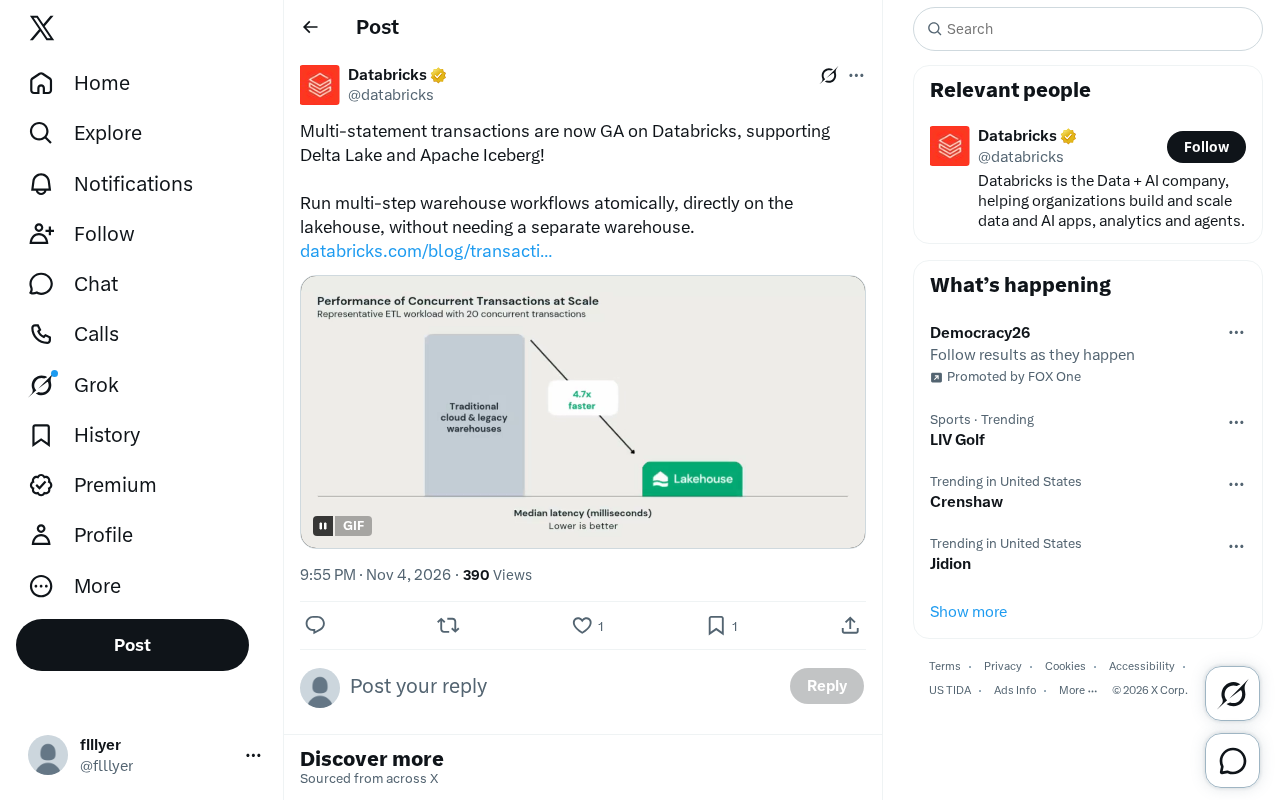
Databricks has announced the general availability (GA) of multi-statement transactions, with support for both Delta Lake and Apache Iceberg open table formats. This means data teams can now run multi-step data warehouse workflows atomically directly on the lakehouse platform, without needing to set up a separate data warehouse.
A Capability Leap from "Single-Step Writes" to "Multi-Step Transactions"
In the past, performing multi-step writes on a data lake typically involved splitting them into multiple independent jobs, each committing separately. If an intermediate step failed, it was easy to leave behind partial data or intermediate states requiring manual cleanup. Multi-statement transactions turn this "step-by-step commit" into an "all-at-once commit": a group of operations either all take effect or all roll back, thereby ensuring data consistency across multiple statements.
The core value Databricks emphasizes in the announcement is "atomicity"—multi-step warehouse-level workflows can be executed atomically directly on the lakehouse. For teams accustomed to traditional data warehouse transaction semantics, this is the long-missing piece of the puzzle when migrating data warehouse capabilities to the lakehouse.
You may not have noticed that this GA covers both Delta Lake and Apache Iceberg, rather than being tied only to its own format. This sends a clear signal: Databricks is taking a more explicit stance on promoting open format compatibility in the lakehouse, and users don't have to be locked into a single table format because of transaction capabilities.
ACID and Transaction Semantics: The core of multi-statement transactions is satisfying ACID (Atomicity, Consistency, Isolation, Durability) properties. In data lake scenarios, early writes could often only guarantee the reliability of a single operation's result, and consistency across multiple statements or tables was difficult to ensure. Delta Lake implements optimistic concurrency control through its transaction log (Delta Log), while Iceberg relies on snapshots and a metadata tree to manage commits. Both can provide atomic commits, but they differ in conflict detection and isolation level implementation—a point users should pay attention to when choosing across formats.
Why "No Separate Data Warehouse Needed" Is the Key Selling Point
In traditional architectures, transactional workloads are often run in a separate data warehouse, while the data lake handles analytical and raw data storage. Data movement, synchronization, and consistency maintenance between the two systems have long been a source of technical debt for data platform teams.
With multi-statement transactions GA, such multi-step workflows can run directly on the lakehouse, reducing the operational overhead of an additional system and the data replication pipeline. For teams already building data platforms on the lakehouse, this lowers the need to "build another data warehouse just for transaction semantics."
However, an objective view is needed: the announcement itself focuses on the availability of transaction capabilities and does not disclose specific performance metrics, concurrency limits, or isolation level details. Whether it can fully replace a separate data warehouse in practice still depends on the scale and latency requirements of specific workloads.
Lakehouse Architecture: The lakehouse attempts to blend the openness of the data lake with the transaction management capabilities of a data warehouse on top of low-cost object storage. In traditional architectures, the data lake handles raw storage and a separate data warehouse handles transactional queries, with ETL required to synchronize between them. The lakehouse adds a metadata and transaction layer on top of storage through table formats (such as Delta Lake and Iceberg), enabling the same data to serve BI, machine learning, and stream processing simultaneously, reducing data duplication and system fragmentation.
Direct Impact on Data Engineering Practice
From an engineering perspective, the most direct beneficiaries of multi-statement transactions include: multi-table correlated writes that need to remain consistent, ETL processes where multiple steps need to succeed or fail as a whole, and composite logic that requires completing "read—validate—write" within a single transaction.
For teams using Delta Lake, this means stronger transaction guarantees on their existing table format; for teams adopting Apache Iceberg, it adds a managed platform option that supports transaction semantics. Support for both formats also lowers migration costs when choosing across formats.
Beyond transaction semantics, this release also echoes the long-term direction of lakehouse integration: pushing data warehouse capabilities (transactions, constraints, workflows) down onto open storage, rather than making users choose between different systems.
Isolation Levels and Concurrency Control: The isolation level of a transaction determines visibility and conflict handling between concurrent transactions. Common levels include Read Committed and Serializable. In lakehouse scenarios, optimistic concurrency control typically triggers retries under high contention, which may affect throughput. The announcement does not specify the default isolation level or conflict resolution strategy for multi-statement transactions. In practice, attention should be paid to behavior when concurrently writing to the same table, and appropriate retry and timeout configurations should be determined through stress testing.
A Few Calm Observations
First, GA means the feature is officially available, but whether ecosystem adaptations (such as BI tools, scheduling frameworks, and ORM layers) keep pace typically lags behind the release of core capabilities.
Second, multi-statement transactions introduce locking and concurrency control overhead, and performance under high-concurrency write scenarios needs to be evaluated through actual stress testing—the announcement does not provide relevant data.
Third, supporting both Delta Lake and Iceberg is a plus, but whether differences in transaction implementation details between the two could lead to inconsistent behavior still requires further clarification in official documentation.
Overall, this is a step forward for the lakehouse platform toward "data warehouse-grade transaction capabilities," and it has reference value for teams evaluating whether to retain a separate data warehouse.
FAQ
Q: Which table formats do multi-statement transactions support? A: According to the official announcement, both Delta Lake and Apache Iceberg are supported.
Q: Is a separate data warehouse still needed? A: The announcement's positioning is to enable multi-step warehouse workflows to execute atomically directly on the lakehouse, thereby reducing dependence on a separate data warehouse. However, whether it fully replaces one in practice needs to be evaluated based on workload.
Q: Is this feature now GA or in preview? A: The announcement explicitly states general availability (GA).
Related articles

Qwen 3.8 Beats Opus at Coding—But Can Your Mac Run It?
Open-source Qwen 3.8 beats Opus 4.6 at coding at just 18GB, but how much Mac memory do you need? 24GB crashes; 32GB is the sweet spot. Full config guide inside.

Claude Code + Agent: Building a Fully Automated AI Testing Loop
Bilibili course breakdown: how test developers can use Claude Code terminal-based Agents to build a fully automated AI testing loop. Compares permission boundaries of terminal vs. device Agents, explains why enterprise projects choose Claude Code over Open Claude-type tools, and outlines the Node.js environment setup and DeepSeek model integration path.

Working with AI Agents Requires Nerves of Steel
The more autonomous AI agents become, the heavier the user's psychological burden. Drawing from a Hacker News discussion, this article analyzes black-box anxiety, behavior drift, and monitoring fatigue in agent collaboration, and offers practical approaches like sandbox isolation, permission control, and task granularity management to reduce cognitive load.