AI Scams Are Everywhere: Hacker News Buzzes with 'Everything Is an AI Scam Now'

A Hacker News discussion reveals that the proliferation of the AI label has caused widespread distrust in the tech community, requiring actionable judgment criteria.
The article uses the Hacker News post 'Everything is an AI scam now' as a starting point to explore the tech community's widespread distrust of AI label proliferation. The author categorizes AI scams into three layers: concept packaging, false-need manufacturing, and outright fraud, with increasing harm. Though the post received only 64 points and 15 comments, it reflects a trust deficit among engineers toward the AI narrative—the label no longer serves as a quality signal. This distrust causes collateral damage to genuine tech teams and affects capital and talent flows. The author advises users to ask: what value remains without the AI label, and is effectiveness verifiable? The conclusion stresses that suspicion is necessary, but treating everything as a scam and everything as an opportunity are the same mistake.
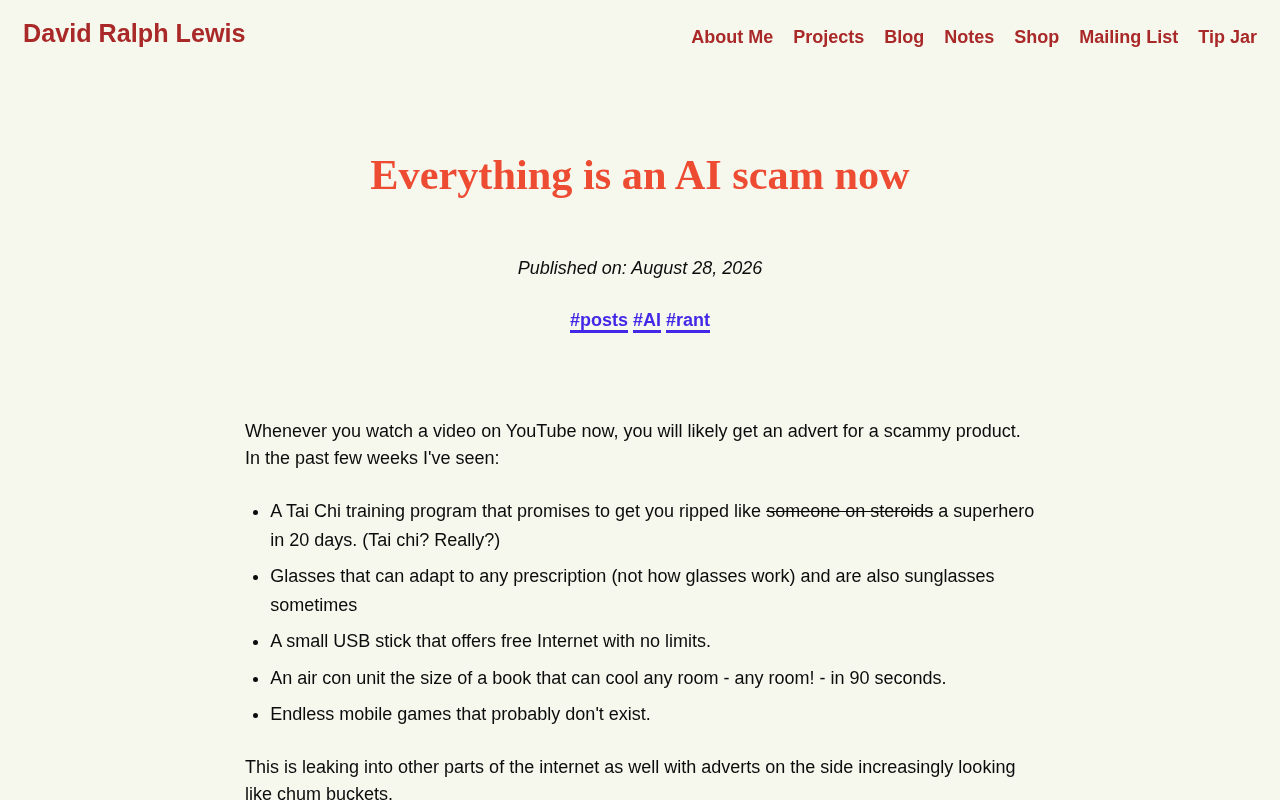
AI is becoming the new cloak for scams. A discussion thread on Hacker News titled "Everything is an AI scam now" has drawn attention, with the poster describing in near-absolute terms a troubling phenomenon: from investment opportunities to technical solutions, more and more things branded with the name "AI" are fundamentally deceptive. The post received 64 points and 15 comments—not a large discussion by any measure—but the sentiment it touches is remarkably widespread: when "AI" becomes a universal prefix, it's increasingly hard for ordinary people to tell genuine technological progress from packaged illusion.
Why "AI scam" has become a common feeling
The source of this feeling is directly tied to the proliferation of the AI label. Over the past period, virtually any product can add the word AI to its marketing: writing tools, investment advisors, fitness apps, emotional companionship services. Once marketing rhetoric erases the technical barrier, consumers face a highly homogenized information environment—everyone claims to use AI, but few can clearly explain what AI actually does in their product.
When the label can no longer serve as a quality signal, suspicion becomes the default reaction. The Hacker News community itself has strong immunity to hype, and the poster's use of an absolute term like "everything" indicates that this distrust has moved beyond individual products to become distrust of the entire narrative. Interestingly, the post offers no specific cases or data—it's more an expression of sentiment, and that's precisely where the discussion has value: when a technical community starts using "scam" to characterize an industry, it shows that the trust deficit has accumulated to a considerable degree.
The diminishing marginal utility of the AI label is an economic concept manifested in technology communication: when a signal is overused, its discriminating power declines, and receivers can no longer make effective judgments based on that signal. In the AI field, this process has been especially rapid—from the explosion of large models in 2022 to the present, nearly every piece of software claims to be "AI-powered," causing "AI" to degenerate from a differentiating selling point into a default configuration. Signaling Theory points out that effective signals must be costly and difficult to fake; when the cost of adding an AI label approaches zero, it no longer conveys any real information about quality, and the market shifts to treating suspicion as the default strategy.
The specific forms of scams: from concept packaging to outright fraud
Breaking down "AI scam," there are at least several layers, and their harm to users differs.
The lightest layer is concept packaging. The product has some functionality, but AI is just a marketing term, and actual capabilities fall short of the claims. Users pay a premium for it but don't receive corresponding value.
The middle layer is the manufacturing of false needs. Some services first create anxiety, then sell solutions—for example, claiming "you'll be eliminated if you don't use AI," then pitching expensive courses or tools of dubious effectiveness. Such operations aren't necessarily illegal, but they're ethically questionable.
The heaviest layer is outright fraud. Investment projects, tokens, and subscription services under the name of AI promise unrealistic returns and ultimately turn into Ponzi schemes or exit scams. Victims at this layer often lose real money and have difficulty seeking redress.
Although the Hacker News discussion doesn't elaborate on these categories, the phrase "everything is an AI scam" resonates precisely because it points to all three forms at once—what users feel isn't a specific instance of deception but exhaustion from an environment where it's impossible to tell true from false.
The manufacturing of false needs corresponds to "anxiety marketing" in behavioral economics: first distorting consumers' risk perception by creating a sense of scarcity or fear (such as "you'll be eliminated if you don't use AI"), then offering high-priced solutions. This type of operation exploits information asymmetry—buyers have difficulty assessing the actual effectiveness of courses or tools beforehand, while sellers hold all the information. Unlike outright fraud, products from false-need manufacturing often genuinely exist; their value is simply severely exaggerated, placing them in a legal gray area. The key to identifying this pattern is to ask: Is the anxiety being deliberately amplified? Does the pricing of the solution match verifiable deliverables?
What the tech community's trust crisis means
Hacker News's user base consists mainly of engineers, entrepreneurs, and technical professionals—people who are highly receptive to new technology but have low tolerance for hype. When such a group starts using "scam" as the framework for discussing AI, the signal it sends deserves attention.
On one hand, it shows that the marginal utility of the AI narrative is declining. Early on, "AI-powered" could bring a product attention and funding; now, the same label may trigger skepticism and aversion. For teams genuinely doing technical work, this is unfair collateral damage—they have to work harder to prove they aren't scams.
On the other hand, this distrust will also affect the flow of capital and talent. When a technical community's trust in a field declines, investment decisions become more cautious, and top talent may转向 other directions. The post didn't get many points, but if the sentiment it reflects continues to spread, it's not good news for the industry's long-term development.
Hacker News is a technology news aggregation community under Y Combinator, with users mainly engineers, entrepreneurs, and early technology adopters. Its voting mechanism surfaces high-signal content and makes it a bellwether for sentiment in the tech industry. The community has strong collective immunity to marketing rhetoric, so when "scam" becomes the framework for discussing AI, it often means the patience of a professional audience has been exhausted. It's important to distinguish that community sentiment is not the same as market reality—it reflects more the attitude shift of early adopters, a group that typically leads the mainstream market by 6 to 18 months, so its skeptical signal has forward-looking reference value.
How to make judgments amid the AI noise
For ordinary users and technical professionals alike, rather than passively suspecting everything, it's better to establish some actionable criteria.
When looking at an AI product, prioritize a few questions: What specific problem does it solve? If you remove the word AI, how much value does the product have left? Can its effectiveness be verified, rather than relying only on demos and testimonials? Is the team willing to disclose technical details or limitations? These questions can't guarantee identifying every scam, but they can filter out a considerable number of purely packaged products.
For content consumers, it's equally important to be wary of emotionally charged content with AI in the headline. The Hacker News post itself is an example: it provides no arguments yet resonates because the cost of spreading emotion is far lower than fact-checking. Understanding this is itself a form of immunity to "AI scams."
Verifiability is the core criterion for distinguishing real AI capabilities from packaging. Specifically, verifiability includes: public benchmark results (rather than curated demos), reproducible APIs or trial environments, candid explanations of failure cases and limitations, and independent third-party evaluations. The opposite is "demo-driven development"—showing results only in carefully prepared scenarios while avoiding edge cases and error rates. For non-technical users, a practical alternative indicator is: Does the product dare to let users try it freely without sales intervention, and is the team willing to answer "under what circumstances does this feature fail?"
Conclusion: Suspicion is necessary, but not the end point
"Everything is an AI scam now" is an exaggerated assertion, but the problem it points out is real. AI technology itself is still developing rapidly, and genuinely valuable applications are constantly emerging; the problem is that label abuse drowns the signal in noise.
For the industry, the way to rebuild trust is not more marketing but more transparent products, more honest promotion, and clearer boundaries. For individuals, maintaining suspicion while preserving the patience to verify may be the most pragmatic attitude at this stage. After all, treating everything as a scam and treating everything as an opportunity are the same mistake.
One-line Summary
A Hacker News discussion reveals that the proliferation of the AI label has led to widespread distrust in the tech community, requiring actionable criteria for judgment.
Paragraph Summary
Using the Hacker News post "Everything is an AI scam now" as a starting point, the article explores the tech community's widespread distrust of the proliferation of the AI label. The author divides AI scams into three layers: concept packaging, manufacturing of false needs, and outright fraud, with increasing degrees of harm. Although the post received only 64 points and 15 comments, it reflects a trust deficit among engineers toward the AI narrative—the label can no longer serve as a quality signal. The article notes that this distrust will cause collateral damage to teams genuinely doing technical work and affect the flow of capital and talent. To this end, the author suggests users ask specific questions: What value remains after removing the AI label, and is the effectiveness verifiable? The conclusion emphasizes that suspicion is necessary, but treating everything as a scam and treating everything as an opportunity are the same mistake.
Related articles

Qwen 3.8 Beats Opus at Coding—But Can Your Mac Run It?
Open-source Qwen 3.8 beats Opus 4.6 at coding at just 18GB, but how much Mac memory do you need? 24GB crashes; 32GB is the sweet spot. Full config guide inside.

Claude Code + Agent: Building a Fully Automated AI Testing Loop
Bilibili course breakdown: how test developers can use Claude Code terminal-based Agents to build a fully automated AI testing loop. Compares permission boundaries of terminal vs. device Agents, explains why enterprise projects choose Claude Code over Open Claude-type tools, and outlines the Node.js environment setup and DeepSeek model integration path.

Working with AI Agents Requires Nerves of Steel
The more autonomous AI agents become, the heavier the user's psychological burden. Drawing from a Hacker News discussion, this article analyzes black-box anxiety, behavior drift, and monitoring fatigue in agent collaboration, and offers practical approaches like sandbox isolation, permission control, and task granularity management to reduce cognitive load.