AI Buzzword Bubble: How Psychology Research Exposes the Cognitive Traps of Corporate Jargon

Psychology research on corporate jargon exposes why AI buzzwords fool decision-makers over real technical work.
A Reddit post connecting psychology research on 'corporate-bullshit receptivity' to the AI industry reveals how buzzword-fluent talkers consistently outshine actual builders in boardrooms. The piece dissects the cognitive mechanisms behind AI hype, compares it to past tech cycles like blockchain, and offers three practical strategies for practitioners to build critical immunity against jargon-driven decision-making.
A Psychology Study That Sparked Industry-Wide Reflection
A data science practitioner posted on Reddit sharing a psychology study that seemed entirely unrelated to AI — yet it accidentally illuminated a phenomenon that has become pervasive in the tech industry since ChatGPT's explosive rise. The study, published on PsyPost, explores why some people are more easily impressed by corporate buzzwords.
Researcher Littrell found that people react very differently when faced with jargon-heavy business statements. Those who scored higher on "corporate-bullshit receptivity" were more likely to perceive terminology-laden statements as "insightful" or "indicative of professional competence." More notably, these same individuals were also more likely to use exaggerated or misleading language themselves to impress others.
It's worth noting that "corporate-bullshit receptivity" builds on the broader "bullshit receptivity" research tradition. In a landmark 2015 paper, psychologist Gordon Pennycook and colleagues first systematically measured people's acceptance of statements that sound meaningful but are actually vacuous. Littrell extended this framework to business contexts, finding that workplace environments reinforce positive associations with jargon — because within organizational hierarchies, using "elevated vocabulary" is often linked to authority and status, creating a kind of social conditioning. This aligns closely with the "framing effect" in cognitive linguistics: when a term is repeatedly paired with success stories, the brain automatically builds a positive association between the two, even when no logical connection exists.
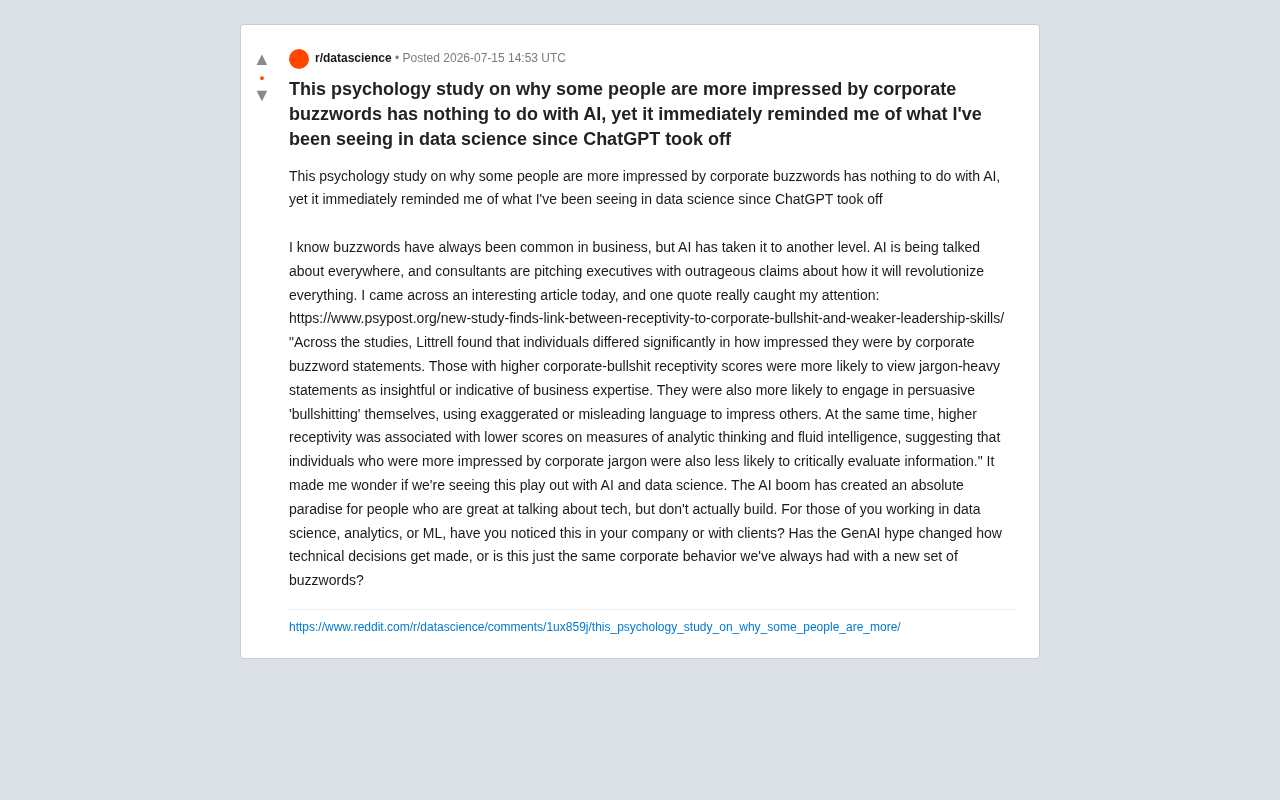
The study also points to an intriguing correlation: high receptivity to corporate jargon tends to be associated with lower analytical thinking ability and fluid intelligence. In other words, people who are most easily impressed by terminology are also least skilled at critically evaluating the actual value of the information.
The AI Boom Has Created a "Buzzword Paradise"
The Reddit poster astutely mapped these psychological findings onto today's AI industry. As they noted: "Buzzwords have always existed in the business world, but AI has taken things to a whole other level." With AI now an omnipresent topic, consultants are pitching enterprise executives with sweeping promises that "AI will revolutionize everything."
Talkers vs. Builders
The sharpest observation in the post was: "The AI hype has created an absolute paradise for people who are good at talking about technology but not actually building it." This hits a genuine industry nerve. In today's landscape saturated with generative AI concepts, someone who can fluently deploy terms like "large language model," "agent," "vector database," "RAG," and "multimodal" can easily appear to have more "strategic vision" in a boardroom than the engineers grinding away at actual code and model tuning.
It's worth clarifying what these terms actually mean. "RAG" (Retrieval-Augmented Generation) is an architecture that combines external knowledge base retrieval with language model generation, designed to address model knowledge cutoffs and hallucination issues. "Vector databases" (such as Pinecone, Weaviate, and Chroma) enable semantic similarity search by converting text into high-dimensional vectors and serve as core infrastructure for RAG systems. "Agents" refer to AI system architectures capable of autonomous planning, tool use, and completing multi-step tasks. These concepts carry precise definitions in an engineer's vocabulary, but in a PowerPoint deck they can serve as professional-sounding packaging that masks a hollow proposal. The key differentiator is whether someone can answer specific questions like: "Why was this approach chosen for this use case rather than an alternative?"
The danger here is that technical decisions may increasingly be driven by "rhetoric" rather than "evidence." When executives themselves score high on buzzword receptivity, they're more easily persuaded by polished presentations and jargon-filled proposals — and more likely to overlook whether those proposals are actually implementable or genuinely solve business problems.
Is This a New Problem, or Just an Old Disease with New Branding?
The poster raised a thought-provoking question: has generative AI fundamentally changed how technology decisions are made, or has it simply given the same old corporate behavior a fresh set of buzzwords?
A Familiar Historical Script
In one sense, this isn't new at all. Over the past few decades, "big data," "cloud computing," "blockchain," and "digital transformation" have all played similar roles — each technology wave accompanied by a cohort of skilled concept-sellers. Companies rushed in to chase trends, and many projects quietly faded away as inconclusive "proof of concepts."
These cases closely mirror Gartner's "Hype Cycle" model, which describes the full arc of emerging technologies from "technology trigger" through the "peak of inflated expectations," down through the "trough of disillusionment," and eventually to the "plateau of productivity." Blockchain is a recent textbook example: enterprise blockchain projects attracted billions in investment between 2017 and 2018, but most quietly died off for lack of genuine business use cases. What makes AI's current moment distinctive is that the "peak of inflated expectations" phase of its Hype Cycle has lasted unusually long, while the underlying technical capabilities are genuinely and rapidly advancing. This makes the boundary between hype and reality harder to draw than in any previous technology cycle — and that ambiguity objectively creates more room for buzzwords to thrive.
Why the AI Bubble Is More Dangerous
But AI stands apart in two important ways. First, the outputs of generative AI carry an inherently persuasive appearance. Generative AI is a technical paradigm built on large-scale pre-trained language models (LLMs) — represented by GPT-4, Claude, Gemini, and others. These models learn to generate fluent, coherent text through self-supervised training on massive text corpora. Yet there is a fundamental gap between "fluency" and "accuracy" — this is what the industry calls the "hallucination" problem, where models generate content that sounds authoritative but is factually incorrect, with high apparent confidence. A prototype that simply calls an API can be built in fifteen minutes but produce outputs that are visually nearly indistinguishable from a production-grade system refined through extensive engineering work — dramatically lowering the cost of creating false impressions.
Second, AI's technical barrier and its marketing barrier are severely asymmetric: building a genuinely reliable machine learning system requires deep engineering and data expertise, while producing an impressive AI demo is comparatively easy.
This asymmetry is exactly the breeding ground for "buzzword arbitrage." When decision-makers lack the critical evaluation skills to see through the surface, resources tend to flow toward the best storytellers rather than the teams most capable of delivering results.
Three Takeaways for Tech Practitioners
For practitioners in data science, analytics, and machine learning, this research serves as both a mirror and a reminder.
Build immunity to buzzwords. When confronted with dense AI jargon, the instinctive response should be to ask: what specific problem does this solution solve? What are the success metrics? How is it technically implemented? If the response is just more terminology stacked on top of terminology, that's a red flag.
Let verifiable outcomes do the talking. Technical people often aren't good at "packaging" themselves, but the real competitive moat lies in the ability to deliver measurable value. In an environment saturated with buzzwords, solid, grounded results become a genuinely scarce resource.
Watch out for self-entrapment. The research reminds us that people most enthusiastic about using jargon are often the ones most likely to be "generating bullshit" themselves. Staying honest about how you communicate — expressing ideas with clarity rather than showing off vocabulary — is itself a form of professional integrity.
Closing Thoughts
The value of this psychology study lies not in slapping a "bubble" label on the AI industry, but in illuminating a more fundamental cognitive mechanism: humans are naturally defenseless against things that "sound professional." AI technology itself contains genuine transformative power — and precisely because of that, we need to maintain critical thinking amid the noise of hot-take terminology, shifting our attention from "who speaks most eloquently" to "who delivers most reliably." That may be the timeless answer to every cycle of technology hype.
Key Takeaways
Related articles

Disaster and Glory of the Apollo Program: The History We Must Revisit Before Returning to the Moon
From the fatal Apollo 1 fire to Apollo 8's daring lunar orbit to Apollo 11's successful landing—revisiting the disasters, fears, and compromises of the Apollo program and their lessons for today's return to the Moon.

Netflix Trust Exercise Turns Into Firing Trap: Where Are the Boundaries of Corporate Trust?
A Netflix employee was fired after sharing private info in a trust exercise. We analyze the risks of corporate trust exercises and how employees can protect themselves.

AMD CDNA5 Architecture Deep Dive: Technical Evolution and the AI Computing Competition Landscape
Deep analysis of AMD's CDNA5 architecture covering Chiplet packaging upgrades, HBM memory evolution, and low-precision compute optimization, examining how AMD challenges NVIDIA's AI chip dominance.