AI Calibration: Turning Unpredictable Model Decisions into Trustworthy Ones

Calibration gives model outputs real probability semantics, enabling guardrail design, honest guarantees, and data-driven decisions.
The article focuses on "calibration," noting that model scores are often relative rankings rather than true probabilities—a 0.9 prediction may only be sixty percent correct, complicating threshold setting and external explanation. Calibration returns confidence numbers to their true meaning, turning the model from a black-box scorer into a quantifiable engineering component. This yields three benefits: knowing decision accuracy enables "just sufficient" guardrails that intercept or escalate in low-confidence intervals; it enables honest guarantees about when the model is reliable or error-prone; and it gives product and engineering a shared measurement language for evidence-based decisions on what to implement and how. Calibration should be part of evaluation—a prerequisite for trustworthy deployment, not an option.
AI Calibration: Turning Unpredictable Model Decisions into Trustworthy Ones
When a model outputs a probability value, should engineers trust it? This is the most real dilemma when deploying AI. In a recent technical talk, the speaker nailed the key with one word—calibration. It allows engineers to attach real confidence numbers to a model's otherwise unpredictable outputs. This shift directly determines whether a model can be safely placed into production systems.
What Calibration Actually Solves
The scores a model produces are often just a "relative ranking," not a "true probability." A prediction that outputs 0.9 may in reality only be right about sixty percent of the time. What calibration does is return this number to its original meaning: when the model says "I'm ninety percent confident," it is statistically right about ninety percent of the time.
This distinction is crucial for engineers. Without calibration, you can't determine where to set the threshold, nor can you explain to stakeholders when the system is reliable and when it might fail. The speaker pointed out that calibration lets us "attach real confidence to those otherwise unpredictable numbers the model gives." In other words, the model transforms from a black-box scorer into an engineering component that can be quantitatively evaluated.
Calibration has a quantifiable definition in machine learning. The most common is the reliability diagram: dividing predicted probabilities into intervals (such as 0.8–0.9) and tallying the actual accuracy of samples within each interval; if the two roughly match, the model is calibrated on that interval. Overall deviation can be measured with Expected Calibration Error (ECE), which is the weighted sum of |accuracy − average confidence| across intervals, weighted by sample count. Common post-hoc calibration methods include Platt scaling (fitting a logistic regression to the scores) and isotonic regression, the latter of which makes no assumption about the shape of the mapping but requires more data. It's worth noting that calibration and discrimination are two different things: a model can have high AUC yet be severely overconfident, or have mediocre discrimination yet produce accurate probabilities. Therefore, evaluation typically requires reporting both ranking metrics and calibration metrics.
Knowing Accuracy Enables Guardrail Design
The first direct benefit of calibration is that guardrail design gains a foundation. If you know with what probability a decision is correct, you can design "sufficient guardrails" around that model—intercepting or escalating to humans in low-confidence intervals, and letting things through in high-confidence intervals.

The speaker's exact words were: "If we know how often a decision is right, we can engineer the sufficient guardrails around that model." The word "sufficient" is key here—guardrails aren't about having more, but about having just enough. Over-interception sacrifices efficiency, while under-interception introduces risk. The frequency information calibration provides is precisely the prerequisite for finding this balance point.
A guardrail is a layer of policy logic deployed after model outputs, commonly taking the form of threshold interception, escalation to humans at low confidence, output content filtering, and multi-model cross-validation. Calibration is the prerequisite for guardrail design because thresholds must be built on truthful probability semantics: if a model says 0.9 but is actually only 0.6, a release line set at 0.9 will systematically overestimate reliability. In engineering practice, teams typically layer selective prediction thinking onto calibrated confidence—allowing the model to "abstain" in low-confidence intervals and explicitly modeling that traffic as human cost or business loss. This way, guardrail tightness becomes a tunable parameter, selected by the trade-off curve between coverage and error rate rather than by gut feeling.
Giving Honest Guarantees, Not Vague Promises
A calibrated model enables teams to make "honest guarantees" externally: clearly stating under what conditions the model is likely correct and under what conditions it is likely wrong. This is far more valuable than vaguely saying "our model has high accuracy."

This honesty is especially important in engineering decisions. It shifts the discussion from "is the model good" to "in which scenarios is the model trustworthy," making the choice of implementation approach well-grounded. For scenarios requiring compliance or safety review, such interpretable confidence intervals are often the decisive factor in whether something can go live.
Data-Driven Decisions: What to Implement, How to Implement It
The ultimate payoff of calibration is enabling teams to make truly data-informed decisions—deciding what features to implement and how to implement them. When a model's confidence can be reliably interpreted, the conversation between product and engineering gains a shared measurement language.

The speaker's summary was that calibration lets teams "make real data informed decisions on what to implement and how to implement it." This line seems plain, but it actually captures the core of AI engineering: the model is not the delivery endpoint—every engineering trade-off made around the model is. The confidence numbers calibration provides turn these trade-offs from intuition into evidence.
Practical Implications for Engineers
Incorporating calibration into the workflow means paying attention during model evaluation to the consistency between confidence and actual accuracy, not just overall accuracy. It requires teams to build the habit of confidence-stratified evaluation and to map those stratified results onto guardrail strategies and launch decisions.
Calibration is not an optional optimization—it is a prerequisite for whether a model can be trustworthily deployed. When confidence numbers become real, engineers can truly be accountable for the model's behavior.
One-line Summary
Calibration gives model outputs real probability semantics, supporting guardrail design, honest guarantees, and data-driven decisions.
Paragraph Summary
The article centers on the concept of "calibration," pointing out that model scores are often just relative rankings rather than true probabilities—a 0.9 prediction may actually be only sixty percent correct, which directly leads to difficulties in threshold setting and external explanation. The meaning of calibration is to return confidence numbers to their original intent, transforming the model from a black-box scorer into a quantifiable engineering component. This yields three benefits: first, knowing the frequency of correct decisions allows designing "just sufficient" guardrails, intercepting or escalating to humans in low-confidence intervals; second, it enables honest external guarantees, clarifying when the model is reliable and when it's error-prone, shifting the discussion from "is the model good" to "which scenarios are trustworthy"; third, it gives product and engineering a shared measurement language for evidence-based trade-offs on what to implement and how. The article concludes that calibration should be part of the model evaluation process—a prerequisite for trustworthy deployment, not an optional item.
Related articles

Amap World Model Launched, GPT-6 Protein Design Validated
AI daily roundup: Amap launches interactive world model ABot-World 0.5 with audio-visual sync and natural language reshaping; Tencent open-sources HiMT3 translation model covering 102 languages; OpenAI says GPT-6 can design proteins validated in labs; Anthropic and OpenAI internally concerned about models being too powerful; UK NCSC warns of rising AI-driven cyberattacks.

GPT-6 Designs Proteins on Its Own: 35 of 322 Bind, General Model Challenges Specialized Tools
OpenAI's GPT-6 protein design paper: 35 of 322 small proteins bind, all five targets hit. A general model designs backbones and sequences without specialized tools, but structure prediction and experimental validation remain weak spots—the paper lists four limits.
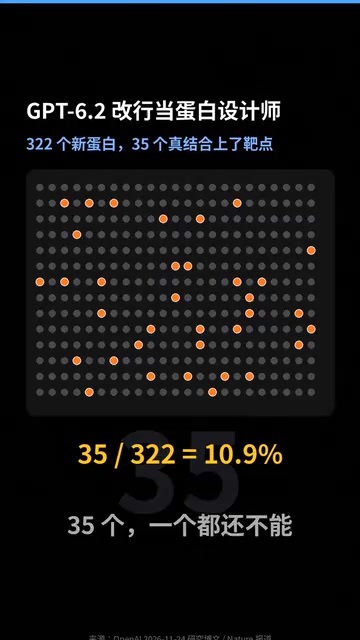
GPT-6.2 Protein Design: 35 of 322 Bind Successfully — How Far from a Drug?
OpenAI's preprint claims GPT-6.2 designs proteins via reasoning, with 35 of 322 binding successfully (10.9%). But the pipeline relies on specialized models, structure prediction trails expert models, it's not peer-reviewed, and none of the 35 is close to becoming a drug.