GPT-6.2 Protein Design: 35 of 322 Bind Successfully — How Far from a Drug?
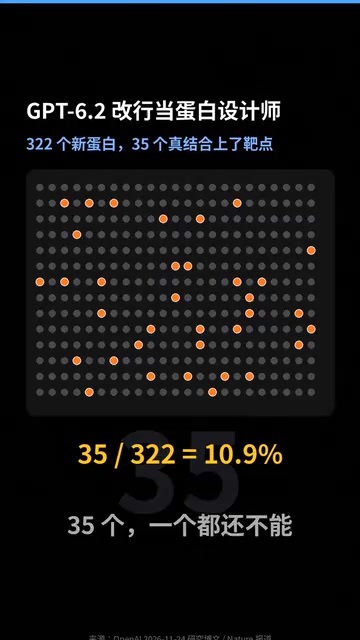
GPT-6.2's protein design succeeds only 10.9% of the time and relies on specialized models — none of the 35 binding proteins is directly druggable.
OpenAI's preprint claims GPT-6.2 can design novel proteins through reasoning and code-writing, but a Bilibili creator's breakdown shows: of 322 proteins designed against 5 targets, only 35 bound successfully (10.9%), with IL-17A performing best (18) and TRIQ hardest (1). Engineering existing proteins reached 85% (75 of 88), but that task is an order of magnitude easier. The pipeline isn't end-to-end — sequence design relies on Soluble MPNN and screening on specialized models like Bose2; structure prediction scores just 0.26 versus 0.93 for expert models. Plus, as an unreviewed, unreproduced preprint, the conclusions are only the team's own account. Binding a target is just the first step in drug development — none of the 35 proteins is directly druggable today.
OpenAI released a preprint on November 24, claiming that GPT-6.2 can design novel proteins using only reasoning and code-writing. A Bilibili creator broke down the data in "AI News EP07": of 322 designed proteins, only 35 actually bound to their targets — a 10.9% success rate. Not one of those 35 can directly become a drug.
Key Data: Only 35 of 322 Bound
The key numbers the creator gave: GPT-6.2 designed 322 novel proteins against 5 targets, and only 35 successfully bound, for an overall success rate of 10.9%. Results varied widely by target — IL-17A had the most successes with 18 bound designs; TRIQ was the hardest, with only one success.
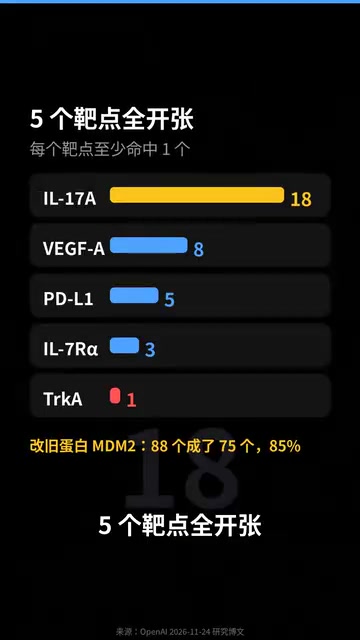
These numbers show the model is usable on some targets, but it's still far from being a "general-purpose protein designer." A 10.9% success rate isn't outrageous in the context of wet-lab screening, but under the narrative of "AI directly delivering usable proteins," it warrants a cooler look.
De novo design and wet-lab screening
De novo design means conceiving entirely new proteins directly from amino acid sequences, without relying on protein backbones that already exist in nature. The search space grows exponentially with sequence length, and there's no evolutionarily refined, stable framework to build on, making it far harder than engineering existing proteins. The 322 designs against 5 targets in this paper are a typical de novo design task.
"Successful binding" must be verified by wet-lab experiments: researchers express the designed sequences as proteins and measure their binding affinity to the target using techniques like SPR, BLI, or yeast display, counting a success only if it exceeds a preset threshold. The 10.9% figure is an end-to-end success rate across the full "design—expression—binding" chain, not an internal model score, so it's more convincing than purely computational metrics and better reflects real-world usability.
Engineering Existing Proteins: The Truth Behind the 85% Success Rate
GPT-6.2 performs better at engineering existing proteins. The source material mentions that in an MDMR engineering task, 75 of 88 designs succeeded — an 85% success rate. That number looks impressive, but note the nature of the task: engineering an existing protein is an order of magnitude easier than designing a new one from scratch. The model is making local adjustments to an existing structural framework, so the search space is far smaller.
The gap between the two tasks' success rates (10.9% vs 85%) makes one thing clear: GPT-6.2 is currently better at "fine-tuning" than at "creating."
A Cold Shower: Not End-to-End, and Structure Prediction Falls Short
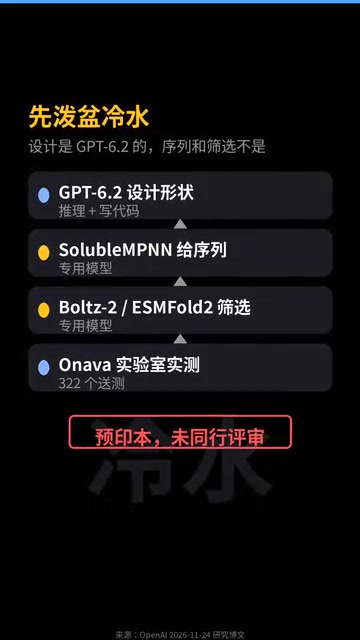
The creator poured cold water on the claims explicitly in the video. Sequence design relies on Soluble MPNN for filtering, and the screening step depends on specialized models like Bose2 — the whole pipeline is not completed end-to-end by GPT-6.2. In other words, GPT-6.2 is one link in the assembly line, not the whole thing.
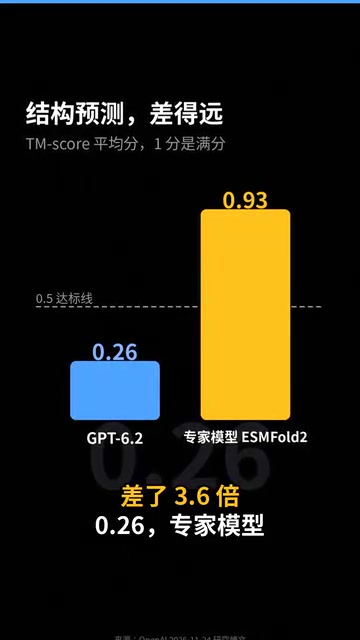
The structure prediction gap is even bigger: GPT-6.2 averaged a score of 0.26, while expert models reached 0.93. That gap means that in scenarios requiring precise 3D structures, general-purpose large models still can't replace specialized tools like AlphaFold.
Moreover, this is a preprint — not peer-reviewed, and not independently reproduced by anyone. All the data currently amounts to "the team's own account" and cannot be treated as established scientific conclusions.
Soluble MPNN, Bose2, and structure prediction scores
MPNN (message-passing neural network) refers to a class of models trained on joint protein sequence–structure representations; ProteinMPNN and its soluble variant Soluble MPNN are commonly used to "infer sequences from a given backbone" and filter out candidates prone to aggregation or hard to express. Specialized models like Bose2 handle binding affinity or developability prediction. Chaining them with GPT-6.2 shows that the general-purpose model outputs candidate sequences, which still need filtering by domain-specific models.
The gap between structure prediction scores of 0.26 and 0.93 is typically measured with metrics like TM-score or GDT: the former reflects overall similarity between predicted and true structures — 0.26 means even the gross topology is wrong, while 0.93 is close to experimental accuracy. This explains why general-purpose large models can't yet replace AlphaFold-class tools — protein design depends heavily on precise 3D structures, and inaccurate structure prediction directly drags down downstream design quality.
Binding Is Not a Drug: How Far Are the 35?
The question in the title — can those 35 actually become drugs? — has an answer: not one of them, for now. Binding to a target is only the first step in a long march of drug development. A new drug takes 10 to 15 years on average and costs between $880 million and $2.3 billion. If protein design works, new drugs could become faster and cheaper — but between "binding" and "becoming a drug" lie a whole series of hurdles: affinity optimization, stability, immunogenicity, toxicology, clinical trials, and more.
What this means for ordinary people: if AI can genuinely raise the efficiency of the protein design stage, the timeline and cost of future drug R&D could be compressed. But as far as this GPT-6.2 preprint goes, what it proves is that "general-purpose large models can participate in protein design" — not that "general-purpose large models can design drugs."
How to View This Release
GPT-6.2's protein design capability is worth watching, but it needs to be placed in the right frame of reference: it can produce bindable designs against specific targets (like IL-17A) and has a high success rate on engineering tasks, but it relies on specialized models to fill the gaps, its structure prediction is far inferior to expert models, and it lacks independent verification. The 10.9% de novo design success rate is a starting point, not the finish line. Let's discuss in the comments: do you think general-purpose large models will replace specialized protein design tools, or remain one link in the pipeline long-term?
Related articles
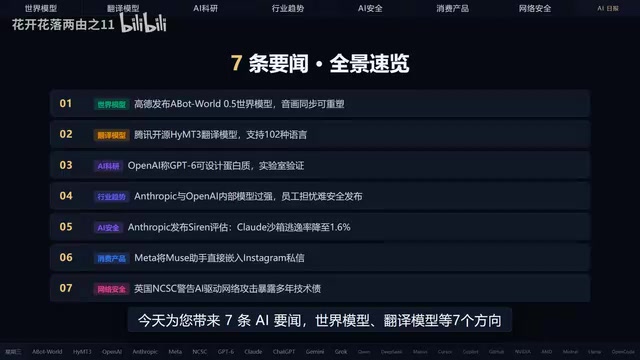
Amap World Model Launched, GPT-6 Protein Design Validated
AI daily roundup: Amap launches interactive world model ABot-World 0.5 with audio-visual sync and natural language reshaping; Tencent open-sources HiMT3 translation model covering 102 languages; OpenAI says GPT-6 can design proteins validated in labs; Anthropic and OpenAI internally concerned about models being too powerful; UK NCSC warns of rising AI-driven cyberattacks.
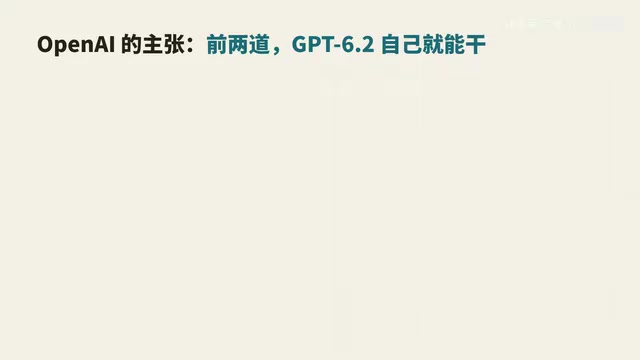
GPT-6 Designs Proteins on Its Own: 35 of 322 Bind, General Model Challenges Specialized Tools
OpenAI's GPT-6 protein design paper: 35 of 322 small proteins bind, all five targets hit. A general model designs backbones and sequences without specialized tools, but structure prediction and experimental validation remain weak spots—the paper lists four limits.
GLM-5.4 Loop Transformer: The Gap Between Z.ai's Claims and Measured Reality
Z.ai released GLM-5.4 with a loop Transformer, claiming it matches larger models and beats GLM-5.3—but methodology is missing and the API is closed. We break down the gap between vendor claims and verifiable results.