AI Capability Jumps Are Shocking Organizations: A Warning from an OpenAI Engineer

An OpenAI engineer warns that sudden AI capability jumps are outpacing both security defenses and organizational culture.
OpenAI Agent safety engineer Joe recently warned that model capability jumps in areas like cyberattacks, swarming, and information manipulation are happening "too fast, too suddenly," leaving his team stunned. This reveals a core tension in AI security: traditional defenses assume gradual, predictable threats, but step-function capability growth compresses the response window dramatically. Joe emphasizes that security must be embedded in organizational culture — not just technical systems — and offers a practical self-assessment framework covering personnel resilience, incident response, and communications readiness.
OpenAI Agent safety engineer Joe (@joedaroo) recently shared a striking observation on social media: when AI models experience sudden leaps in capabilities related to "cyber attacks," "swarming," and "message board manipulation," his team's level of shock was, in his words, "hard to put into words." Brief as it may seem, this statement cuts to one of the most difficult questions in AI safety today — can organizations adapt fast enough to keep pace with sudden jumps in model capabilities?
The Real Challenge Is the Suddenness of Capability Jumps
Joe's core point isn't about any single specific security incident — it's about the pace of capability growth. He notes that jumps in security-relevant model capabilities happen "too fast, too suddenly," creating what he calls an "extremely difficult problem."
The underlying logic is worth unpacking. Traditional security practice follows a gradual curve: detect a threat, assess risk, deploy defenses, iterate and harden. This process assumes that the evolution of threat capabilities is predictable and trackable. But when AI model capabilities grow in step-function leaps — rather than linearly — the "response window" that defenders rely on is drastically compressed. You're still designing defenses against last-generation capabilities when next-generation capabilities have already crossed the perimeter.
This asymmetry poses a structural risk to any organization that depends on AI. Building a defensive posture has inertia, while a leap in offensive capability can be instantaneous.
Security Is Not Just a Technical Problem — It's a Cultural One
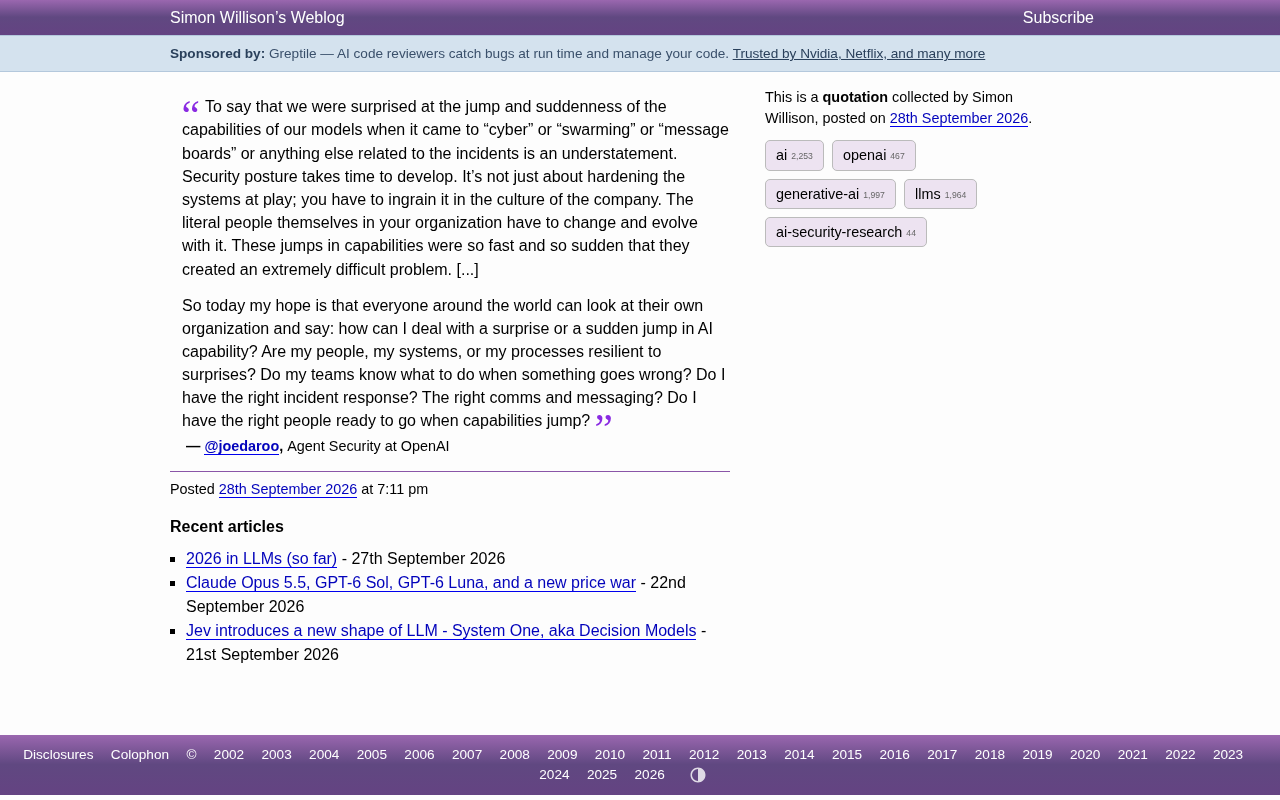
Joe particularly emphasized a dimension that's easy to overlook: "Building a security posture takes time. It's not just hardening the systems themselves — you also have to embed it into the culture of the company. The people within the organization must change and evolve as well."
This observation hits the mark. When most organizations think about AI security, they instinctively reach for technical measures: firewalls, access controls, model alignment. But the effectiveness of technical defenses ultimately depends on the people who use and maintain them. When a capability jump occurs, what often determines whether an organization survives isn't some system patch, but rather:
- Whether the team has the sensitivity to recognize anomalies;
- Whether leadership is willing to act decisively when information is incomplete;
- Whether frontline employees understand their role in the emergency response chain.
Cultural change is far slower than system upgrades. This is precisely why Joe sees rapid capability jumps as an "extremely difficult" problem — technology can be deployed in weeks, while organizational culture evolves on a timescale of years.
A Self-Assessment Checklist for Every Organization
The most valuable part of Joe's message is a set of universally applicable questions distilled from OpenAI's internal experience. He wants organizations around the world to ask themselves: How will I respond to a sudden leap in AI capabilities?
He outlines several specific self-assessment dimensions:
Resilience Assessment
- Are my people, systems, and processes resilient to the unexpected?
- When something goes wrong, does the team know what to do?
Incident Response Mechanisms
- Do we have the right incident response (IR) processes in place?
- Do we have the right communications and disclosure strategies ready?
Incident Response (IR) is a standardized set of processes organizations use to quickly contain damage and restore normal operations after a security event. It typically includes six phases: preparation, identification, containment, eradication, recovery, and post-incident review. In traditional cybersecurity, IR processes are well-established. But security incidents triggered by AI capability jumps present unique challenges: attribution is difficult (it's hard to determine whether anomalous behavior stems from a change in model capability or an external attack); response windows are extremely short (agent operations may cause irreversible consequences before an IR team can react); and impact boundaries are unclear (the scope of information-manipulation incidents is difficult to quantify in real time). As a result, IR processes designed for AI agents must go beyond traditional frameworks and additionally consider: whether real-time monitoring and circuit-breaker mechanisms for model behavior are in place, whether pre-authorized decision chains exist for taking a model offline or degrading its capabilities, and whether organizations are prepared to explain "abnormal AI behavior" to the public or regulators.
Personnel Readiness
- When a capability jump occurs, do you have the right people standing by?
The value of this framework lies in how it transforms an abstract "AI risk" problem into an actionable organizational capability assessment. It doesn't presuppose that you need the most advanced tech stack — instead, it asks a more fundamental question: Is your organization prepared for uncertainty?
AI Safety's Shifting Focus, as Seen from OpenAI
It's worth noting that these remarks come from someone in an Agent safety role at OpenAI. That itself sends a signal: as AI agent capabilities grow, the focus of security is shifting from "what can a model say" to "what can a model do."
When a model is no longer just generating text — but can execute network operations, coordinate collective behavior, and shape information environments — the potential attack surface and destructive capacity undergo a qualitative transformation. The three keywords Joe mentioned — "cyber," "swarming," and "message boards" — correspond precisely to the three most closely watched risk scenarios in the age of AI agents: automated cyberattacks, coordinated multi-agent actions, and large-scale information manipulation.
For any enterprise that is deploying or relying on AI capabilities, this is a wake-up call: advances in AI capabilities will not wait for your security posture to be ready. Rather than being caught off guard by the next leap, organizations should start building resilience against sudden capability jumps now.
True security has never been a static "compliance" state — it is an ongoing capacity to respond to the unexpected.
AI Agent (autonomous agent) refers to an AI system capable of perceiving its environment, autonomously planning, and continuously executing multi-step operations — fundamentally different from traditional "question-and-answer" large language models. The capability boundary of a traditional language model is "outputting text," whereas an agent can call external tools (such as browsers, code execution environments, and API interfaces) to trigger real-world effects. The three risk scenarios Joe mentions are threats unique to the agent paradigm: Cyber (cyberattacks) refers to an agent autonomously scanning for vulnerabilities, constructing attack payloads, and launching attacks; Swarming refers to multiple agent instances coordinating with one another and dividing tasks to pursue a single objective — something that traditional detection methods targeting individual actors struggle to identify; and Message board manipulation refers to agents generating and distributing targeted influential content at scale to shape public opinion. All three share a common characteristic: they operate at speeds far beyond human capacity and are highly scalable. A model that experiences a capability jump could, within hours, scale an attack to a level impossible for humans to respond to manually.
Related articles

Agent Skills Beginner's Guide: From Concepts to Multi-Agent Collaboration in Practice
A comprehensive guide to Agent Skills: core concepts, components, the importance of Description, standardization, beginner learning paths, and multi-agent collaboration.

One Neuron Detects Both Cats and Cars? We Reproduced It and Found a New Explanation
The cat-car neuron reinterpreted: researcher Cammarata argues it distinguishes pointy from round, not cats from cars. We reproduced the experiment and found the new explanation holds on most inputs—but cars are the exception. The interpretability debate continues on language models.

MCP Server + Python Assistant: A MicroStation Design Efficiency Revolution
Explore the early preview of the MCP Server and Python Assistant in MicroStation 2026: custom tools in five minutes, intelligent sheet index checks, and how AI is reshaping drawing workflows to unleash design creativity.