AI Character Transfer in Practice: Can MiniMax H3 Rival Seedance?
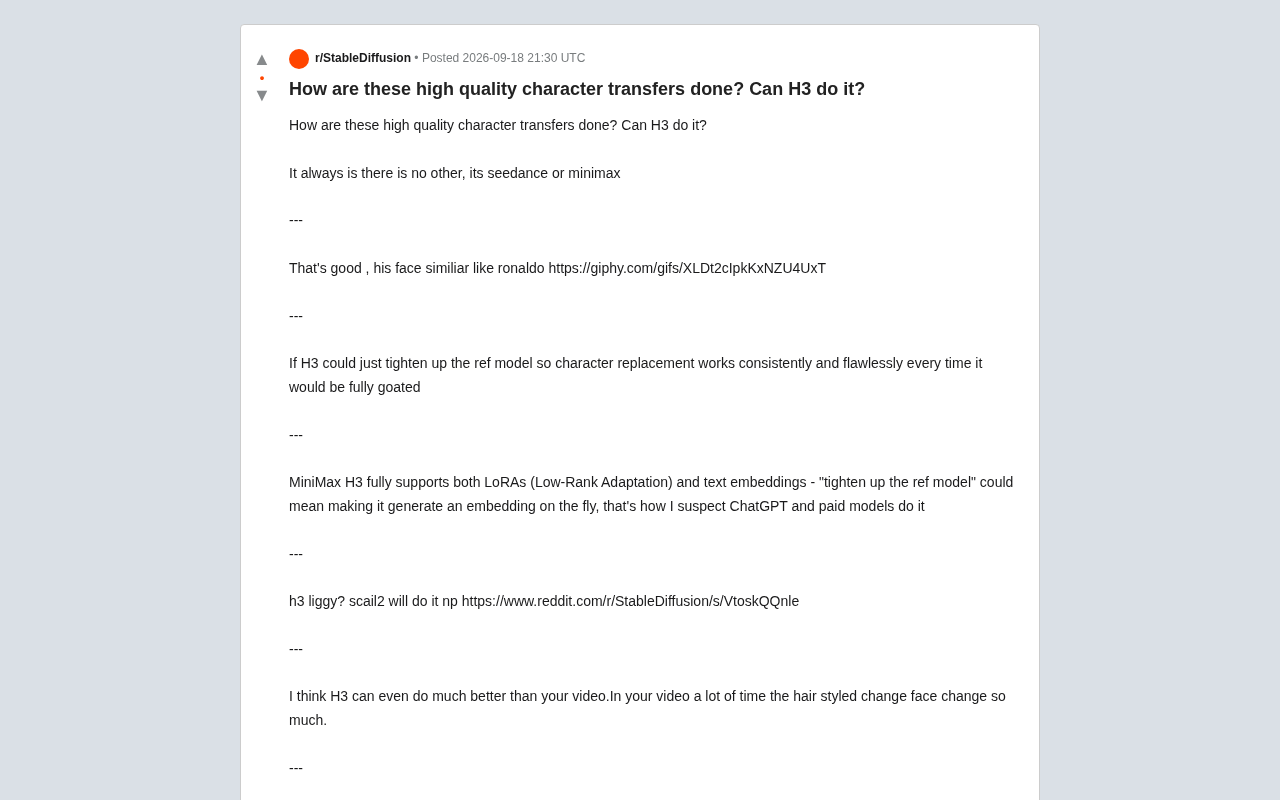
Reddit users test AI character transfer: Seedance leads on quality, MiniMax H3 offers flexibility but consistency remains a shared challenge.
A Reddit discussion reveals the real state of AI video character transfer. Seedance and MiniMax H3 are the two most competitive options: Seedance leads on final output quality, while H3's support for both LoRA and text embeddings offers greater flexibility. Hands-on testers concluded that "H3 can do it, but quality isn't as good as Seedance." Both models share a core challenge — character consistency, with hairstyle drift and facial variation persisting across generations. On the workflow side, a dual-reference approach combining image references with clean vocal audio for segment-by-segment generation is considered a practical quality booster. Overall, tools are impressive enough to produce stunning results, but stable reproducibility remains the unsolved final mile.
The Technical Battle Behind High-Quality Character Transfer
In AI video generation communities, "character transfer" has become one of the most closely watched capabilities. It refers to replacing a character in a video with a specified one, while preserving the original motion, expressions, and scene consistency. A Reddit discussion thread centered on this topic: users tried to figure out exactly how those high-quality character transfer results are achieved — and whether the emerging model MiniMax H3 is up to the task.
One recurring consensus in the thread: the models that can genuinely deliver high-quality character transfer "come and go, but it's always the same few" — Seedance and MiniMax dominate the field by a wide margin. One user put it bluntly: "It always is there is no other, its seedance or minimax" — capturing the competitive landscape of this niche in a single sentence.
MiniMax H3's Capability Boundaries
MiniMax H3 is at the center of this discussion. Multiple users offered mixed assessments of its capabilities, painting a picture of something that's "usable, but not quite there yet."
Supporters argued that H3 has a solid technical foundation. One commenter noted that H3 supports both LoRA (Low-Rank Adaptation) and text embeddings for character control. A technically-minded user speculated that "tightening up the ref model" likely means having the model "generate an embedding vector on the fly" — and guessed this is probably the approach used by closed-source paid services like ChatGPT. This observation points to the core mechanism behind character transfer: the model needs to extract stable identity features from a reference image and inject them into the generation process.
Consistency Is the Biggest Pain Point
Criticism focused primarily on consistency issues. One user said directly that if H3 could "tighten up the ref model so character transfer works consistently and flawlessly every time," it would be "fully goated." That half-joking assessment pinpoints the current shortcoming — character transfer results are hit-or-miss, lacking reliability.
Interestingly, another user actually argued that H3 outperforms the video shown in the original post in certain dimensions: "in your video, the hairstyle and face change way too much a lot of the time" — implying the original video's character consistency wasn't great either, and H3 might actually do better on that front.
Technical sidebar: LoRA vs. Text Embeddings
LoRA (Low-Rank Adaptation) is a parameter-efficient fine-tuning technique. Its core idea is to guide model outputs toward specific styles or character features by injecting low-rank matrices — without modifying the original model weights. In character transfer scenarios, users can train a lightweight LoRA weight file for a specific character, then layer it on top of the base model at inference time, producing stable results that reliably reflect that character's appearance. Text embeddings take a different approach: encoding a character's visual features as high-dimensional vectors and injecting them directly into the model's attention mechanism or conditioning inputs — no additional training required, making inference faster, though demanding higher quality and quantity from reference images. Each method has its strengths — LoRA generally delivers more stable character consistency but requires prior training; text embeddings are more flexible and suited for on-the-fly character swapping, which is why closed-source paid services tend to favor this direction.
Hands-On Experience: H3 Can Do It, But Not as Well as Seedance
The most valuable contributions in the thread came from users with actual hands-on experience. One user stated clearly: "I can do this with H3, but the quality isn't as good as Seedance." This gives the whole debate a pragmatic conclusion — H3 is functionally capable, but still falls behind Seedance on final output quality.
Another user shared a specific workflow tip: use an image reference + audio reference (ideally with clean vocals only, to filter out unnecessary "noise") to generate independent segments one at a time. This "image + audio" dual-reference approach is a practical technique for improving both quality and controllability in character transfer — well worth trying for anyone looking to get started.
Some users also mentioned alternative tools — one brought up "scail2" as something that handles similar tasks easily — suggesting the broader tool ecosystem in this space is expanding rapidly, with no single player holding a monopoly.
Technical sidebar: The Dual-Reference Workflow Explained
The logic behind the "image + audio dual-reference" workflow is to provide visual identity information and motion/rhythm information to the model separately. The image reference anchors the character's appearance (facial structure, hairstyle, clothing), while the audio reference — especially clean vocals — gives the model cues for lip sync and emotional timing, while avoiding background music or sound effects that might confuse the model's interpretation of "intended motion." Segment-by-segment generation means splitting a long video into shorter clips, generating each independently, then splicing them in post. This avoids the character drift caused by attention decay in long-sequence generation — each segment's independent constraints significantly improve overall consistency. In essence, this workflow uses a "divide and conquer + multimodal constraint" strategy to work around current models' inherent limitations in maintaining character identity over long temporal sequences.
Practical Takeaways for Creators
Pulling together the key threads of this discussion, here are a few practical pointers for creators looking to experiment with AI character transfer:
- Prioritize Seedance for maximum output quality: Multiple users consistently recognize Seedance's lead in final video quality.
- Consider H3 for flexibility and control: H3's support for both LoRA and text embeddings gives advanced users more room to fine-tune, and it sometimes performs better on character consistency.
- Leverage multi-reference inputs: Pairing an image reference with clean vocal audio noticeably improves generation quality and segment-level control.
- Manage your expectations: No matter which model you use, character transfer still isn't "perfect every time" — hairstyle drift, facial variation, and other artifacts mean you'll still need to manually filter results across multiple generations.
What looks like a casual community Q&A thread actually maps out the real state of AI video character transfer technology: the tools are already powerful enough to produce genuinely impressive results, but "stable reproducibility" — that final mile — remains a shared challenge that no model has fully solved yet.
Related articles

Signs of a Conversational Narcissist: Why Some People Only Talk About Themselves
Conversational narcissists always redirect talk back to themselves — rooted in insecurity, not arrogance. A survey of 4,000 people found the biggest social fear is awkward silence. Learn the signs and how assertive curiosity is the fix.

Buridan's Ass: How One Word Keeps You Stuck in Place
Buridan's Ass reveals a universal psychological trap: when two conflicting desires are bound by "but," you end up paralyzed. Learn how to break free with "and" thinking.

Conversation Is the Overlooked Longevity Hack: The Three Things Everyone Craves
Everyone craves to be understood, chosen, and loved — and conversation is the only vehicle to get there. Discover why conversation is the overlooked longevity hack and how to train it like a skill.