AI Chatbot Has a Knowledge Base but Still Gets It Wrong? Here's the Real Problem with RAG Retrieval

RAG chatbots answer incorrectly not from missing knowledge, but from retrieving condition-mismatched content — metadata filtering and condition-first retrieval are the fix.
This article examines the most common yet overlooked failure in enterprise RAG deployments: wrong answers stem not from gaps in the knowledge base, but from retrieving semantically similar content that doesn't match the applicable conditions. Using a financial platform as a case study, it proposes three solutions — attaching structured metadata (scenario, region, version, date) to knowledge entries, having the Agent identify conditions before retrieval to narrow scope, and establishing conflict arbitration rules that prioritize official policy over FAQs and favor refusal over uncertain answers.
The Problem Isn't Missing Answers — It's Retrieving the Wrong Ones
Many teams building AI customer service systems run into the same frustrating issue: the answer is clearly spelled out in the knowledge base, yet the AI still gets it wrong. This exposes one of the most commonly overlooked failure modes in real-world RAG (Retrieval-Augmented Generation) deployments.
The standard mental model of RAG goes like this: "User asks a question → vector similarity search → retrieved content is fed to the LLM → answer is generated." It sounds airtight, but real business scenarios are far more complex. The most common RAG failure isn't "can't find the answer" — it's "found the wrong answer." High similarity doesn't mean applicable; semantic closeness doesn't mean conditions match.
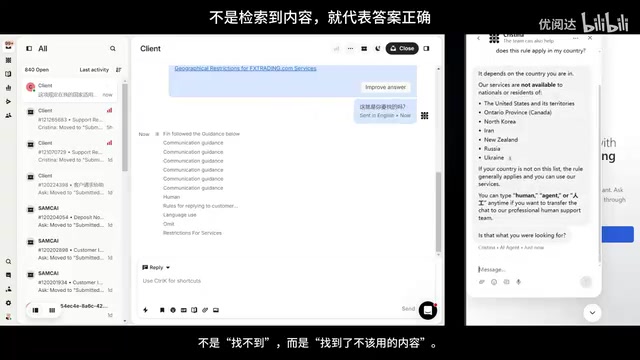
Take a financial trading platform as an example. The same "withdrawal rule" can look completely different depending on the country, account type, payment channel, and effective date. With pure vector similarity search, the system will likely retrieve outdated policies or rules from other regions — and the LLM will confidently stitch them into a response that sounds authoritative. The user can't tell it's wrong, but the answer may be entirely inapplicable to their situation.
RAG (Retrieval-Augmented Generation) is currently one of the most widely adopted architectures for enterprise LLM applications. Its core idea: rather than baking all knowledge into model weights, it dynamically retrieves from an external knowledge base at inference time, appends the retrieved content as context into the prompt, and lets the LLM generate the final answer. The advantage is that knowledge can be updated at any time without retraining, and the sources of answers remain traceable. Vector similarity search is the most common retrieval method — text is converted into high-dimensional vectors, and the most semantically similar passages are found using cosine similarity or dot product. However, "semantically similar" and "condition-matched" are two entirely different dimensions. A document about "withdrawal rules" is semantically relevant to every withdrawal question — but only the version specific to a particular country and a particular policy version actually applies to the current user. Pure vector search cannot perceive this kind of conditional boundary, and that's exactly the root cause of the problem this article addresses.
Give Your Knowledge an Identity: The Role of Metadata
The key to solving this problem isn't making the AI retrieve more — it's making every piece of knowledge carry a clear "identity tag," i.e., metadata.
When configuring a knowledge base, attaching structured attribute fields to content is critical, such as:
- Business scenario: Is this rule about withdrawals, deposits, or account verification?
- Country/region: Korea, EU, Southeast Asia, etc.
- Product and account tier: Differences across product lines or VIP levels
- Language and version: Current version vs. historical version
- Effective date: When did this rule take effect?
- Source priority: Official policy document vs. general FAQ
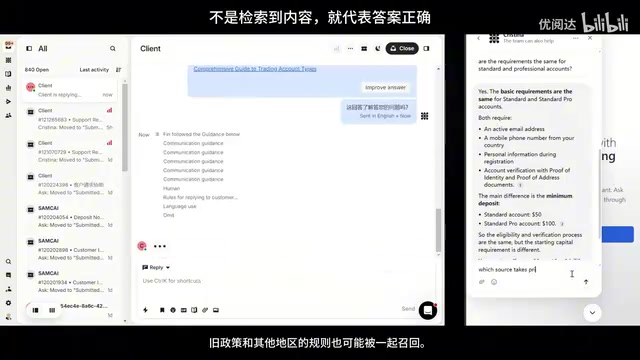
Metadata transforms knowledge from "a pile of semantically similar text" into "structured information with conditions, boundaries, and ownership." When retrieval happens, the system no longer relies solely on semantic similarity — it first applies metadata filters to the candidate content, ensuring what's retrieved genuinely fits the user's context.
In vector database implementations, metadata filtering typically works in one of two modes: pre-filtering or post-filtering. Pre-filtering narrows the candidate set using structured fields before computing vector similarity — only semantically searching documents that meet the conditions. This yields higher precision but requires the vector store to support hybrid queries (Pinecone, Weaviate, and Qdrant all do). Post-filtering retrieves the Top-K semantically similar results first, then eliminates entries that don't meet the metadata conditions — simpler to implement but risks ending up with too few usable results. For business scenarios with strict conditional constraints (like the financial compliance case described here), pre-filtering is generally the more reliable choice, because it eliminates the risk of "an answer already generated from a non-compliant source" at the root.
Identify Conditions First, Then Filter: The Agent's Retrieval Logic
In a truly professional RAG workflow, the key is placing "condition identification" before retrieval — not delegating all judgment to similarity scoring.
Concretely: when a customer asks a question, the Agent doesn't immediately fetch the most similar passages from the vector store. Instead, it first completes a round of "condition identification": Which country is this user from? What account type do they have? Which business scenario are they asking about? Only after these applicable conditions are established does the Agent narrow the retrieval scope to the corresponding knowledge subset.
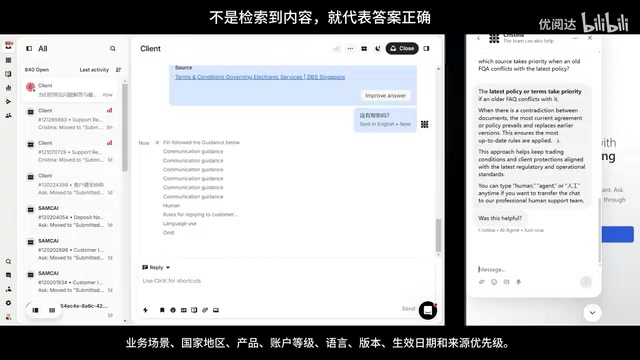
A concrete example: a customer entering from the Korean-language page asks about local verification requirements. The AI should prioritize content tagged "applicable to Korea" — not pull a "looks similar enough" English passage from the global knowledge base and patch together a response. This distinction is what separates a "professional assistant" from a system that "confidently makes things up."
Conflict Arbitration: When Multiple Knowledge Entries All Qualify
Even with metadata filtering in place, multiple knowledge entries may still satisfy the conditions simultaneously. That's when a clear set of "arbitration rules" is needed to determine priority.
Several principles worth adopting in practice:
- Official policy overrides general FAQ: When an official policy document and an FAQ entry conflict, the policy wins
- Newer versions supersede older ones: Prevent expired rules from misleading users
- When the applicable scope can't be confirmed, don't answer directly: This is the most overlooked — and most important — rule
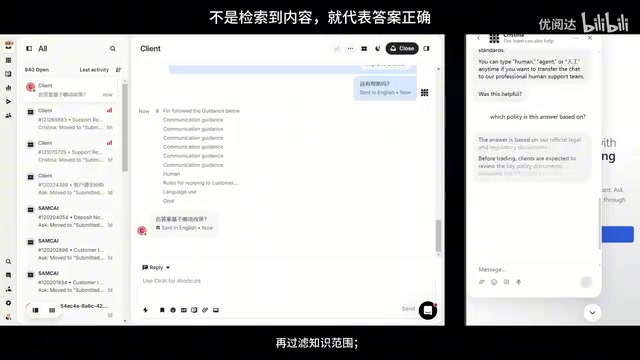
"Better to not answer than to answer wrong" is especially critical in high-risk domains like finance, healthcare, and law. An AI that honestly says "I need to verify this further" is far more trustworthy than one that confidently delivers a wrong answer. Giving an Agent the ability to "recognize its own boundaries" is a key marker of RAG system maturity.
At the technical implementation level, "better to not answer than to answer wrong" corresponds to designing the LLM's refusal capability. There are two common approaches: The first is to include explicit instructions in the System Prompt, requiring the model to output a standardized uncertainty expression — rather than forcibly synthesizing an answer — when retrieved knowledge passages contradict each other or when the applicable scope cannot be confirmed. The second is to add a confidence judgment node within the Agent pipeline: when the conflict score of retrieved content exceeds a threshold, the question is routed to a human agent rather than answered automatically. The latter is better suited to high-risk business scenarios because it shifts "boundary recognition" from a model capability requirement to engineering process control — more reliable and easier to audit. The two approaches aren't mutually exclusive; production-grade systems often deploy both simultaneously for layered protection.
The Essence of Professional RAG: Using the Right Content Under the Right Conditions
Back to the original question — why does an AI chatbot with a knowledge base still get things wrong? The answer is now clear: the problem isn't whether the knowledge base is complete. It's whether the retrieval mechanism can understand "conditions" and "boundaries."
The core principle of professional RAG can be summarized in one sentence: Don't make the AI retrieve more — make it use only the right content under the right conditions, and make it clearly know where each answer comes from.
This means shifting the engineering focus at the system design level from "increasing recall volume" to "improving retrieval precision and explainability." Metadata annotation, condition identification, scope filtering, conflict arbitration, and boundary awareness — these components together form a RAG customer service system that's truly production-ready. For teams exploring AI Agent deployment, rather than chasing a more powerful embedding model, it's far more effective to first get the knowledge structuring and conditional constraints right.
Related articles

Chain of Thought Isn't Just for AI: How Humans Can Use CoT to Improve Thinking Quality
Chain of Thought isn't just a prompt trick for large models. Starting from a Hacker News discussion, this article analyzes why CoT works for human thinking too, breaks down actionable ways to transfer it, and highlights the key differences between human CoT and machine CoT.
Cloudflare Teams Up with OpenAI: Closi…
Cloudflare Teams Up with OpenAI: Closing the Loop from Vulnerability Discovery to Defense with AI
Cloudflare uses OpenAI Daybreak to investigate security vulnerabilities and generate reviewable remediation plans, while developers use Codex to boost coding efficiency and quality.

Orca Multi-Agent Orchestration in Practice: A Guide to Parallel Collaboration with Claude and Codex
Orca is Stable AI's free open-source agent workbench supporting 34 agents like Claude Code and Codex in parallel. Learn its Git worktree isolation, multi-model orchestration, and mobile management.