AI Proves the Riemann Hypothesis via Formal Verification? The Truth and the Controversy

Passing Lean formal verification does not mean the Riemann Hypothesis is recognized as proven; AI mathematical breakthroughs should be viewed rationally.
The article analyzes the rumor that "Claude and a mathematician collaborated to prove the Riemann Hypothesis and passed Lean formal verification." According to Bilibili creator "Yinshi Fenjie," Claude raised the proportion of nontrivial zeros on the critical line from 41.6% to 67.2%, then produced a 250,000-page proof draft in about six weeks and converted it into 17 million lines of Lean code, which passed verification by Lean officials, the MathLib community, and independent checkers. The article notes that formal verification only shows the code-level proof chain is self-consistent under the given proposition, not that the Riemann Hypothesis has been recognized as proven by the mathematics community; strict equivalence between the formal proposition and the original conjecture, and the choice of axioms, still require peer review. In addition, converting 17 million lines of code into human-readable papers remains a formidable task, and key figures lack independent third-party verification. The event's real value lies in demonstrating the feasibility of AI participating in extremely long formal constructions and in the Lean/MathLib quality inspection stage.
Recently, a piece of news spread rapidly in Chinese tech communities: the Lean and MathLib communities jointly announced that the Riemann Hypothesis proof, completed by Levin-Alperg and Claude, had fully passed formal verification, and that a problem that has plagued the mathematics world for 167 years had been "officially cracked." Is this really true? Based on an explainer video by Bilibili creator "Yinshi Fenjie" and cross-referenced with public information, this article clarifies which parts are solid progress and which are overinterpretations.
Event Recap: From "41.6%" to "67.2%" to "Proof Complete"
According to the breakdown by Bilibili creator "Yinshi Fenjie," the Riemann Hypothesis was proposed by the German mathematician Riemann in 1859. Its core claim is that the real part of every nontrivial zero of the Riemann zeta function equals one-half. The difficulty lies in the fact that there are infinitely many zeros—even if a huge number of zeros are verified to follow the pattern, a single counterexample would disprove the conjecture.
Over the past 167 years, mathematicians have built a large number of conditional propositions around this conjecture. If the conjecture were disproved, the mathematical system would suffer a chain reaction. The previous rigorous result was this: it has been proven that at least 41.6% of all nontrivial zeros lie on the line whose real part equals one-half. According to the video, Anthropic announced in August that Claude had raised this proportion to 67.2%, seen as a signal that AI is pushing the known boundary forward.
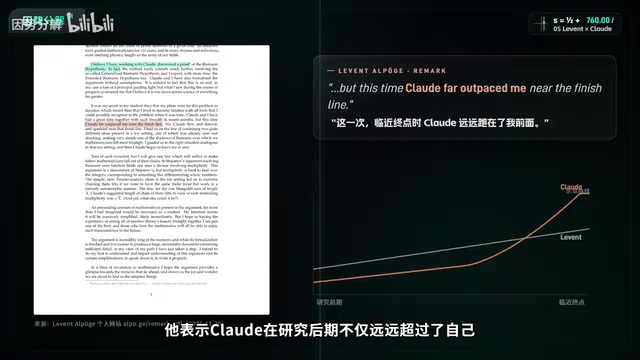
Then, on November 20, Anthropic mathematician Levin-Alperg announced a collaboration with Claude that found a proof of the Riemann Hypothesis in about six weeks. The video claims that in the later stages of the research, Claude not only far outperformed its collaborator but also provided key insights, generating a proof draft of more than 250,000 pages and converting it into 17 million lines of Lean formal code.
The Riemann zeta function is a function defined on the complex plane, originally given by an infinite series and extended to the entire complex plane (except for a simple pole) through analytic continuation. Its nontrivial zeros are those zeros that are not at the negative even integers (the trivial zeros). The Riemann Hypothesis asserts that the real part of all these nontrivial zeros is exactly 1/2. This conjecture is closely related to the distribution of primes: if it holds, the error term in the prime number theorem can be precisely controlled. Historically, the first several zeros that have been verified all satisfy this property, but verifying finitely many zeros cannot rule out the possibility of a counterexample among infinitely many zeros, so a rigorous mathematical proof is needed.
What Passing Formal Verification Means
Lean plays the role of an "automatic acceptance system for the mathematics world": every step of reasoning is converted into computer-checkable logical rules, and any noncompliant step cannot pass. According to the video, one day later, Lean officials, the MathLib community, and multiple independent checkers participated in verification, confirming that the formal proposition was consistent with the Riemann Hypothesis and that the proof passed the check—this also corresponds to the screenshots.
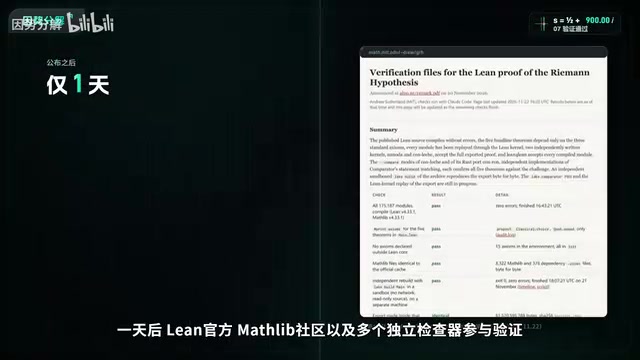
Two levels need to be distinguished: passing formal verification shows that the "proof chain at the code level" is self-consistent under the given proposition; but it is not equivalent to the proposition having been recognized by the mathematics community as a complete proof of the Riemann Hypothesis. Whether the formal proposition is strictly equivalent to the original conjecture, and whether the choice of axioms and definitions is uncontroversial, still require peer review.
A more practical problem is that converting 17 million lines of code into mathematical papers that humans can read and discuss is a formidable project. The video also clearly points out that this remains the next task.
Lean is an interactive theorem prover and also a programming language based on dependent type theory, allowing users to write mathematical propositions as formal statements and construct machine-checkable proof terms. MathLib is Lean's mathematics library, with a large number of formalized mathematical definitions and theorems maintained by the community. The core of formal verification is "proof checking": given a formal proposition and a purported proof, the Lean kernel verifies step by step whether each derivation follows logical rules. However, the formulation of the formal proposition itself requires manual translation, and the accuracy of the translation and the choice of axioms (such as whether to use the axiom of choice or nonstandard analysis) may affect the equivalence of the final conclusion. Therefore, passing formal verification only guarantees that the proof is valid within the given formal framework; it is not automatically equivalent to a proof of the original natural-language conjecture.
A Milestone for AI Research, or Amplification in Communication
On the positive side, if this event is true, it demonstrates at least three things: AI can participate in the formal construction of extremely long chains; the formal toolchain (Lean/MathLib) is becoming a "quality inspection stage" for AI mathematical output; and in human-machine collaboration, AI is beginning to contribute ideas rather than merely perform computation.
But the narrative that "AI solved a centuries-old problem in a few weeks" needs restraint. Historically, there have been multiple rumors that the Riemann Hypothesis had been proven, and none ultimately passed peer review. The rigor of formal verification deserves recognition, but what it verifies is a "formal statement," not the natural-language proposition of the Riemann Hypothesis itself.

In addition, figures such as "at least 41.6%," "raised to 67.2%," "250,000 pages," "17 million lines," and "6 weeks" all come from one-sided narration in the video and lack independent third-party verification. Until the mathematics community officially responds, they should be regarded as information awaiting verification.
A Rational View of AI Mathematical Breakthroughs
For developers and researchers, the more noteworthy signal is the maturity of the toolchain: Lean formal verification is lowering the trust cost of "machine-produced mathematics." Regardless of the final conclusion of this event, the combination of AI-assisted proof and formal verification has become a foreseeable research direction. For problems at the level of the Riemann Hypothesis, the final authority still rests with the mathematical community, not with the heat of social media discussion.
One-line Summary
Passing Lean formal verification does not equal the Riemann Hypothesis being recognized as proven; AI mathematical breakthroughs should be viewed rationally.
Paragraph Summary
The article analyzes the rumor that "Claude and a mathematician collaborated to prove the Riemann Hypothesis and passed Lean formal verification." According to Bilibili creator "Yinshi Fenjie," Claude raised the proportion of nontrivial zeros lying on the critical line from 41.6% to 67.2%, then produced a 250,000-page proof draft in about six weeks and converted it into 17 million lines of Lean code, which passed verification by Lean officials, the MathLib community, and independent checkers. The article points out that formal verification only shows that the proof chain at the code level is self-consistent under the given proposition, and is not equivalent to the Riemann Hypothesis having been recognized by the mathematics community as proven; the strict equivalence between the formal proposition and the original conjecture, as well as the choice of axioms, still require peer review. In addition, converting 17 million lines of code into human-readable papers remains a formidable task, and key figures lack independent third-party verification. The real value of the event lies in demonstrating the feasibility of AI participating in extremely long formal constructions and in the Lean/MathLib quality inspection stage.
Related articles

AI Teams Up with Mathematicians to Attack the Riemann Hypothesis: 17 Million Lines of Code Tear Open a 167-Year Gap
In November 2026, Anthropic mathematicians and Claude claimed to have discovered a proof of the Riemann Hypothesis, publishing 17 million lines of Lean formalized code that passed machine verification. This article analyzes the event's impact on mathematics and cryptography, and the deeper questions raised by the separation of discovery and understanding.

AI Claims Formal Proof of the Riemann Hypothesis — But Machine Verification Isn't a Mathematical Proof
In Nov 2026, Anthropic's Levent Alpöğe released a Riemann Hypothesis proof of 175,000 code files that passed machine formal verification. But machine verification isn't a mathematical proof: the kernel can't confirm the proposition is the Riemann Hypothesis humans understand, and there's no human-readable paper. This article breaks down how ζ function zeros determine prime-count deviation, and the core of the controversy.

Anthropic Raises Over $80 Billion in IPO, DeepSeek Secures $100 Billion in Funding: AI Weekly Roundup
This week in AI: Anthropic's Nasdaq IPO raises $93.5B in the largest ever, DeepSeek closes ~100B yuan round, AI claims formal Riemann proof, MiniMax breaks crypto candidates in seconds.