AI Coding Agents Over-Edit? Evidence from 6,600+ Trajectories: Most Extra Code Is Tests and Docs

DRA decomposes agent over-editing: patches are larger but code necessity matches developers, with extra edits mostly tests and docs.
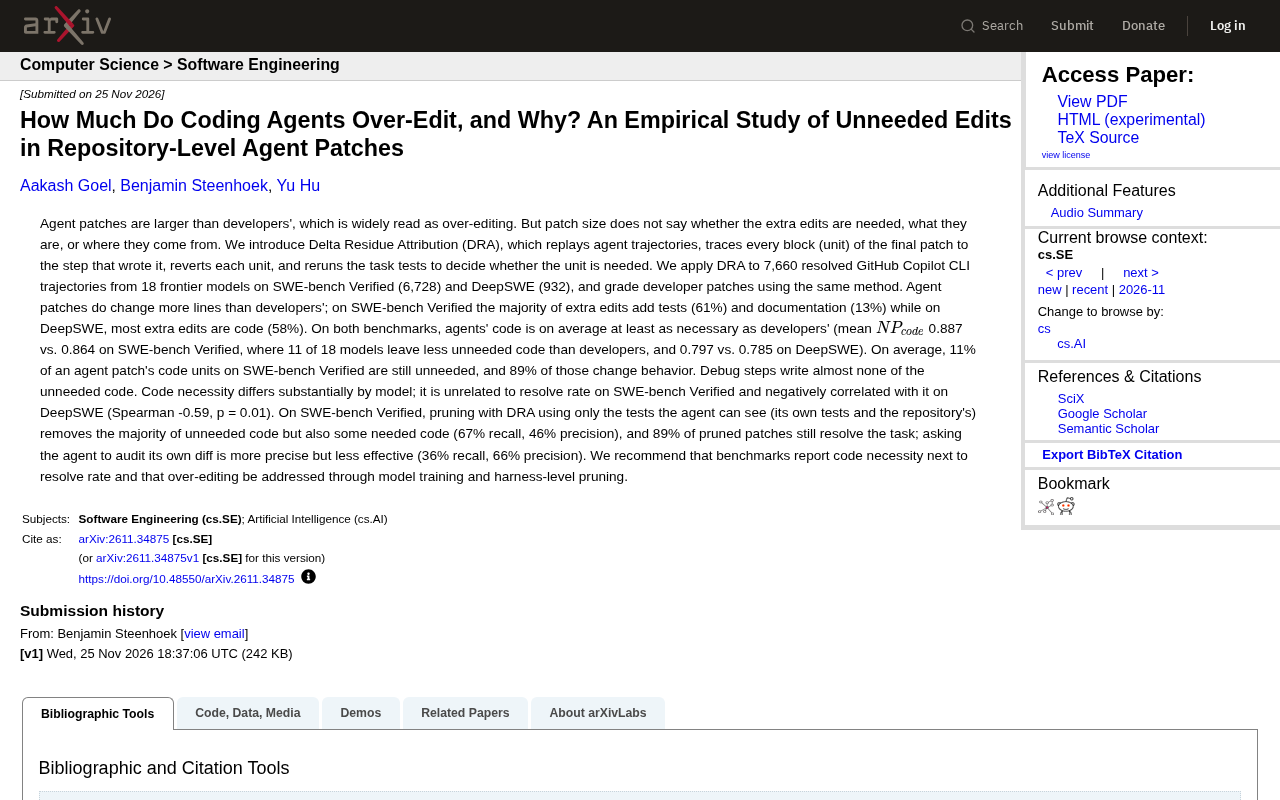
This study proposes Delta Residue Attribution (DRA), which quantifies the necessity of each code unit in agent patches by replaying trajectories, reverting patches block by block, and rerunning tests. Covering 18 frontier models and 7,660 successful Copilot CLI trajectories plus a human-developer control, results show agent patches are larger, but extra edits are mainly tests (61%) and docs (13%) on SWE-bench Verified and mainly code (58%) on DeepSWE; agent code necessity is on average no lower than developers' (0.887 vs. 0.864; 0.797 vs. 0.785), with 11 of 18 models leaving less unnecessary code. Debugging steps almost never produce useless code, yet 11% of code units remain unnecessary on average, 89% of which change behavior. Necessity is uncorrelated with resolve rate on SWE-bench Verified and negatively correlated on DeepSWE (-0.59). Pruning can remove most useless code but requires weighing recall against precision. The authors recommend benchmarks report both code necessity and resolve rate, and reducing useless edits at the training and tooling levels.
Introduction: Bigger Patches Don't Mean Worse
In evaluations of AI coding agents, a common observation is that agent-generated patches are larger than those of human developers, touching more lines of code. This is often directly interpreted as "over-editing." But patch size alone doesn't tell us whether the extra edits are necessary, what they consist of, or where they come from.
A recent empirical study proposes the Delta Residue Attribution (DRA) method, which replays agent trajectories, traces each code block in the final patch back to the step that wrote it, reverts them one by one, and reruns the task tests to determine whether each code block is necessary. The study covers 7,660 successfully solved trajectories from 18 frontier models via GitHub Copilot CLI—6,728 from SWE-bench Verified and 932 from DeepSWE—and scores human developer patches using the same method.
Core Finding: The Composition of Extra Edits Varies by Benchmark
Agent patches do touch more lines than developer patches, but "what was added" paints strikingly different pictures across the two benchmarks.
On SWE-bench Verified, most extra edits are added tests (61%) and documentation (13%); on DeepSWE, most extra edits are code (58%). This means that in real repository-level tasks, agents tend to supplement verification and explanatory content rather than randomly modifying business logic.
This discrepancy suggests that evaluating agent editing behavior cannot be divorced from the characteristics of the benchmark tasks. Added tests and documentation increase patch size but may improve maintainability—which is a different matter from "useless code bloat."
SWE-bench Verified is a curated subset of SWE-bench, released by OpenAI in 2024, containing 500 human-verified GitHub issue instances with clear problem descriptions that are confirmed solvable. Its tasks typically come from Python open-source repositories and require models to generate patches that pass the repository's existing unit tests, so added tests and documentation are often considered reasonable, low-risk contributions.
DeepSWE is a task benchmark closer to real repository-level software engineering, emphasizing multi-file, long-context repair scenarios that require cross-module reasoning. Because the tasks themselves involve deeper code logic changes, agents naturally produce more code-level edits during solving—which explains why extra edits on this benchmark are predominantly code (58%). The differing design goals of the two benchmarks directly determine the differences in patch composition, so agent behavior must be interpreted in light of benchmark characteristics.
Code Necessity: Agents Are at Least on Par with Developers
The study uses a "code necessity" metric (NP_code) to measure how necessary the code units in a patch are to retain. Results show that on both benchmarks, agent code is on average at least as necessary as developer code:
- On SWE-bench Verified, the agent mean is 0.887 versus 0.864 for developers; 11 of 18 models leave less unnecessary code than developers.
- On DeepSWE, the agent mean is 0.797 versus 0.785 for developers.
Despite larger agent patches, their code portions are not systematically less necessary than human code. On SWE-bench Verified, an average of 11% of code units are still unnecessary, and 89% of these change behavior—this is the truly noteworthy "over-editing residue."
NP_code (code necessity metric) is the core quantitative metric of the DRA method, defined as the proportion of "code units in the patch that still pass the task tests when retained" out of all code units. Specifically, researchers split the final patch into code blocks (e.g., functions, statement blocks), revert each block and rerun the tests: if the tests still pass after reverting, the block is deemed unnecessary; otherwise it is necessary. A higher NP_code indicates a greater proportion of code in the patch that genuinely affects task correctness.
The key advantage of this metric is that it does not rely on human annotation but obtains reproducible judgments through automated replay and testing. Note that NP_code only measures the necessity of "code units"; non-code changes such as tests and documentation are not counted, so it is specifically designed to answer the question "Does the agent write redundant business-logic code?" rather than to assess overall patch quality.
Debugging Steps Almost Never Produce Useless Code
A counterintuitive finding is that non-necessary code written during debugging steps is nearly zero. This suggests that temporary modifications produced during exploration and repair are often cleaned up or transformed in the final patch, and the truly residual useless code comes more from other stages.
This result has direct implications for improving agent design: rather than constraining debugging behavior, it is more productive to focus on review and pruning mechanisms for the final patch.
The Relationship Between Code Necessity and Resolve Rate Is Inconsistent
The study further analyzes the correlation between code necessity and task resolve rate, finding that the relationship varies by benchmark:
- On SWE-bench Verified, code necessity and resolve rate are uncorrelated.
- On DeepSWE, the two are negatively correlated (Spearman -0.59, p = 0.01).
This means that higher resolve rates do not automatically correspond to cleaner code. If evaluation only looks at resolve rate, it may mask differences in agents' code cleanliness. The authors therefore recommend that benchmarks report both code necessity and resolve rate to avoid misleading single-metric conclusions.
Pruning Strategies: Most Useless Code Can Be Removed, but Trade-offs Apply
The study evaluates DRA-based pruning methods. On SWE-bench Verified, pruning using only tests visible to the agent (its own tests and repository tests) can remove most unnecessary code but also mistakenly deletes some necessary code (recall 67%, precision 46%), and 89% of pruned patches still resolve the task.
Another approach is to have the agent audit its own diff, which yields higher precision (66%) but weaker effectiveness (recall 36%). The two strategies involve different trade-offs: the former is more aggressive and preserves solving capability; the latter is more conservative and makes fewer mistaken deletions.
In the pruning evaluation, recall refers to the proportion of all unnecessary code that is correctly removed, reflecting the coverage of pruning; precision refers to the proportion of removed code that is truly unnecessary, reflecting the accuracy of pruning. There is an inherent tension between the two: aggressive pruning can raise recall and substantially shrink patches but tends to mistakenly delete necessary code, potentially breaking task-solving capability; conservative pruning has high precision and few mistaken deletions but leaves more residual useless code.
In the study, pruning "using only tests visible to the agent" achieves 67% recall and 46% precision, meaning about one-third of unnecessary code remains unremoved while nearly half of the deleted code was actually necessary. The agent self-auditing its diff raises precision to 66% but recall is only 36%, indicating it tends to delete only the useless code it is most confident about. In practice, the appropriate pruning strength should be chosen based on whether the task prioritizes correctness or patch cleanliness.
Conclusions and Recommendations
Using fine-grained attribution methods, this study breaks "over-editing" down from a vague patch-size problem into measurable, traceable code-unit necessity. Key recommendations include:
- Evaluation level: Report code necessity metrics alongside resolve rate, paying particular attention to unnecessary code that changes behavior.
- Training level: Reduce useless edits through model training rather than relying solely on post-processing.
- Tooling level: Integrate pruning mechanisms into agent harnesses, but weigh recall against precision.
For developers, larger agent patches are not necessarily a bad thing—the extra tests and documentation are often valuable. What truly warrants caution is the portion of code that changes behavior but is unnecessary, and methods like DRA are making this portion visible and quantifiable.
One-line Summary
DRA decomposes agent over-editing: patches are larger but code necessity matches developers, with extra edits mostly tests and docs.
Paragraph Summary
This study proposes the Delta Residue Attribution (DRA) method, which quantifies the necessity of each code unit in agent-generated patches by replaying agent trajectories, reverting patches block by block, and rerunning tests. It covers 18 frontier models and 7,660 successful Copilot CLI trajectories plus a human-developer control. Results show that agent patches are larger, but extra edits are mainly tests (61%) and documentation (13%) on SWE-bench Verified, and mainly code (58%) on DeepSWE; agent code necessity is on average no lower than developers' (0.887 vs. 0.864; 0.797 vs. 0.785), with 11 of 18 models leaving less unnecessary code. Debugging steps almost never produce useless code, yet an average of 11% of code units remain unnecessary, 89% of which change behavior. Code necessity is uncorrelated with resolve rate on SWE-bench Verified and negatively correlated on DeepSWE (-0.59). Pruning strategies can remove most useless code but require weighing recall against precision. The authors recommend that benchmarks report both code necessity and resolve rate, and that useless edits be reduced at the training and tooling levels.
Related articles

A 19-Year-Old's Rental Horror Story: Ceiling Collapse, Bug Infestation, and the Lessons It Taught Me
At 19, my first off-campus rental brought bug infestations, no heat, a collapsed ceiling, and a ruined laptop with no renter's insurance. Here are the hard-won lessons for first-time student renters.

Veda Nurse's Cranial Nerve Exam: Why ASMR Role-Play Is Going Viral
Bilibili creator Veda's cranial nerve exam ASMR video goes viral, blending humor and sensory triggers through nurse role-play. This article analyzes its unique appeal and the audience psychology behind ASMR role-play.

LG Cinebeam AI Review: 120-Inch Giant Screen + 3000 Lumens, a New Choice for the Living Room Theater
LG Cinebeam AI projector review: 3000 ANSI lumens, 4K, 100 inches from about 8 cm and 120 inches from about 18 cm. Built-in webOS, AI Concierge voice recommendations, AI Sound Pro 11.1.2 virtual surround, and Game Optimizer—positioned for fixed living room installation, complementing the portable Cinebeam S.