AI Coding Tool Performance Optimization & Latest Advances in Multimodal Agents

Multi-front breakthroughs in AI tools: browser extensions, agents, stealth browsers, and foundation models advance together
This article covers several major recent AI developments: OpenAI's Codex Chrome extension enabling browser authentication, Everything Cloud Code providing cross-platform AI coding agent optimization, ByteDance's UiTARS Desktop V0.2.0 adding remote control capabilities, Cloak Browser achieving stealth automation through source-level modification, Baidu's ERNIE 5.1 reducing pre-training costs to 6% of industry standards while topping domestic rankings, and Anthropic's NLA technology making AI internal thinking readable.
OpenAI Launches Codex Chrome Extension: Enhanced Browser Operation Efficiency
OpenAI recently released a Codex Chrome extension for both Mac and PC, designed to streamline various tasks users perform in the browser. This update precisely addresses the growing trend of users working primarily in the browser, enabling Codex to handle web-related tasks more efficiently.
Unlike the previous built-in sandbox browser and plugin library, the new extension fills a critical gap—real user authentication operations. Previously, Codex couldn't handle website operations requiring login sessions, but this limitation has been removed, making it especially useful for platforms requiring authentication like LinkedIn and Salesforce. For public pages that don't require login, users can still use Codex's built-in browser, ensuring smooth local development and file previews without interfering with personal Chrome configurations.
Technical Background: Browser Authentication State & Extension Permissions Browser authentication state is essentially user identity credentials maintained through Cookies, Session Tokens, or OAuth tokens. Traditional AI agents running in sandbox environments are completely isolated from the user's real browser environment, unable to access these credentials, and therefore can only operate on public pages. Chrome extensions gain the same permission context as the user session through native browser APIs, fundamentally breaking through this limitation—this is why the same functionality cannot be achieved through regular web applications and must be distributed as an extension.

This design philosophy reflects OpenAI's deep understanding of real-world work scenarios: developers and knowledge workers perform a large portion of their operations in the browser, and enabling authentication access means AI assistants can truly participate in daily workflows.
Everything Cloud Code: Multi-Platform AI Agent Performance Optimization System
A Unified Solution Compatible with Major AI Coding Tools
Today's featured GitHub project is Everything Cloud Code, an AI agent performance optimization system that won an award at an Anthropic hackathon. Its core value lies in broad compatibility—supporting Claude Code, Codex, OpenCode, Cursor, Gemini, and other major AI coding tools.
The project provides AI agents with four core capabilities:
- Skill Enhancement: Expanding the boundaries of AI agent coding capabilities
- Intuition Optimization: Improving code generation accuracy and contextual understanding
- Memory Management: Optimizing context retention in long conversations and complex projects
- Security Assurance: Ensuring AI agent operations are safe and controllable
Technical Background: The Context Window Challenge for AI Agents One of the core challenges for AI coding agents is the limited context window. As project scale grows and conversation turns increase, models tend to lose critical early information, leading to degraded code generation quality—a phenomenon researchers call the "Lost in the Middle" problem. Memory management optimization typically involves techniques such as vector database retrieval, sliding window compression, and key information summarization. Everything Cloud Code provides a unified memory management layer that allows different AI tools to share the same context optimization strategies, which is key to improving stability in long-running tasks.
For developers who use multiple AI coding tools simultaneously, this project offers a unified performance optimization solution, eliminating the hassle of repeated configuration across different tools and significantly boosting development efficiency.
ByteDance UiTARS Desktop V0.2.0: Major Multimodal Agent Update
ByteDance's open-source multimodal AI agent desktop application UiTARS Desktop has received its V0.2.0 update, bringing several practical feature improvements.
Core Update Highlights
The new version supports multi-tool streaming and an event stream viewer, enhancing data flow tracking and debugging capabilities.
Technical Background: Multimodal Agents & Event Stream Architecture Multimodal AI agents need to simultaneously process heterogeneous data including screenshots, UI element coordinates, and text instructions, making their internal execution chain far more complex than single-modal models. Event Stream architecture draws from Reactive Programming principles, encapsulating each operation step of the agent—clicks, inputs, screenshot analysis, tool calls—as observable discrete events that support real-time monitoring, breakpoint replay, and performance analysis. This design enables developers to precisely locate specific failure steps when complex automation workflows encounter anomalies, rather than facing an opaque black box system.
In complex agent workflows, real-time event stream viewing means more efficient problem diagnosis and performance tuning.
More notably, V0.2.0 introduces free remote computer and remote browser operation capabilities, requiring no configuration for remote control, greatly enhancing convenience and intelligence.
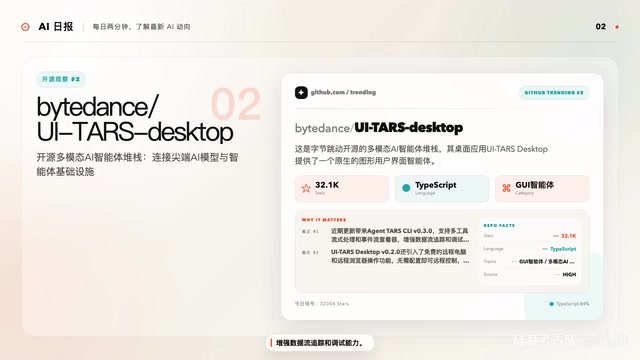
This update transforms UiTARS Desktop from a purely local desktop agent into a full-scenario AI assistant with remote control capabilities, dramatically expanding its application scope.
Cloak Browser: Source-Level Stealth Automation Browser
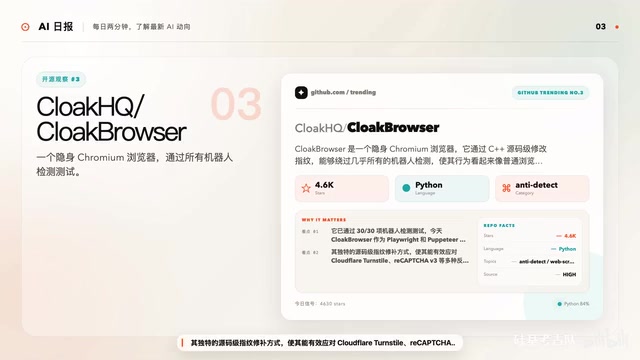
Cloak Browser is a stealth Chromium browser that modifies fingerprints through C++ source-level modifications, capable of bypassing virtually all bot detection. It has passed 30/30 bot detection tests and serves as a direct replacement for Playwright and Puppeteer, providing developers with powerful stealth automation capabilities.
Technical Background: The Fundamental Difference Between Browser Fingerprinting & Source-Level Modification Browser fingerprinting generates a unique device identifier by combining dozens of attributes including Canvas rendering characteristics, WebGL parameters, font lists, hardware concurrency, and audio processing features—modern detection systems can cross-validate data across hundreds of dimensions. Traditional anti-detection solutions override properties of objects like
navigatorandscreenthrough JavaScript Hooks, but modern detection systems like Cloudflare Bot Management and DataDome can now identify the existence of Hook behavior itself—because legitimate browsers don't intercept their own APIs. Cloak Browser directly modifies underlying return values at the Chromium C++ rendering engine layer, fundamentally eliminating detectable Hook traces, which is the core reason it can pass all 30 tests.
Its unique source-level fingerprint patching approach effectively handles various anti-scraping mechanisms including Cloudflare Turnstile and reCAPTCHA V3. Compared to traditional browser fingerprint spoofing solutions, source-level modification fundamentally solves detection issues rather than simply overriding JavaScript properties.
ERNIE 5.1 Released: Pre-training Cost Reduced to 6% of Industry Average
Baidu officially launched its next-generation foundation model ERNIE 5.1, employing innovative multi-dimensional elastic pre-training technology to achieve a remarkable balance between performance and cost.
Key Performance Metrics
- Pre-training Cost: Reduced to approximately 6% of industry models at the same scale, representing an extremely significant cost advantage
- LMARENA Ranking: Scored 1223 points, ranking first domestically and fourth globally on the search leaderboard
- Unique Position: The only Chinese-developed model among the top rankings

Technical Background: Pre-training Cost Compression & LMARENA Evaluation Mechanism The main components of large model pre-training costs are GPU compute consumption (typically exceeding 70%) and data processing overhead. Compressing costs to 6% of industry standards typically requires coordinated innovation across multiple dimensions: adopting Mixture of Experts (MoE) at the model architecture level to reduce active parameter count, reducing ineffective computation through high-quality data filtering at the data level, and optimizing distributed training communication efficiency and mixed-precision training strategies at the engineering level. LMARENA (formerly LMSYS Chatbot Arena) is a large model capability evaluation platform initiated by UC Berkeley, using a human blind-test battle mechanism—users vote on responses from two models without knowing their identities, with final rankings calculated through an Elo scoring system. Because it eliminates benchmark overfitting issues, it is widely recognized by academia and industry as one of the most credible evaluation methods.
The 6% pre-training cost figure is particularly striking, indicating that Baidu has achieved an order-of-magnitude breakthrough in training efficiency, which will have far-reaching implications for the cost structure of the entire industry. ERNIE 5.1 is now fully available on Baidu's Qianfan Model Plaza and the ERNIE Bot official website, open for enterprise and developer experience.
Anthropic NLA Technology: Making AI Internal Thinking Transparent and Readable
Anthropic released a breakthrough Natural Language Autoencoder (NLA) technology that can directly convert Claude's internal numerical activations into human-readable text. This innovation makes AI's "thinking process" transparent and readable for the first time.
Related articles
 Tech Frontiers
A Rare Quiet Day in AI: Recursive Self-Improvement Stirs Beneath the Surface
A rare quiet day in AI sees multiple sources go silent simultaneously. Behind the calm, Recursive Self-Improvement (RSI) research continues. What this means for the industry.
 Tech Frontiers
Reve 2 vs. Ideogram 4: A Deep Dive into Layout Control in AI Image Generation
A deep comparison of Reve 2 and Ideogram 4's layout control capabilities, covering technical approaches, real-world use cases, and industry trends for designers and creators.
 Tech Frontiers
In the Weights: Check Your Influence Score in the AI World
In the Weights is an AI influence search engine that quantifies your presence in the AI world with a score. Explore how it evaluates practitioners and what it means for digital identity.