AI Coding Tools Locking You to Models? How Developers Can Avoid Lock-in

AI coding tool ecosystems show soft lock-in, and developers must weigh official experience against third-party flexibility.
Starting from a Reddit developer's question, the article explores whether AI coding tools lock users into vendor ecosystems. The core point is: models such as Claude can be used in third-party tools through APIs, but official tools form a "soft lock-in" through advantages in latency, context management, and first release of features. Model-agnostic tools like OpenCode offer switching flexibility but face incomplete support for advanced features, billing differences, and update lag. Developers therefore adopt hybrid strategies: official tools as the main choice with API backup, or insisting on open-source tools in exchange for control. The deeper reason for ecosystem fragmentation is that vendors use official tools to collect telemetry data to optimize models and achieve differentiated competition. In the short term, official and third-party tools will coexist, and API standardization and open-source catching up will gradually improve the model-agnostic experience.
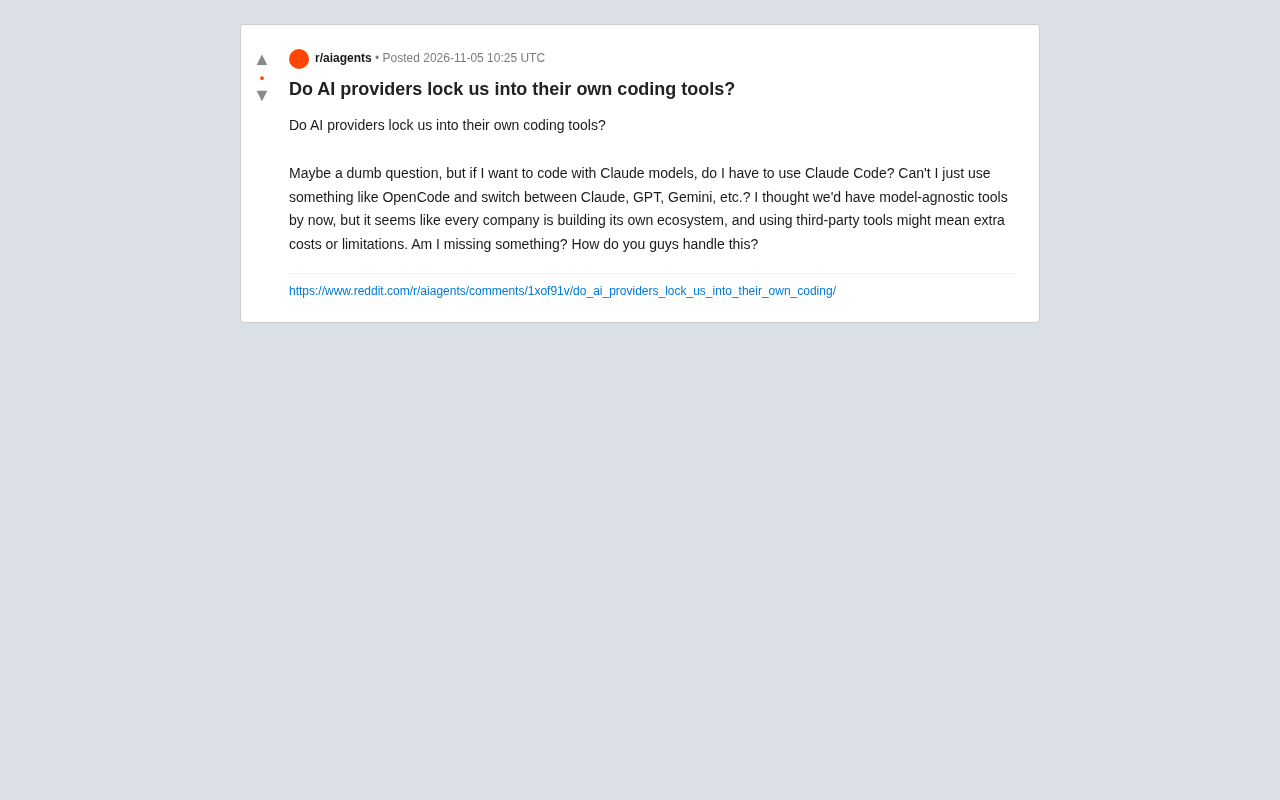
A developer's question on Reddit struck a chord: if I want to write code with the Claude model, do I have to use Claude Code? Can I use tools like OpenCode to switch freely between different models? This question touches on the core contradiction in the current AI coding tool ecosystem—we assumed there would be model-agnostic tools, but the reality is that every company is building its own closed loop.
The Phenomenon of Model-Tool Binding
On the surface, the Claude model does not force you to use Claude Code. Through the API, you can absolutely call Claude from any editor or third-party tool. But the problem is that official tools often deliver the best experience: lower latency, more complete context management, earlier feature updates. This "soft lock-in" puts developers in a dilemma—using third-party tools may mean extra costs or feature limitations.
The Reddit user mentioned that he originally expected model-agnostic coding tools to already exist on the market, but the reality is that every AI company is building its own ecosystem. Anthropic pushes Claude Code, OpenAI has the Codex series, and Google builds its toolchain around Gemini. This trend complicates the ideal of "freely switching models."
Soft Lock-in is a common strategy in software ecosystems: vendors do not force users to use their products through technical means, but rather make users "voluntarily" stay through experience optimization, exclusive features, or cost advantages. In the AI coding tool space, soft lock-in manifests as deep integration between official tools and their own models—for example, lower inference latency (because the internal call chain is shorter), more complete context window management (official tools may be specially optimized for model characteristics), and priority first release of new features (such as extended thinking mode). This kind of lock-in is not as binding as a hard contract, but the migration cost is real—developers need to weigh whether giving up these advantages is worth it. Compared with traditional vendor lock-in (such as proprietary file formats), soft lock-in is more subtle and harder to solve through simple API standardization.
The Survival Space for Third-Party Tools
Tools like OpenCode do exist, and they attempt to provide a model-agnostic coding experience. You can configure different API keys and switch between Claude, GPT, and Gemini. But in actual use, developers often encounter several problems: first, some advanced features of certain models (such as extended thinking mode) are not fully supported in third-party tools; second, billing methods may differ, and official subscriptions are often more cost-effective than API calls; third, updates lag, and new features of official tools take time to be adapted by third parties.
However, third-party tools also have unique advantages. They are usually lighter and can be integrated into the editor you are used to, avoiding being bound to a single vendor's interface. For developers who need to frequently compare outputs from different models, this flexibility is very valuable.
Extended Thinking is a capability introduced by Anthropic for the Claude model that allows the model to perform a longer internal reasoning chain before giving a final answer, thereby improving accuracy on complex coding tasks (such as debugging and architecture design). This mode is usually controlled through API parameters (such as the thinking budget), but third-party tools need explicit adaptation to pass these parameters and parse the returned thinking content. Similarly, OpenAI's reasoning models also have an independent "reasoning effort" parameter. These advanced features are not fully supported by all third-party tools, because their API wrapper layers may not have kept up in time, or the tool's own design assumptions (such as only handling final output) are incompatible with the return structure of thinking mode. For coding scenarios that rely on deep reasoning, this lack may significantly affect the experience.
Developers' Practical Response Strategies
From community discussions, developers have gradually formed several patterns. Some choose "primary tool + API backup": use official tools daily to enjoy the best experience, and call other models through the API for specific tasks. Others insist on using third-party open-source tools, accepting imperfect features in exchange for full control. Still other developers adopt a hybrid approach—using official tools for prototyping and third-party tools for integration.
The key is to recognize your own priority needs. If you deeply rely on the unique capabilities of a certain model, official tools may be the most worry-free choice; if you need cross-model comparison or want to avoid vendor lock-in, third-party tools are worth the learning cost.
The Deeper Reasons for Ecosystem Fragmentation
AI companies promoting their own tools is not simply about locking in users. Coding tools are an important channel for collecting feedback and optimizing models. Official tools can provide more direct telemetry data to help improve model performance on coding tasks. At the same time, the tool layer is also key to differentiated competition—with the same model, different context management strategies bring completely different coding experiences.
But this strategy does indeed cause trouble for developers. Model capabilities are rapidly converging, but fragmentation at the tool layer may become a new friction point. Ideally, models should be like databases, callable by any tool through standard interfaces. The reality is that although各家 APIs are similar, there are always differences in details, increasing adaptation costs.
Telemetry refers to usage data automatically collected by tools during operation, such as request frequency, context length, error types, and the proportion of user adoption of suggestions. For AI companies, official coding tools are ideal channels for obtaining high-quality telemetry data: these data directly reflect model performance in real coding tasks and can be used for reinforcement learning fine-tuning, prompt optimization, and product roadmap formulation. Although third-party tools can also generate data through API calls, the granularity available to vendors is coarser (usually only requests and responses), lacking interaction details at the tool layer (such as how users edit model output). Therefore, official tools are not only carriers of user experience but also the data flywheel for model iteration. This also explains why vendors are motivated to deploy the latest features in their own tools first, forming a positive feedback loop.
Will It Move Toward Openness in the Future
In the short term, the coexistence of official tools and third-party tools will not change. But with the advancement of model API standardization and open-source tools catching up on advanced features, the model-agnostic coding experience will gradually improve. For developers, maintaining flexibility at the tool layer while focusing on the actual differences in model capabilities is more meaningful than agonizing over "whether I am locked in."
The Reddit user's confusion is very representative: what we want is not a specific tool, but the right to choose freely. Before the ecosystem matures, actively managing your tool portfolio may be the most pragmatic strategy at present.
One-line Summary
AI coding tool ecosystems show soft lock-in, and developers must weigh official experience against third-party flexibility.
Paragraph Summary
The article starts from a Reddit developer's question and explores whether AI coding tools lock users into vendor ecosystems. The core point is: models such as Claude can be used in third-party tools through APIs, but official tools form a "soft lock-in" through advantages in latency, context management, and first release of features. Model-agnostic tools such as OpenCode provide switching flexibility, but face incomplete support for advanced features, billing differences, and update lag. Developers therefore adopt hybrid strategies: official tools as the main choice with API backup, or insisting on open-source tools in exchange for control. The deeper reason for ecosystem fragmentation is that vendors use official tools to collect telemetry data to optimize models and achieve differentiated competition. In the short term, official and third-party tools will coexist, and API standardization and open-source catching up will gradually improve the model-agnostic experience.
Related articles
 Tech Frontiers
Google Omni 1.2 Flash: 15-Second AI Video at Just $0.07 per Second
Google DeepMind releases Gemini Omni 1.2 Flash: 15-second video, 720p at $0.07/sec (30% cheaper), multi-turn editing without regeneration, draft upscaling to 4K.
 Tech Frontiers
No AI Ghostwriting: Writer's Quarter Reinvents Novel Writing with a Visual Workbench
The Writer's Quarter is an AI-free novel writing and planning tool that unifies character building, story planning, and manuscript writing in one visual workbench. This article analyzes its positioning, target users, and differentiated value amid the rise of AI writing tools.
 Tech Frontiers
Fleeep: A Unified Inspiration Collection Notes App for Creatives
Fleeep is a notes app for creatives that unifies screenshots, bookmarks, saved posts, and inspiration into one calm, cross-device, offline-capable space. This article analyzes its positioning, differentiation, and target users.