No AI Ghostwriting: Writer's Quarter Reinvents Novel Writing with a Visual Workbench
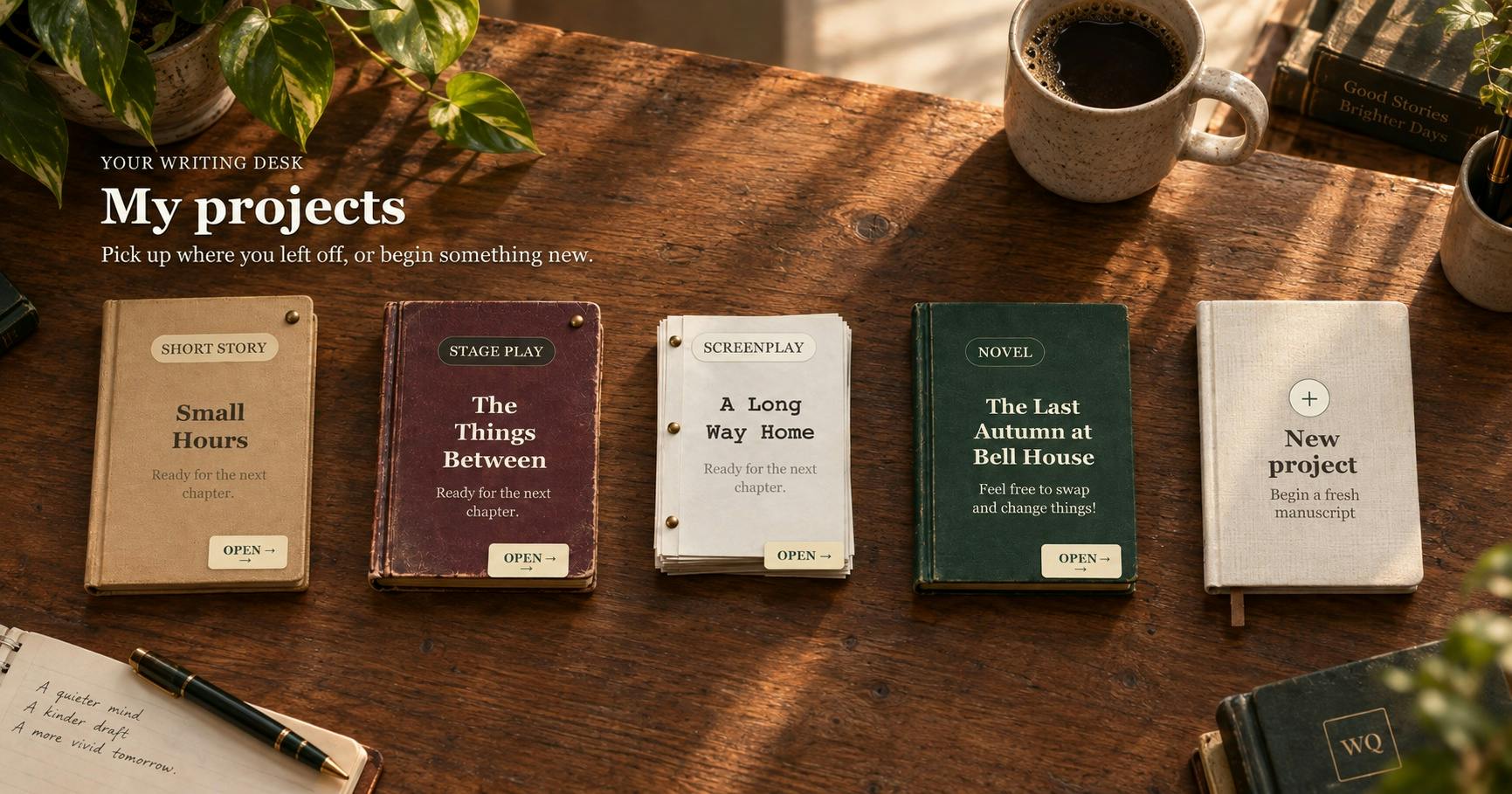
An explicitly AI-free novel writing and planning tool differentiated by structure and visualization.
The Writer's Quarter is a novel writing and planning tool independently developed by Lucy Bond, tagged "AI-Free Writing & Novel Planning Software" on Product Hunt with 77 upvotes, 5 comments, and a rank of 8th. It combines character building, story planning, and manuscript writing in one calm visual workbench, solving not "can't write" but "writing too scattered." The article views "AI-Free" as a deliberate stance—giving up generative features for authorial control and an uninterrupted environment, targeting authors with established habits rather than those seeking rapid drafts.
While writing software rushes to advertise "AI continuation" and "one-click outline generation" as selling points, a product on Product Hunt is doing the opposite—The Writer's Quarter. Its tagline is blunt to the point of provocation: AI-Free Writing & Novel Planning Software. At a moment when AI is permeating every creative tool, a novel writing and planning tool that explicitly declares itself "AI-free" is itself a noteworthy signal.
A writing tool that "doesn't generate"
The Writer's Quarter's positioning is clear: write your manuscript, build characters, and connect every part of your story in one calm, visual space. The keywords that recur throughout the official description are calm and visual—which is itself a statement of attitude toward today's writing software.
The problem it aims to solve isn't "I can't write" but "my writing is too scattered." The real difficulty in long-form fiction often isn't sentence-level expression but the mutual constraints among character relationships, timelines, setting details, and chapter structure. The traditional approach is to use tools like Scrivener plus a pile of external documents, or to build your own structure in a general-purpose note-taking app. The Writer's Quarter tries to put "manuscript writing" and "story planning" in the same workbench, so that character cards, plot threads, and the main text no longer live in separate places.
The product is independently developed by Lucy Bond and currently has 77 upvotes and 5 comments on Product Hunt, ranking 8th and categorized under Productivity, Writing, and Text Editors. That's hardly a breakout result, but for a clearly vertical tool, it already shows that a group of writers is actively looking for this kind of solution.
Scrivener is a long-form writing tool developed by Literature & Latte, popular among fiction and nonfiction authors for years. Its core design is the "Binder": organizing chapters, scenes, notes, and character materials into a tree structure, with the main text and source material living in the same project file rather than scattered across multiple Word documents. It also offers split-screen reference, snapshot versions, and compile-and-export features geared toward long-form projects. The article mentions Scrivener as an established representative of "structured writing tools"—the comparison benchmark The Writer's Quarter faces is exactly this type of product. Both address the problem of "manuscript and materials separated"; the difference is that the latter emphasizes a more visual connection view, while Scrivener leans more toward folder-style hierarchical management.
"AI-Free" isn't a technical limitation—it's a product stance
What really makes this product worth discussing is the "AI-Free" label.
Nearly all mainstream writing software today is moving toward generation: helping you continue paragraphs, generating character backstories, expanding chapters from an outline. These features do lower the barrier to entry, but they come with a side effect—the creative process gets split into "prompt input" and "result filtering," and the author's sense of control over the text is diluted. For those writing long-form fiction, stylistic consistency and continuity of character voice are precisely the parts that can least afford to be generated.
According to the Product Hunt description, The Writer's Quarter treats "AI-free" as a core selling point rather than a supplementary note, meaning it has deliberately abandoned the generative-feature track and instead gone deep on structure and visualization. This trade-off has a cost: it won't help you think up plot, and it won't write dialogue for you. But it buys something else—a quiet environment that doesn't interrupt your train of thought or stuff suggestions into your manuscript.
Who it's for, and who it isn't
This tool clearly isn't aimed at the "zero-basics, rapid-draft" crowd. It's closer to authors who already have writing habits and are dealing with complex story structures: those who need to manage multi-character, multi-thread, long-cycle projects and don't want to outsource creative decisions to a model.
Conversely, if what you expect is "type one sentence, get a chapter," The Writer's Quarter's value will be very limited. Its positioning is a structuring tool, not a content generator.
In the context of AI writing tools, "continuation" usually means the model reads the text before the cursor as context and generates subsequent paragraphs in the author's style; "expansion" means giving outline points or a single sentence and having the model generate paragraph-length main text. These features rely on a large language model's probabilistic prediction of context; their output is locally fluent, but stylistic consistency and character-voice stability across chapters are hard to guarantee, and the author must filter and rewrite segment by segment. The article's point that "the creative process gets split into prompt input and result filtering" refers precisely to how this interaction changes the rhythm of writing: the author goes from continuous writer to instruction issuer and result reviewer.
Visual planning: reconnecting a scattered story
Judging from the product description, "keeping every part of the story connected" is the design throughline. This aligns with a trend in writing tools in recent years: what authors lack isn't a text editor but a view that aligns character motivations, event causality, and chapter pacing.
Putting character cards and the manuscript in the same space has a real impact on the revision stage. When adjusting a subplot after the first draft, if character settings, foreshadowing notes, and the main text are scattered across different files, the cost of change is high; in a unified workbench, structural adjustments can map directly to the relevant passages. The official description summarizes this as "one calm, visual workspace," emphasizing reduced context switching rather than more features.
It should be noted that currently available public information stays at the product-positioning level; specific interface details, data model, and export capabilities require actual use to assess. From the Product Hunt page alone, it's impossible to confirm the extent to which it delivers on the "fully connected" promise.
Another way for an independent tool to survive
The Writer's Quarter is developed by a single person, which isn't unusual in the writing-tool space—Scrivener and Ulysses were also early small-team or even solo works. The moat of a vertical writing tool often isn't technology but whether the developer truly understands the pain points of long-form writing. By putting "AI-free" in the tagline, Lucy Bond is herself performing a target-user filter: it doesn't chase the lowest common denominator but gathers people who share this view of creation.
The figures of 77 upvotes and 5 comments also remind us that such tools are unlikely to become mass-market products in the short term. But user loyalty in writing software has always been high: once a tool is embedded in an author's workflow, switching costs become very substantial. For independent developers, this may be more reliable than chasing hype.
Conclusion
The value of The Writer's Quarter isn't in what new features it adds but in the boundary it clearly draws: which parts of novel writing can be tooled, and which should be left to the author. At a time when AI writing features have become standard, this choice is itself a form of differentiation. Whether it's actually good still needs time to tell, but the need for "a quiet, structured, non-ghostwriting creative space" has indeed been neglected for a long time.
One-line Summary
A novel writing and planning tool that explicitly champions being AI-free, differentiating itself through structure and visualization.
Paragraph Summary
The Writer's Quarter is a novel writing and planning tool independently developed by Lucy Bond. On Product Hunt it uses the tagline "AI-Free Writing & Novel Planning Software," with 77 upvotes, 5 comments, and a rank of 8th. It puts character building, story planning, and manuscript writing into one calm, visual workbench, addressing not "I can't write" but "my writing is too scattered"—in long-form creation, character relationships, timelines, settings, and chapter structure constrain one another, traditionally patched together with Scrivener plus external documents. The article argues that "AI-Free" is a deliberate product stance: giving up generative features like continuation and expansion in exchange for the author's sense of control over the text and an uninterrupted writing environment. Its target users are authors with established writing habits who handle complex structures, not those seeking rapid drafts.
Related articles
 Tech Frontiers
Stylome Bot Slammed as Useless Junk: Why Do AI Detection Tools Keep Failing?
Reddit users test the Stylome AI detection bot: Gemini-rewritten text judged human-written, consistently low confidence. An analysis of AI text detection's technical dilemmas, privacy concerns, and credibility crisis in community governance.
 Tech Frontiers
When AI Becomes a Productivity Divide: Clarity or "AI Psychosis"?
A civil engineer's deep use of agentic AI boosted efficiency but bred contempt for peers who refuse to learn. Is this clarity or AI psychosis? An analysis of the cognitive and psychological challenges behind the AI productivity divide.
 Tech Frontiers
Opus 5.5 Benchmark Scores Climb, Community Says Its "Weights Are Blessed"
Reddit community discusses Opus 5.5's rising scores on the Benchmaxxing Bench, with users describing its performance as "weights are blessed." This article interprets the community reaction and cautions against conflating benchmark scores with real capability.