AI Companion Tolan Secures $30M Funding, Surpasses 250K Monthly Active Users

AI companion app Tolan raises $30M, surpasses 250K active users, targeting the life companionship sector.
AI companion app Tolan has announced a new $30 million funding round, with active users surpassing 250,000, providing data evidence of real demand for "emotional companionship" AI. Unlike mainstream AI tools pursuing productivity, Tolan positions itself as a conversational partner helping users "navigate life," focusing on emotional organization and a sense of direction in life. The article notes that the competitive moat in this sector lies not in the underlying model but in memory mechanisms, persona settings, conversation pacing, and boundary control, with the conversational relationship accumulated between users and AI constituting switching costs. The funding will most likely go toward product iteration and user growth. At the same time, companionship products still face weaker willingness to pay than productivity tools, the question of whether subscription unit economics can work, and ethical and safety boundary issues arising from emotional dependence.
The AI companion sector has another major funding round. Tolan—an AI companion app focused on "helping users navigate life"—has announced a new $30 million funding round, with active users surpassing 250,000. At a time when AI tools generally pursue productivity and efficiency, Tolan has chosen a path closer to emotional and everyday companionship.
Funding and User Data: A Validated Demand
According to the original report, Tolan raised $30 million in this round, with active users exceeding 250,000. For an AI companion app, this number shows that "companionship" is not a false need, but one with a real foundation for user retention.
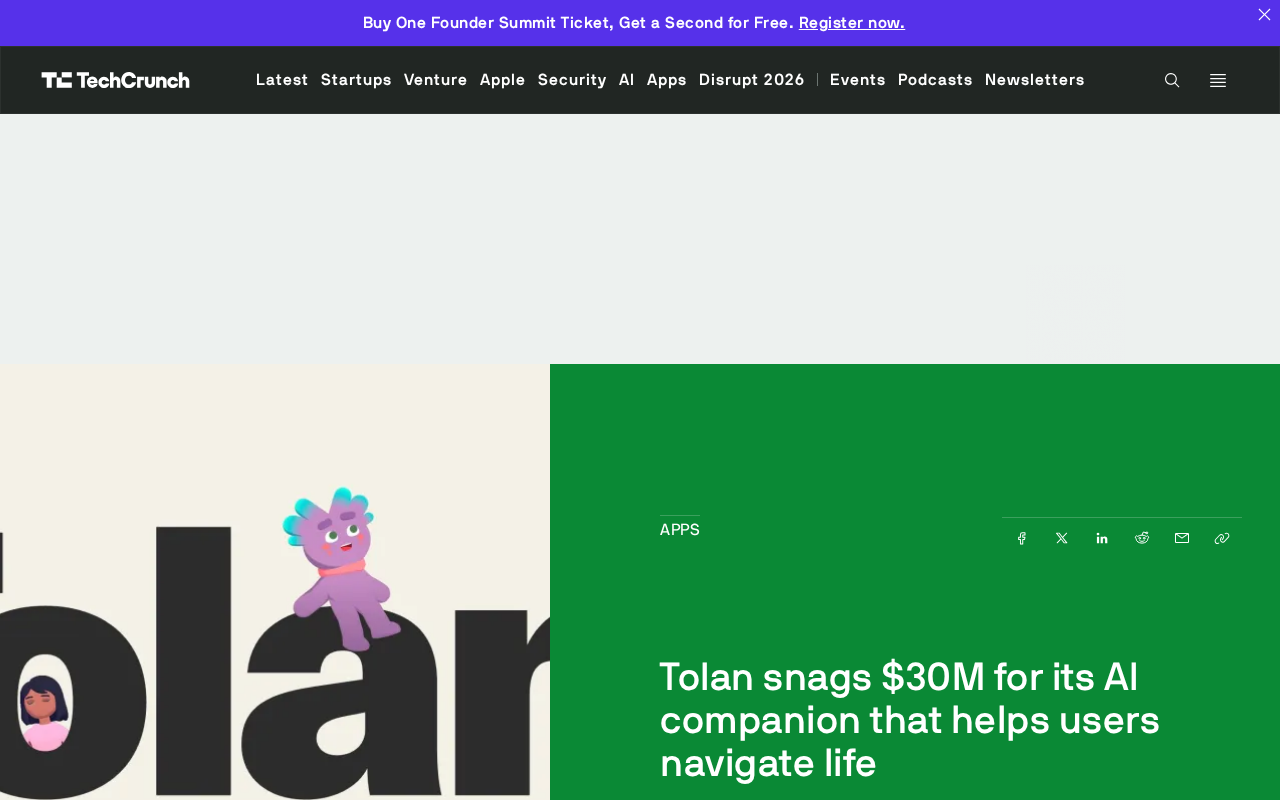
The significance of 250,000 active users is that it is no longer the brief curiosity of early adopters. AI companion products have long been questioned for "churning after the novelty wears off," and Tolan's ability to accumulate active users at this scale at least shows that its product mechanics are consistently retaining people. The willingness of investors to double down at this stage also reflects the capital market's reassessment of the "AI + emotional companionship" direction.
Product Positioning: Not an Efficiency Tool, but a Life Navigator
Tolan's core proposition is to help users "navigate life"—to sort out their sense of direction and emotions in life. This creates a clear distinction from the many AI products on the market focused on writing, coding, and office automation.
It is closer to a companion you can converse with, confide in, and that can help you organize chaotic thoughts clearly, rather than a tool that executes instructions. The difficulty of such products lies not in model capability, but in product design: how to keep conversations from degenerating into mechanical Q&A, how to sustain users' willingness to converse, and how to find a balance between being "useful" and "warm." Tolan's ability to reach 250,000 active users shows that it has found its own solutions to these details.
The Competitive Logic of the AI Companion Sector
AI companionship is not a new concept, but few products have truly achieved user scale. The competitive moat in this sector rarely comes from the underlying model itself—most teams use similar base capabilities. Differentiation lies in memory mechanisms, persona settings, conversation pacing, and boundary control.
Users are extremely sensitive to the perception of "companionship": a single stiff reply or an ill-timed lecture can make a user abandon the product. Therefore, the real asset of products like Tolan is the conversational relationship and trust accumulated between users and the AI, which is also where switching costs lie. The $30 million in funding will most likely go toward product iteration and user growth rather than model training.
Memory mechanisms are one of the core sources of experiential differentiation in AI companion products. Unlike ordinary conversational AI, where each interaction is approximately "stateless," companion-type products need to persistently store the people, events, preferences, and emotional cues users mention, and proactively recall them in subsequent conversations, thereby creating a sense of continuity that "it remembers me." Common implementations include conversation summary compression, vector retrieval recall, and structured user profile storage. The design challenge of memory lies in trade-offs: remembering too much feels intrusive and produces false associations, while remembering too little degrades into stranger-like conversations. Therefore, memory mechanisms are not only a technical issue but also directly determine the persona consistency of the product and the speed at which user trust accumulates.
The Dual Test of Monetization and Ethics
Securing funding is only the beginning. AI companion products face two unavoidable issues.
First, the monetization path. Willingness to pay for companionship products is typically weaker than for productivity tools; whether a subscription model can support a healthy unit economic model requires both user scale and retention rates to meet standards. 250,000 active users is a good starting point, but there is still a distance to规模化 profitability.
Second, ethical and safety boundaries. When users develop emotional dependence on AI, product designers need to bear corresponding responsibilities. How to avoid excessive dependence, how to identify users' negative emotional states, and how to guide users to seek real interpersonal support at critical moments—these are questions such products must answer. These approaches will also gradually become the focus of regulatory and public scrutiny.
Unit Economics refers to calculating the relationship between revenue and costs on a per-user basis, typically focusing on average revenue per user (ARPU), customer acquisition cost (CAC), and lifetime value (LTV). For AI companion products, the cost side also includes the inference compute overhead generated by each conversation, which means that users with high-frequency, deep usage may actually lower gross margins. The key to judging whether a subscription model can work is whether LTV is significantly higher than the sum of CAC and ongoing service costs, and whether the retention curve can stabilize after early churn. Active user scale itself does not equal a healthy model; retention rate and paid conversion rate are the decisive variables.
Final Thoughts
Tolan's funding round is a signal for the AI companion sector: emotionally companionable AI is moving from fringe experimentation to a formal sector with users and capital. Whether it can convert 250,000 active users into a sustainable business model will determine how far this direction can go. For those watching AI applications move into practice, Tolan's next product moves are worth continued observation.
One-line Summary
AI companion app Tolan raises $30M, surpasses 250K active users, targeting the life companionship sector.
Paragraph Summary
AI companion app Tolan has announced a new $30 million funding round, with active users surpassing 250,000, providing data evidence of real demand for "emotional companionship" AI. Unlike mainstream AI tools pursuing productivity, Tolan positions itself as a conversational partner helping users "navigate life," focusing on emotional organization and a sense of direction in life. The article notes that the competitive moat in this sector lies not in the underlying model but in memory mechanisms, persona settings, conversation pacing, and boundary control, with the conversational relationship accumulated between users and AI constituting switching costs. The funding will most likely go toward product iteration and user growth. At the same time, companionship products still face weaker willingness to pay than productivity tools, the question of whether subscription unit economics can work, and ethical and safety boundary issues arising from emotional dependence.
Related articles

When Did Paid Childcare Become the Norm? Working Mothers and the Evolution of Childcare
When did paid childcare become the norm? This article traces the evolution from the rise of childcare centers in the 1970s–80s and the 1990s linking of federal subsidies to work requirements, to declining stigma and rising costs, and explores advocates' 25-year effort to catch up with other countries on childcare and paid parental leave.

Red Flags for Product-Market Fit: A Practical Guide from Top VCs and the Superhuman Founder
Investors from Iconiq and Sapphire Ventures and Superhuman founder Rahul Vohra share PMF red flags and practical methods, including the 40% disappointment rule, retention curves, and acquisition costs.

What Task Should AI Agents Take Over Most? Heated Reddit Discussion
Reddit discussion: Which task do you most want AI agents to take over completely? Cross-app data migration, CRM updates, and report generation top the list, but insufficient reliability and the trust gap are the biggest obstacles to automation adoption.