What Task Should AI Agents Take Over Most? Heated Reddit Discussion

AI agent adoption bottleneck isn't capability but reliability—trust is the last mile of automation.
Starting from a Reddit question, the article outlines the repetitive tasks users most want AI agents to handle, including cross-website research, cross-app data migration, CRM updates, and report generation. These tasks have clear rules but involve multiple tools and interfaces, which traditional RPA struggles to cover, while agents' understanding and adaptability can fill the gap. The real obstacle is trust: agents are error-prone in multi-step tasks, lack explainability, have weak exception handling, and raise security concerns when operating sensitive systems. The article proposes four evolution directions—observability and human intervention, self-correction and exception recovery, least privilege and audit trails, and domain-specific optimization—concluding that trust, not capability, is the key bottleneck.
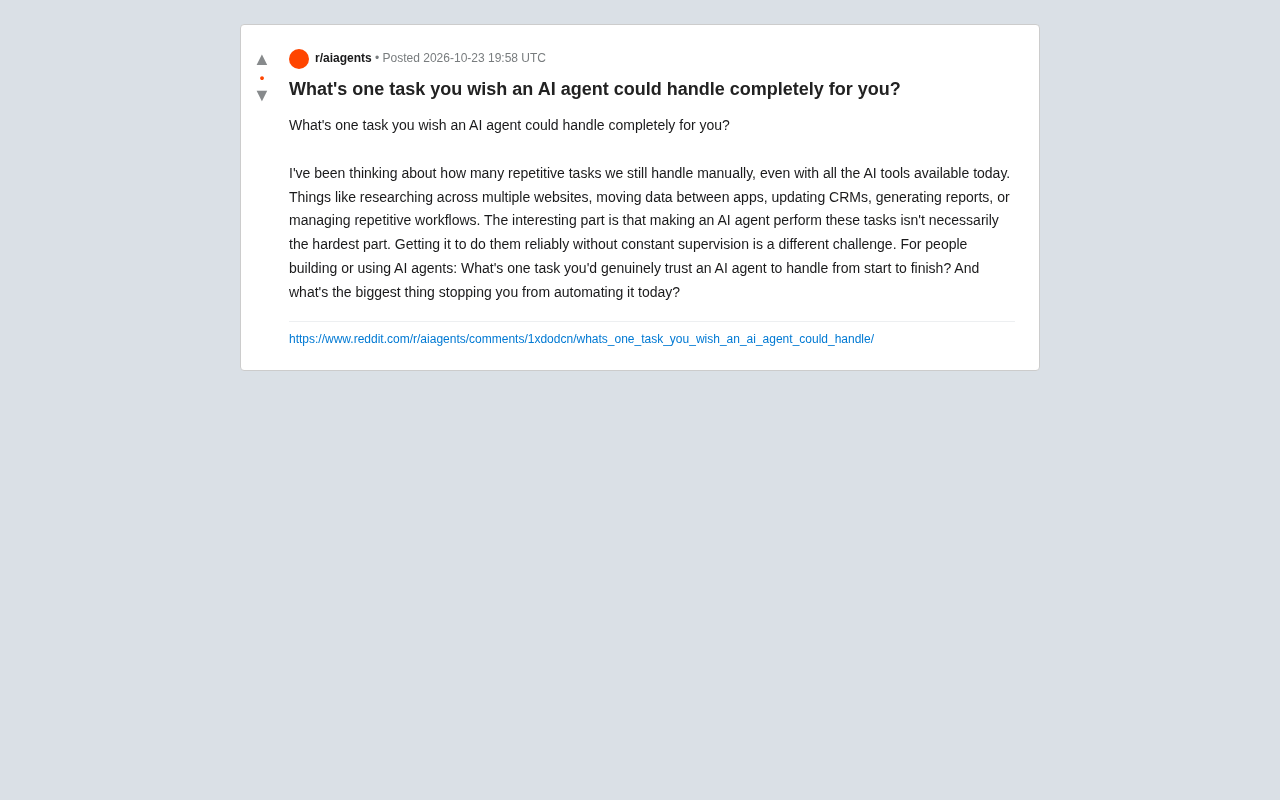
In today's world of endless AI tools, we still manually handle a massive amount of repetitive work. A Reddit user's question struck a chord with many: What task do you wish an AI agent could handle completely for you? This seemingly simple question touches on the core contradiction of current AI adoption—getting AI to execute tasks isn't hard; making it run reliably from start to finish without supervision is.
Repetitive Tasks: The Ideal Prey for AI Agents
According to the discussion, the tasks users most want AI to take over center on moving information and managing processes across apps and websites. Typical scenarios include:
- Research across multiple websites: Automatically collect, compare, and summarize information, eliminating the hassle of manually switching tabs.
- Data migration between apps: For example, syncing data from one system to another to avoid copy-pasting.
- CRM updates and maintenance: Automatically entering customer information and updating deal statuses, reducing salespeople's administrative burden.
- Report generation: Pulling data from multiple sources and generating weekly or monthly reports based on templates.
- Repetitive workflow management: Operations with clear rules but high frequency, such as approval routing and notification sending.
What these tasks share is that the rules are relatively clear and the steps fixed, but they involve multiple tools and interfaces. They consume a lot of time yet are hard to perfectly cover with traditional RPA (Robotic Process Automation), because interfaces and data structures change frequently. AI agents' understanding and adaptability fill exactly this gap.
RPA (Robotic Process Automation) is a software technology that simulates human clicks, inputs, copy-pasting, and other operations on graphical interfaces through scripts or visual workflow orchestration to execute repetitive tasks. It excels in scenarios with fixed rules and stable interfaces, such as batch form entry or scheduled report exports. But traditional RPA relies on precise positioning of interface elements—once a webpage is redesigned, button positions change, or a CAPTCHA pops up, the process breaks down. AI agents introduce natural language understanding and dynamic planning capabilities, allowing them to "understand" interface semantics and try alternative paths when steps fail, and are thus seen as the evolution of RPA. However, agents also carry higher uncertainty, and the two are often used together: RPA ensures stability in deterministic steps, while agents handle flexible steps requiring judgment.
The Trust Gap: Why We're Afraid to Let Go Completely
The questioner specifically highlighted a key point: Getting an AI agent to execute a task isn't the hardest part—making it run reliably without constant supervision is. This explains why many people remain hesitant about automation.
The obstacles reflected in the discussion include:
- Insufficient reliability: Agents may make errors in multi-step tasks, and errors are hard to predict, forcing users to watch over the entire process.
- Lack of explainability: When agents make decisions, users don't understand why a particular action was chosen, making trust hard to build.
- Weak exception handling: When encountering unexpected situations like webpage redesigns, pop-ups, or CAPTCHAs, agents easily get stuck and require human intervention.
- Security and permission concerns: Letting AI directly operate sensitive systems like CRMs and email carries risks of data leaks or misoperations.
These concerns are not unfounded. Most current AI agents perform impressively in demo environments, but in real production environments, the failure rate of long-chain tasks rises significantly. What users need is not the showmanship of "what it can do" but the certainty of "getting it right every time."
From "Usable" to "Dare to Use": The Key to Agent Adoption
To bridge the trust gap, AI agents need to keep evolving in several directions:
1. Observability and intervention mechanisms
Agents should provide clear task execution logs, letting users view progress at any time, roll back operations, and request confirmation at key checkpoints. This is similar to the L2/L3 levels of autonomous driving—dynamically adjusting the degree of human intervention based on task risk.
2. Self-correction and exception recovery
When encountering page structure changes or API errors, agents should be able to try alternative paths, or at least pause gracefully and notify the user rather than fail silently. This requires stronger environmental awareness and planning capabilities.
3. Least privilege and audit trails
Grant only the minimum permissions necessary to complete the task and record all operations, both reducing risk and providing a basis for post-hoc auditing.
4. Domain-specific reliability optimization
General-purpose agents are often less reliable in specific scenarios than specialized agents deeply optimized for that scenario. For example, an agent focused on CRM data entry can have built-in handling for common field mappings and deduplication rules, improving accuracy.
Observability originates from the field of distributed systems operations and refers to the ability to infer a system's internal state from its external outputs through logs, metrics, and traces. For AI agents, observability means users can see in real time which steps it executed, which tools it called, where it made judgments, and why. Without observability, an agent is like a black box: after a task fails, users cannot determine whether it was due to misunderstanding, incorrect tool calls, or environmental changes. In practice, this is often achieved through structured execution traces, snapshots of inputs and outputs at each step, and natural language explanations. It complements "human intervention"—only by first seeing what the agent is doing can users effectively take over or roll back at key checkpoints.
The Principle of Least Privilege is a foundational principle in information security: any entity should be granted only the minimum access permissions necessary to complete its task, and only for the necessary duration. Applying this principle to AI agents is particularly important because agents typically need to operate across systems; if they directly inherit the user's full account permissions, the damage from prompt injection attacks or misoperations will be amplified. Feasible practices include creating dedicated service accounts for agents, dynamically requesting temporary credentials per task, setting whitelists and rate limits for write operations, and maintaining complete operation audit logs. This both limits the potential blast radius and provides a basis for accountability and compliance review.
Conclusion: Trust Is the Last Bottleneck of Automation
This discussion on Reddit reveals a simple fact: People long for AI to take over repetitive labor but are unwilling to pay the price of losing control. Technical capability is no longer the only bottleneck—reliability, transparency, and security are the key factors determining whether agents can truly integrate into daily work. For builders, rather than pursuing how many tasks an agent can complete, it's better to first ensure it performs flawlessly on a few tasks. After all, a trustworthy agent is far more valuable than a feature-rich one that frequently errs.
One-line Summary
AI agent adoption bottleneck isn't capability but reliability—trust is the last mile of automation.
Paragraph Summary
The article starts from a Reddit user's question and outlines the repetitive tasks users most want AI agents to take over, including cross-website research, cross-app data migration, CRM updates, and report generation. These tasks have clear rules but involve multiple tools and interfaces, making them hard for traditional RPA to cover perfectly, while agents' understanding and adaptability can fill the gap. However, the real obstacle is trust: agents are error-prone in multi-step tasks, lack explainability, have weak exception handling, and raise security concerns when operating sensitive systems. Based on this, the article proposes four evolution directions—observability and human intervention mechanisms, self-correction and exception recovery, least privilege and audit trails, and domain-specific optimization—concluding that trust, not capability, is the key bottleneck for agents to integrate into daily work.
Related articles

AI Digital Twin in Action: Using DOT to Automatically Track Bugs and User Feedback
DOTS engineers demonstrate how AI digital twin DOT collects cross-platform user feedback, categorizes issue themes, opens threads to investigate bug root causes, and submits PRs—showcasing a complete AI agent workflow for defect triage with auditable design.

Why Transistors Are No Longer Flat: The Evolution from Planar to Gate-All-Around
Transistor evolution from planar to FinFET to gate-all-around: why gates went from three-sided to four-sided wrapping to suppress short-channel effects and leakage current, extending Moore's Law.

Swarm Intelligence = a Single RL Agent? A Proof of Multi-Armed Bandit Equivalence
A paper proves that collective decision-making through local imitation in swarms is mathematically equivalent to single-agent reinforcement learning: N blind imitators act as N parallel environment samples, with an effective learning rate of 1/N. This article explains the derivation and implications of the Maynard-Cross Learning algorithm.