AI Cosmos: Situated Learning Through Agentic Infrastructure

AI Cosmos uses situated learning agentic infrastructure to move models into a supporting role, enhancing learning gains and transfer ability.
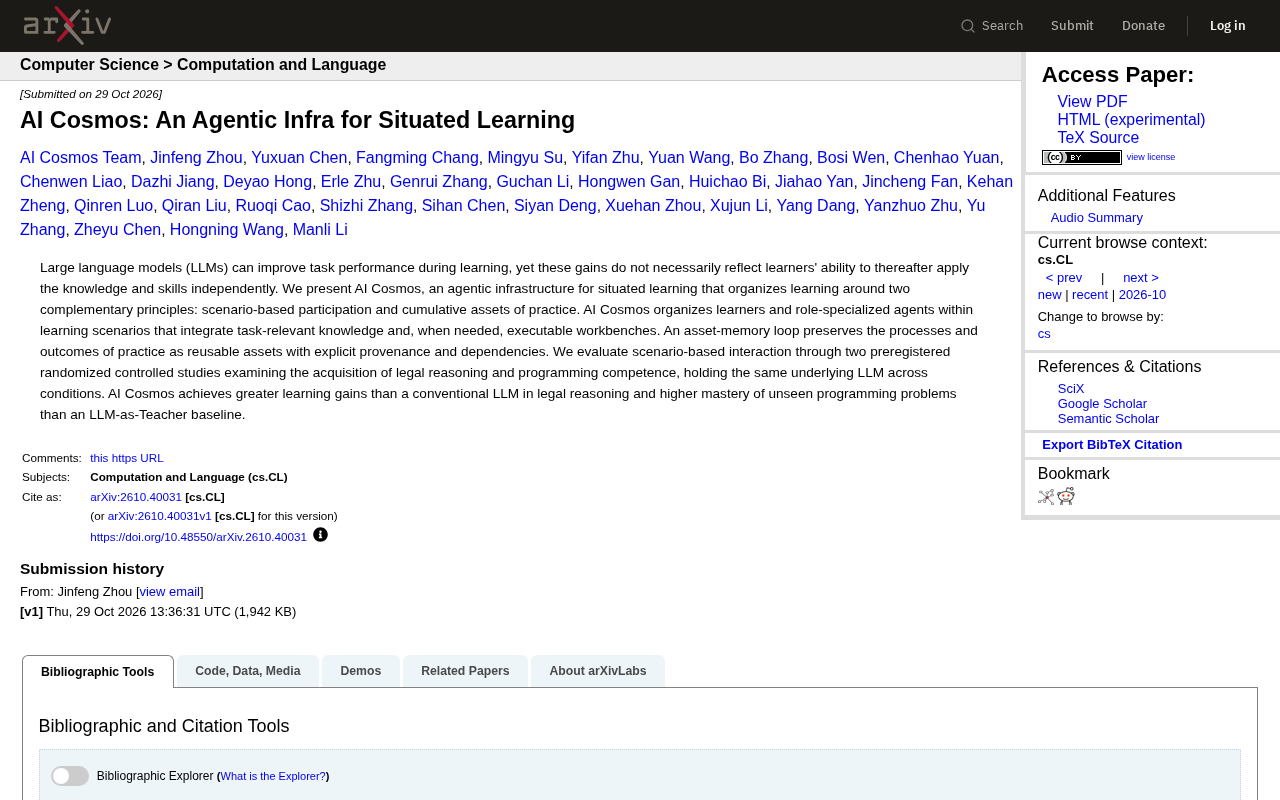
This article introduces research on AI Cosmos, which addresses a core contradiction in AI education: LLMs can improve task performance but do not necessarily translate into learners' independent application of knowledge. AI Cosmos builds agentic infrastructure around scenario-based participation and cumulative practice assets, using an asset-memory loop to preserve practice outcomes as reusable assets with provenance. Two preregistered RCTs show AI Cosmos achieves greater learning gains than conventional LLMs in legal reasoning and superior transfer over the LLM-as-Teacher baseline on unseen programming problems. The article argues for redesigning learner-model collaboration rather than optimizing model explanations.
Large language models can improve task performance, but that improvement does not necessarily translate into learners' ability to independently apply knowledge and skills. This is a core contradiction in current AI education applications: the more the model does on the learner's behalf, the less the learner truly masters. A study from rss proposes AI Cosmos, an agentic infrastructure for situated learning, attempting to address this problem at the architectural level.
The Problem: Task Performance Is Not Learning Outcome
The paper opens by pointing out an easily overlooked distinction: LLMs can significantly improve the quality of task completion during learning, yet these gains do not necessarily reflect learners' ability to independently apply knowledge and skills afterward. In other words, treating LLMs as answer generators looks highly efficient in the short term but may erode learners' independent competence in the long term.
This judgment forms the design starting point of AI Cosmos. Rather than focusing on "making the model answer better," the research team shifts to "enabling learners to genuinely participate in practice within context."
Situated Learning is the key theoretical background for understanding the design philosophy of this paper. Introduced by Jean Lave and Etienne Wenger in 1991, the concept holds that learning is not decontextualized knowledge transmission but a social process of participation occurring within real or simulated communities of practice. Learners gradually enter a community of practice through "legitimate peripheral participation," moving from peripheral tasks toward core tasks. Situated learning emphasizes three elements: authentic practice contexts, role differentiation within the community, and identity formation through practice. AI Cosmos places learners alongside agents with clearly defined roles within learning scenarios, effectively engineering this theory—agents play community members, workbenches provide practice tools, and asset memory takes on the role of accumulating knowledge and experience through practice. Understanding situated learning is essential to understanding why this research adopts "situated participation" rather than "content explanation" as its primary design principle.
Two Design Principles: Situated Participation and Practice Assets
AI Cosmos organizes learning around two complementary principles.
Scenario-based participation: Learners are placed in learning scenarios alongside agents with clearly defined roles. These scenarios integrate task-relevant knowledge and provide executable workbenches when needed. Learners are not passively receiving explanations but actively doing things within the scenario.
Cumulative assets of practice: Through an asset-memory loop, the system saves the process and results of practice as reusable assets, annotating each asset with explicit provenance and dependency relationships. This means the learning process itself becomes an accumulable, traceable structure rather than a one-off disposable conversation record.
The pairing of these two principles is noteworthy: situated participation addresses "how to learn," while asset accumulation addresses "what was learned and how to reuse it."
Preregistered RCT is an important safeguard for the credibility of the experimental methodology in this paper. Preregistration means researchers publicly register their research hypotheses, experimental design, sample size, primary outcome measures, and analysis plan before data collection (common platforms include OSF and AsPredicted). Its purpose is to prevent post-hoc result selection, p-hacking, and other practices that lead to false positives, because the analytical path is locked in before seeing the data. Randomized controlled trials, meanwhile, control for confounding variables by randomly assigning participants to experimental and control groups, allowing between-group differences to be attributed to the intervention itself. In this study, preregistration combined with the dual control of "keeping the underlying LLM consistent across all conditions" means that differences in learning gains can only come from AI Cosmos's infrastructure and interaction structure, not from fluctuations in model capability. This supports causal inference better than ordinary A/B testing and makes the conclusion that "transfer ability exceeds the LLM-as-Teacher baseline" more compelling.
Experimental Design: Same-Model Comparison, Controlled Variables
The research team evaluated the effects of situated interaction through two preregistered randomized controlled trials, examining the acquisition of legal reasoning and programming skills respectively, while keeping the underlying LLM consistent across all conditions.
Holding the underlying model constant is critical—it attributes effect differences to infrastructure and interaction design rather than model capability itself.
Results: Superior Learning Gains and Transfer Ability
The experimental results show advantages in two directions. In legal reasoning, AI Cosmos achieved greater learning gains than conventional LLMs; in programming, when facing unseen programming problems, AI Cosmos demonstrated higher mastery than the "LLM-as-Teacher" baseline.
The latter deserves particular attention. Performance on unseen problems measures transfer ability, not memorization of previously practiced problems. This precisely echoes the judgment at the opening of the paper: true learning outcomes depend on whether learners can independently handle new tasks.
The LLM-as-Teacher baseline is the most mainstream paradigm in current AI education products: a general-purpose large model plays the role of teacher, completing instruction through explanation, Q&A, exercise generation, and feedback. Its difference from AI Cosmos lies not in model strength but in collaborative structure. LLM-as-Teacher typically places learners at the receiving end, with the model holding authority over knowledge organization and pacing; interaction is primarily Q&A and explanation, and learning records are mostly one-off conversations. AI Cosmos, by contrast, has agents take on role differentiation within scenarios, with learners acting through the use of executable workbenches, and outcomes are sedimented by the asset-memory loop into reusable assets with provenance. This is why the two diverge on tests requiring transfer, such as "unseen programming problems": the teacher paradigm trains understanding of explanations, while the situated paradigm trains independent competence in practice. This baseline positioning also shows that what this paper compares is not prompt engineering techniques but fundamental differences in educational interaction paradigms.
Implications: From "Model Doing the Work" to "Infrastructure Support"
The value of AI Cosmos lies not in proposing some stronger instructional prompt but in designing the learning environment as infrastructure: scenarios provide the soil for practice, agents take on role differentiation, and asset memory allows practice outcomes to sediment.
For teams exploring AI education products, this research offers a different approach—rather than continuously optimizing the model's explanatory capabilities, it is better to redesign the collaborative structure between learners and models, letting the model step back into a supporting role and leaving practice and transfer to the learner.
One-line Summary
AI Cosmos uses situated learning agentic infrastructure to move models into a supporting role, enhancing learning gains and transfer ability.
Paragraph Summary
This article introduces research on AI Cosmos, which addresses a core contradiction in AI education: large language models can improve task performance but do not necessarily translate into learners' ability to independently apply knowledge. AI Cosmos builds agentic infrastructure around two principles—scenario-based participation and cumulative assets of practice—using an asset-memory loop to preserve practice processes as reusable assets with provenance and dependency relationships. The research team conducted two preregistered randomized controlled trials, examining legal reasoning and programming skills respectively under consistent underlying LLM conditions. Results show that AI Cosmos achieves greater learning gains than conventional LLMs in legal reasoning and superior transfer ability over the LLM-as-Teacher baseline on unseen programming problems. The article argues that rather than optimizing model explanatory capabilities, we should redesign the collaborative structure between learners and models, leaving practice and transfer to the learner.
Related articles

Mistral Large 4 Open-Sources a Trillion Parameters, Microsoft Offers Voluntary Severance to 60,000 Employees
Mistral Large 4 open-sources a trillion-parameter multimodal model with a coding agent score of 48; SanDisk earnings show AI inference reshaping NAND demand; Google Gemini adds in-app file editing, OpenAI raises Codex quotas, and Microsoft offers voluntary severance to 60,000 employees.
Mistral Large 4 Opens Its Weights: AI Morning Brief Roundup of Models and Ecosystem Trends
Mistral Large 4 opens its weights, a 1-trillion-parameter MoE architecture that can run locally on MacStudio; Meta's test-generation technology enters production; top tax benchmark pass rate only 10.8%; Canadian government takes a stake in Cohere; Doubao Work opens third-party model calls. This AI Morning Brief rounds up model, ecosystem, capital, and policy developments.

Mistral Large 4 Goes Open Source: A 1T-Parameter European Qwen Challenging DeepSeek
Mistral Large 4 is now open source: 1T total parameters, 52B activated, focused on coding and cybersecurity, with ~610G NVFP4 weights. We analyze its comparison with DeepSeek V4 Flash, API pricing, demo realism, and local deployment value.