AI Cracks a 20-Year-Old Black Hole Physics Problem? Anthropic Model Sparks Debate
Anthropic's model reportedly solved two theoretical black hole physics problems in six weeks, but the results are limited to simplified models.
According to a YouTube video report, an internal Anthropic researcher deployed multiple model agents to tackle two open problems in theoretical black hole physics within six weeks: one completed an unfinished 2003 calculation suggesting black holes form via an abrupt phase transition; the other proved a mathematical upper bound on black hole mass in a simplified model universe. The article analyzes the potential of this multi-agent, long-horizon approach for theoretical physics while noting limitations: results are confined to simplified models and legacy calculations, whether AI truly understands physics is unresolved, and the link to real-universe physics is unverified. For AI for Science, AI's role may shift from computational assistant to derivation collaborator, but verification mechanisms are still needed.
Recap: An AI Model Takes On Open Problems in Theoretical Physics
According to a YouTube video report, Anthropic claims its model has solved two open problems in theoretical black hole physics. An internal researcher deployed multiple model agents that tackled a series of theoretical problems over six weeks. One task completed an unfinished calculation left over from 2003, indicating that black holes form through an abrupt phase transition; another task proved a mathematical upper bound on black hole mass in a simplified model universe.
The news quickly drew attention because it touches the frontier where AI meets basic science: can machines be more than computational tools and become participants in theoretical discovery?
The abrupt phase transition of black hole formation: In theoretical physics, a "phase transition" refers to a discontinuous jump in certain macroscopic properties as a system parameter changes continuously, such as water freezing into ice. The unfinished 2003 calculation tried to answer whether gravitational collapse into a black hole also involves a similar threshold—when matter density or spacetime curvature crosses a critical point, whether spacetime structure suddenly "condenses" into a horizon rather than transitioning smoothly. If this picture holds, it means black hole formation is not a gradual process but has a definite critical condition, which is significant for understanding the dynamics and critical phenomena of gravitational collapse.
Simplified model universe: Theoretical cosmology often constructs highly symmetric, single-component "toy models" (such as spherically symmetric universes containing only pressureless dust) in exchange for solvable equations. Although such models do not describe the real universe, they can isolate specific physical mechanisms. The reported "mathematical upper bound on black hole mass" is proved within such a framework: under given model assumptions, black hole mass cannot exceed a bound determined by the model parameters. This is a mathematical theorem rather than an empirical law.
How Does AI "Do" Theoretical Physics?
Unlike fitting experimental data, breakthroughs in theoretical physics often rely on mathematical derivation and physical intuition. The report mentions that the researcher had multiple model agents divide the work and collaborate, continuously working through a list of theoretical problems. This "multi-agent + long-horizon" pattern can, in principle, explore different derivation paths in parallel and reduce the risk of omissions in a single inference run.
As for the specific results, the model completed an unfinished calculation from 2003 and concluded that black hole formation arises from an abrupt phase transition. This is not simple numerical solving; it requires understanding the physical picture and completing a mathematical derivation. The other result was proving a mathematical upper bound on black hole mass in a simplified model universe, a typical theoretical proof task.
It is worth noting that this work took place within theoretical frameworks and does not directly correspond to the real universe. The report also points out that it is currently unclear whether the model can discover physical laws applicable to our actual universe.
Multi-agent collaboration and long-horizon reasoning: A multi-agent system refers to multiple AI model instances, each with its own independent context, completing tasks through division of labor, discussion, or mutual criticism. Unlike a single conversation, long-horizon reasoning allows models to repeatedly attempt, backtrack, and revise derivation paths over weeks. In theoretical physics, this is akin to having multiple researchers explore different hypotheses in parallel and then having the system aggregate candidate proofs. The advantage is reducing the risk of omissions in a single reasoning chain, but the challenge is ensuring consistency and verifiability across the agents' conclusions.
Controversy and Limitations: The Boundaries of Automated Reasoning
The takeaway from this result is that automated reasoning may help theoretical physicists explore complex frameworks beyond human calculational capacity. Handling multiple open problems within six weeks shows AI's potential for systematic deduction.
But the limitations are equally obvious. First, the results are concentrated in simplified models and legacy calculations, still far from a disruptive theoretical breakthrough. Second, whether AI truly "understands" physics or merely searches for feasible paths in a high-dimensional mathematical space remains undecided. The report itself also avoids validating the connection between the model's findings and real-universe physics.
Mathematical consistency versus physical reality: A mathematically consistent derivation only guarantees that the conclusion holds under given axioms and assumptions; it does not guarantee that the assumptions themselves match the real world. In theoretical physics, the solvability of simplified models often comes at the cost of realism. Therefore, "theorems" proved by AI within simplified frameworks must be checked against observational data or more fundamental theories before their physical significance can be judged. This is also why the report emphasizes that "it is unclear whether it can discover physics applicable to the real universe."
Implications for AI for Science
If such capabilities are reproducible, AI's role in theoretical science may shift from "computational assistant" to "derivation collaborator." For fields like black hole physics that rely on complex mathematical frameworks, multi-agent collaboration may accelerate exploration. But the scientific community still needs to establish verification mechanisms to distinguish mathematical self-consistency from physical reality.
The video ends with a question: will AI models soon discover entirely new laws of physics? For now, the answer is more likely "possibly within specific simplified frameworks, but it will take time at the level of the real universe."
One-line Summary
Anthropic's model reportedly solved two open problems in theoretical black hole physics within six weeks, but the results are limited to simplified models.
Paragraph Summary
According to a YouTube video report, an internal Anthropic researcher deployed multiple model agents to tackle two open problems in theoretical black hole physics within six weeks: one completed an unfinished calculation from 2003, indicating that black holes form through an abrupt phase transition; the other proved a mathematical upper bound on black hole mass in a simplified model universe. The article analyzes the potential of this "multi-agent + long-horizon" pattern in theoretical physics while noting its limitations: the results are concentrated in simplified models and legacy calculations, whether AI truly understands physics remains undecided, and the connection between model findings and the real universe has not been validated. For AI for Science, AI's role may shift from computational assistant to derivation collaborator, but the scientific community still needs to establish verification mechanisms.
Related articles
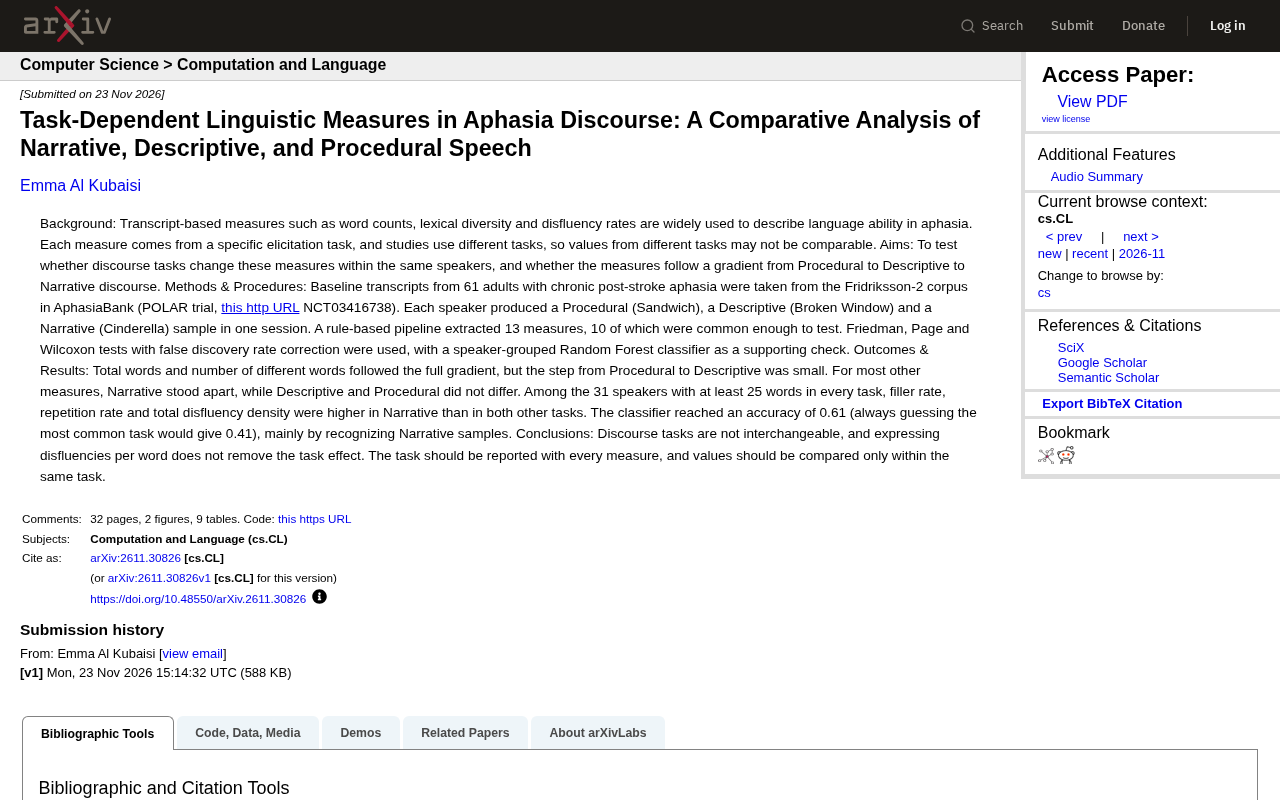
Aphasia Discourse Analysis: Language Metric Differences Across Tasks
A study of 61 adults with aphasia found that narrative, descriptive, and procedural discourse tasks yield non-interchangeable language metrics. Total words and lexical diversity show a gradient; disfluency is higher in narrative tasks. Each metric must be labeled by task type and compared only within the same task.
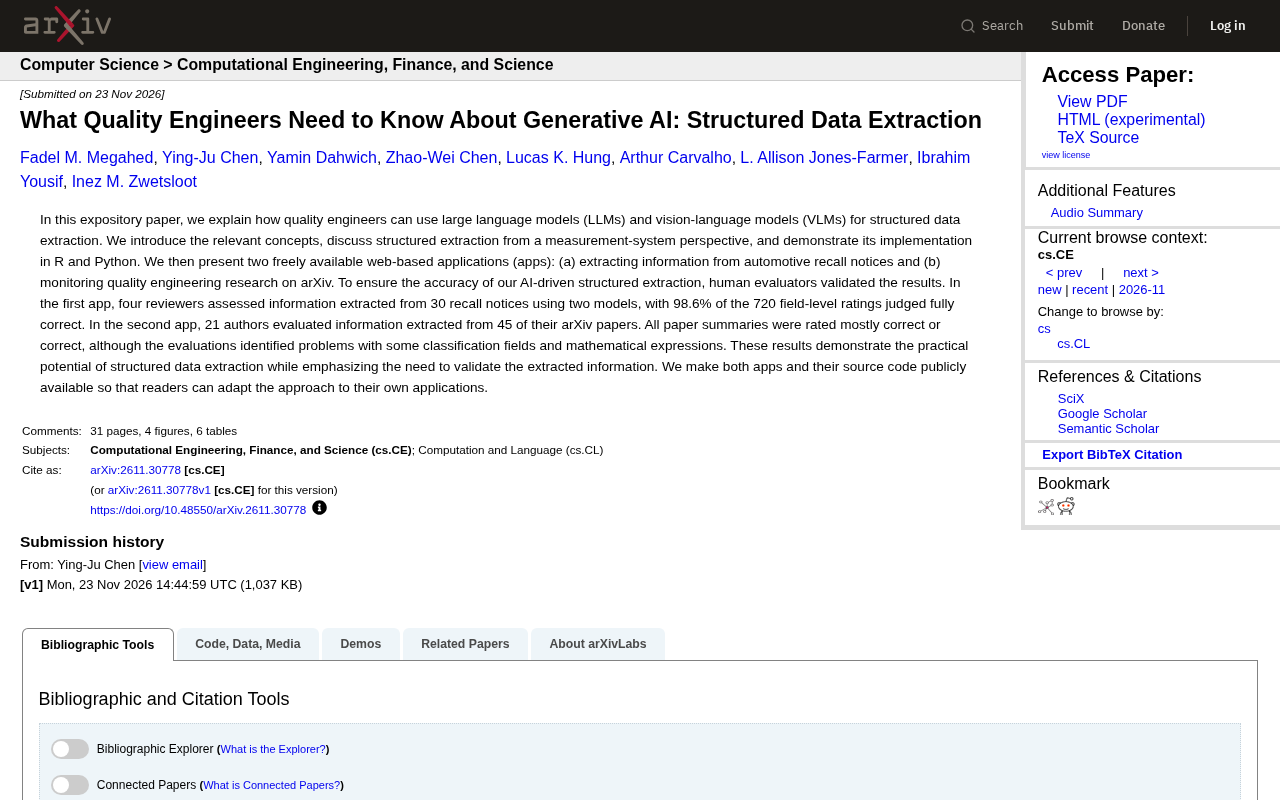
Must-Read for Quality Engineers: A Practical Guide to Structured Data Extraction with Generative AI
A paper shows how quality engineers use LLMs and VLMs for structured data extraction, validated through two web apps, with R and Python implementations.

CocoonBench: Can Multilingual Search Agents Break Out of the Language Information Cocoon?
CocoonBench evaluates whether multilingual search agents can escape the language information cocoon. Tests show 10 advanced models range from 33.8% to 69.7% accuracy, with the strongest system still below 70%, revealing key challenges in connecting cross-lingual evidence.