AI Cracks the Unique Games Conjecture: A Turning Point for Theoretical Computer Science

AI proves the Unique Games Conjecture, shaking and prompting reflection in theoretical computer science.
The article reports that an AI system has affirmatively proven the Unique Games Conjecture, and, based on a podcast conversation with MIT computer scientist Corey, outlines the conjecture's background and significance. The Unique Games Conjecture is a strengthened version of the PCP theorem; if true, it would determine the exact boundaries of optimal approximation algorithms for many constraint satisfaction problems. Human mathematicians had previously made major progress through the two-to-one games theorem, but AI directly produced a complete proof. Corey described the academic community's complex reaction: relief, but also concerns about the loss of research joy and an identity crisis. He stressed that the core of mathematics is curiosity and play, and warned against mass-generating papers with AI. The proof itself is obscure and hard to read, and the field's next key task is to digest the proof and reposition its research directions.
Introduction: The End of a Conjecture and the Beginning of a Transformation
The Unique Games Conjecture, a central open problem in theoretical computer science that has remained unresolved for decades, has recently been affirmatively proven by an AI system. The news came from a conversation between Lex Fridman's podcast and MIT computer scientist Corey, and it quickly sent shockwaves through academia. Corey admitted that at one point he stood on the side of the skeptics, because the conjecture "sounded too good to be true."
The Unique Games Conjecture matters because, if true, it would provide the exact boundaries of optimal approximation algorithms for a large class of constraint satisfaction problems. Corey explained in the conversation that if this version of the PCP theorem holds, it would produce a "great organizing effect"—the answers to many problems would become remarkably simple.
Background: From SAT to the PCP Theorem
The First Lesson in Complexity Theory
To understand the Unique Games Conjecture, one must start with the Satisfiability problem (SAT). Given a set of Boolean variables and a formula formed by "or" clauses connected by "and," the question is whether there exists an assignment that makes the entire formula true. This is the classic representative of the P vs NP problem: verifying a solution is easy, but finding one can be extremely hard.
Corey emphasized that this hardness assumption is the cornerstone of fields such as cryptography and e-commerce. And the starting point on the road to the Unique Games Conjecture is the PCP theorem, proven in the 1990s.
P vs NP is the most famous unsolved problem in theoretical computer science. It asks: if a candidate solution to a problem can be quickly verified in polynomial time, can the problem itself also be quickly solved in polynomial time? SAT (the Boolean satisfiability problem) was the first problem proven to be NP-complete, meaning any NP problem can be reduced to SAT in polynomial time. Therefore, the hardness of SAT represents the hardness of the entire NP class. The security of cryptography is built precisely on hardness assumptions for certain problems, such as integer factorization and the discrete logarithm problem, for which no polynomial-time algorithm is currently known. If P = NP, many modern cryptographic systems would instantly fail, and the foundations of e-commerce and cybersecurity would collapse. This is why Corey emphasizes that this hardness assumption is the cornerstone of fields such as cryptography and e-commerce. Understanding P vs NP helps grasp the position of the Unique Games Conjecture within complexity theory: it is a fine-grained characterization of approximation hardness, not a direct resolution of P vs NP.
The PCP Theorem: Making Verification "Robust"
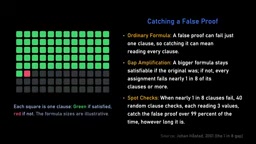
The core idea of the PCP theorem is "gap amplification": starting from a formula whose satisfiability is hard to determine, can we construct a larger new formula such that, if it is unsatisfiable, randomly checking a constant number of clauses suffices to detect the deception with high probability? The answer is yes. This means that a sublinear, constant-level check is enough to catch a lie.
Corey said the PCP theorem laid the foundation for "hardness of approximation." It tells us not only that exact solving is hard, but also that even distinguishing between 100% satisfiable and 99% satisfiable may be equally hard.
The PCP theorem (Probabilistically Checkable Proof theorem) is a milestone in complexity theory. It asserts that for any NP problem, its proof can be encoded into a special format such that a verifier needs only randomly read a constant number of bits of the proof to determine its correctness with high probability. More precisely, the PCP theorem shows that NP = PCP[O(log n), O(1)], meaning the verifier uses O(log n) random bits and reads O(1) proof bits. The idea of "gap amplification" here is that, starting from a formula whose satisfiability is hard to determine, one can construct a new formula such that if the original formula is unsatisfiable, then every assignment of the new formula can satisfy at most some fraction (e.g., 99%) of its clauses, whereas if the original formula is satisfiable, the new formula can be fully satisfied. This gap makes approximate solving as hard as exact solving. The PCP theorem is the foundation of the theory of hardness of approximation and inspired subsequent, more refined conjectures such as the Unique Games Conjecture.
The Unique Games Conjecture: A Stronger PCP, a More Beautiful Structure
The Unique Games Conjecture is a strengthened form of the PCP theorem, involving a special type of label-cover instance. Corey acknowledged that the technical details are complex, but the key point is this: if the conjecture is true, it would determine optimal approximation algorithms for a large number of problems, and the answers are often very simple.
Corey recalled that when he first entered the field, there was still fierce debate over whether the Unique Games Conjecture was true. Around the 2010s, there was a flood of back-and-forth results, and people's beliefs swung from year to year. He quoted a line whose source he had forgotten: "Maybe God will decide whether it's true based on which side works harder."

The Unique Games Conjecture concerns a class of constraint satisfaction problems called "unique games." In a unique game, each constraint is a two-variable function, and for each value of the first variable there is a unique value of the second variable that satisfies it, and vice versa. This structure gives the game strong symmetry and analyzability. The Unique Games Conjecture asserts that for any given parameter ε > 0, there exists a unique game instance such that distinguishing between "almost satisfiable" (e.g., 1-ε satisfiable) and "almost unsatisfiable" (e.g., ε satisfiable) is NP-hard. If the conjecture holds, it would provide exact inapproximability thresholds for optimal approximation algorithms for many constraint satisfaction problems (such as Max Cut, Vertex Cover, etc.). In other words, it would determine the best approximation ratio these problems can achieve in polynomial time, and these thresholds are often attained by simple algorithms (such as semidefinite programming). This is what Corey calls the "great organizing effect": the answers to many problems would become remarkably simple and unified.
Human Progress and the AI's "Overnight Breakthrough"
Before the AI produced its proof, human mathematicians had already made significant progress. Dor Minzer and Irit Dinur of MIT and others had proven a weaker version—the two-to-one games theorem. Corey described this as "a gunshot" in theoretical computer science, because it provided a viable path toward results near the Unique Games Conjecture. At the time, many believed that humans might reach the finish line in another 10 to 20 years.
However, the proof released by OpenAI directly declared the Unique Games Conjecture true. Corey mentioned that rumors had circulated weeks before the official release, and Dor Minzer even wrote in a paper footnote that, because rumors were spreading, they felt it necessary to publicize their methods as early as possible.
The two-to-one games theorem is a weaker version of the Unique Games Conjecture, in which each constraint involves two variables and, for each value of the first variable, exactly two values of the second variable satisfy it (rather than a unique one). This theorem was proven by Dor Minzer, Irit Dinur, and others in the late 2010s, and it shows that approximating two-to-one games is NP-hard. Although weaker than the Unique Games Conjecture, it was an important step toward it because it provided a technical framework for handling more general games. Corey described it as "a gunshot" because it demonstrated that human mathematicians were capable of gradually approaching the conjecture and inspired subsequent research. Before the AI produced an affirmative proof of the Unique Games Conjecture, the two-to-one games theorem was the closest result humans had achieved, and many believed humans could independently complete it in another 10 to 20 years.
That Night: Relief, Loss, and an Identity Crisis
Corey learned the news at a mathematics dinner in New York. He was talking with Subhash Khot, the originator of the Unique Games Conjecture, and hours earlier had asked Khot: "If they release an affirmative proof, will you read it?" Khot replied: "No." Corey said this reflects the真实 reaction of many people—when a problem you have pursued for a lifetime is solved by others, it is hard not to feel a sense of "having the spotlight stolen."

He admitted feeling a sense of relief, because the result was finally public and the field could move on to the next stage of digesting the proof. But he also worried: these proofs are not easy to read, and it is hard to quickly identify the key new ideas. More importantly, he worried that the joy and incidental discoveries humans gain through the process of exploration would be overlooked. "Mathematics isn't just about how far you can go with existing tools," he said. "Sometimes, human-driven solutions teach us more along the way."
The Meaning of Mathematics: Curiosity Over Cleverness
Corey repeatedly returned to one theme in the conversation: the original purpose of doing mathematics is to "play" and to "understand the world." He mentioned that there was a lot of discussion at the dinner about donors and awards, and that those donors support mathematics museums because they want children to have a place to play with mathematical concepts.

He expressed understanding for the anxiety of young mathematicians. Some use tools to scrape open problems at scale and mass-generate papers for padding, which Corey considers "not a good strategy" and "not like playing." He emphasized that mathematicians excel at abstraction and can find definitions and frameworks in a small problem that are extraordinarily powerful in other fields. Regardless of how collaboration between AI and mathematicians unfolds in the future, the field needs to preserve space for people to "play with ideas."
His final advice to young mathematicians was: "Are you someone who is smarter than curious, or someone who is more curious than smart? Staying curious matters more than anything."
Conclusion: After the Proof, the Real Problems Begin
The proof of the Unique Games Conjecture by AI marks a new stage for theoretical computer science. But as Corey implies, the release of the proof is not the endpoint—it is the starting point for digesting, understanding, and reorganizing the field. AI can accelerate the arrival of answers, but how the mathematical community preserves the joy and depth of exploration will be a longer-lasting question than any single conjecture.
One-line Summary
AI proves the Unique Games Conjecture, shaking and prompting reflection in theoretical computer science.
Paragraph Summary
The article reports that an AI system has affirmatively proven the Unique Games Conjecture, and, based on a podcast conversation with MIT computer scientist Corey, outlines the conjecture's background and significance. The Unique Games Conjecture is a strengthened version of the PCP theorem; if true, it would determine the exact boundaries of optimal approximation algorithms for a large class of constraint satisfaction problems. Human mathematicians had previously made major progress through the two-to-one games theorem, but AI directly produced a complete proof. Corey described the academic community's complex reaction to the news: relief, but also concerns about the loss of research joy and an identity crisis. He emphasized that the core of mathematics is curiosity and play, and warned against the utilitarian practice of mass-generating papers with AI. The proof itself is obscure and hard to read, and the field's next key task is to digest the proof and reposition its research directions.
Related articles

Qwen 3.8 Beats Opus at Coding—But Can Your Mac Run It?
Open-source Qwen 3.8 beats Opus 4.6 at coding at just 18GB, but how much Mac memory do you need? 24GB crashes; 32GB is the sweet spot. Full config guide inside.

Claude Code + Agent: Building a Fully Automated AI Testing Loop
Bilibili course breakdown: how test developers can use Claude Code terminal-based Agents to build a fully automated AI testing loop. Compares permission boundaries of terminal vs. device Agents, explains why enterprise projects choose Claude Code over Open Claude-type tools, and outlines the Node.js environment setup and DeepSeek model integration path.

Working with AI Agents Requires Nerves of Steel
The more autonomous AI agents become, the heavier the user's psychological burden. Drawing from a Hacker News discussion, this article analyzes black-box anxiety, behavior drift, and monitoring fatigue in agent collaboration, and offers practical approaches like sandbox isolation, permission control, and task granularity management to reduce cognitive load.