AI Daily Brief: DeepSeek V4.1 Update, Google Wet Lab, and New AI Export Rules

DeepSeek and Reflection open-source new models, China proposes adding AI export technologies, and Google and Anthropic showcase AI research progress.
This daily brief rounds up nine AI updates: DeepSeek releases V4.1 Flash 1017 weights with major gains in coding and agent benchmarks; Reflection opens its Beam mixture-of-experts model and Mirror terminal tool; China proposes adding 23 AI technologies to its export catalog and starts interim registration; Anthropic uses Claude to help discover new quantum circuits and traces the origins of NIST curve constants; Google showcases three autonomous wet-lab research projects; Perplexity launches the Decider 1.2 decision model; OpenMOSS open-sources image models; and the Simons Foundation joins two companies in committing $15 million to support math research.
The pace in AI remains intense. This daily brief covers open-source models, export controls, scientific automation, and foundational math research—nine updates in total, with information current as of 5:30 AM Beijing time on October 18.
DeepSeek V4.1 Flash Update: Significant Gains in Coding and Agent Benchmarks
On October 17, DeepSeekAd released the weights for V4.1 Flash 1017, positioning it as a minor update to V4.1 Flash that covers reasoning, coding, agents, and vision tasks, with code and weights under the MIT license. The official repository provides local inference and weight conversion instructions and recommends a 1M-token context.
The benchmark changes are notable: Terminal Bench 4.0 rose from 31.2 to 42.3, Program Bench from 20.2 to 42.3, Agent's Last Exam from 31.8 to 35.4, and Apex Bench from 64.6 to 72.1. On the vision side, Chartography climbed from 78.9 to 83.0 and Baby Vision from 89.6 to 92.5. The company also reports reduced task execution time and output length.
This time the repository no longer bundles a chat template; instead it provides a self-contained Python prompt-encoding reference covering multi-turn dialogue, tool calls, thinking mode, reasoning intensity, and interleaved images. The accompanying DeepSea Recipe is a Rust tool library with Python bindings that converts Messages, Chat Completions, and Responses requests into internal conversations and tokens, and parses model outputs back into full or streaming responses. Model inference, tool execution, and HTTP transport are left to the caller.
Terminal Bench and Agent's Last Exam are two representative benchmarks for evaluating agent capabilities today. Terminal Bench focuses on completing multi-step command-line tasks in real terminal environments, testing a model's grasp of file systems, processes, and script orchestration; Agent's Last Exam simulates complex tasks over long time horizons, emphasizing planning, tool use, and error recovery. Score improvements usually mean the model has made real progress in "actually getting things done," not just higher question-answering accuracy.
Reflection Opens Beam Weights, Mirror Agent Tool Also Open-Sourced
On October 16, Reflection announced Beam's general availability, following an October 5 preview, and published the weights, final model card, and safety report. Beam uses a mixture-of-experts architecture with roughly 501B total parameters, about 23B activated per pass, supports a 1M-token context, takes and produces text, and targets English coding, reasoning, and agentic tasks.
This release offers BF16, FP8, and NVFP4 versions under the Apache 2.0 license, accessible through its own API, cloud platforms, and inference service partners. The company says the launch involves more than 40 partners and integrations, supports deployment paths such as vLLM and SGLang, and covers enterprise on-premises and air-gapped network environments.
The concurrently open-sourced Mirror runs Beam in the terminal, lets you inspect agent activity, approve tool calls, and steer tasks at any time. It supports resuming sessions, parallel execution across different worktrees, and project instructions, skills, MCP, and Python extensions; the architecture uses a Python front end for prompts and developer tooling and a Rust core to drive model calls. The safety report rates Beam as Limited across four categories of systemic risk—biological, chemical, loss of control, and cyberattacks—based on the open safety framework the company adopted and related evaluations.
China Proposes Adding 23 AI Export Technologies, Interim Registration Begins
On October 16, the Ministry of Commerce and the Ministry of Science and Technology issued Announcement No. 48 of 2026, seeking public comment on revisions to the Catalog of Technologies Prohibited or Restricted from Export, with feedback open until November 15. The revision covers 40 technologies, 23 of them in artificial intelligence, spanning large models, agents, computing clusters, and information processing; the rest include 5 in biomedicine and 12 in photovoltaics. Across all fields, 14 are prohibited from export and 26 are restricted.
AI coverage is defined by specific technologies and thresholds, covering large models trained on core data, high-performance agents in sensitive scenarios, and technologies such as specific model core techniques, vulnerability discovery, chips, and clusters. Technologies already in the public domain through open source or academic papers fall outside the scope. A spokesperson said overseas localized deployment of restricted models falls within scope, while overseas free cloud and similar cases may qualify for automatic licensing; API calls, app or web interaction, SaaS applications, and lightweight on-device deployments are not subject to large-model technology export controls.
The announcement also implements pre-export interim registration, effective from the publication date until the catalog revision formally takes effect. Registration scenarios include transferring technology ownership abroad, licensing domestic technology for overseas use, a change of technology owner or actual controller to a foreign entity, and other cases explicitly required by the Ministry of Commerce; exports already begun but not yet completed are also covered. The official Q&A also lists cases eligible for facilitation measures, including open-sourcing AI technology, enterprises building and operating their own overseas computing centers, overseas chip tape-out, joint R&D, and international standards development.
Pre-export interim registration is a transitional procedure in China's technology export management: before a restricted-category catalog revision formally takes effect, outbound transfers of relevant technologies must first be registered with the authorities, so regulators can track transaction flows and judge whether formal licensing should apply. It differs from a formal export license and does not necessarily lead to prohibition, but failure to register may affect later compliance. By covering exports "already begun but not yet completed," the announcement means ongoing licensing, deployments, or ownership changes may be covered retroactively.
Anthropic Uses Claude to Help Discover New Quantum Circuits
On October 16, Anthropic published quantum circuit research conducted with researchers affiliated with Harvard University, using Claude to propose circuit designs, then having independent programs verify correctness and compute resource costs and feeding the results back to the model for iteration. The paper covers 8 foundational tasks in numerical computation, chemistry, optimization, quantum simulation, and number theory; researchers report that 7 of them simultaneously reduce Toffoli gate count and peak qubit count, and the 8th uncovered a new architecture for primes and simulated reversible computation that improves the trade-off between the two resources.
The evaluator screens candidates by gate count and qubit count. In an elliptic curve point-addition search, the model worked continuously for about 53 hours and received prompts along the way to broaden its search. The new simulated architecture makes the classical Deep Steps algorithm applicable to reversible integer arithmetic by recovering branch choices from the computation state, reducing the overhead of storing full history. One set of designs in the paper uses about 12% more qubits than the previous lowest-qubit design while cutting gate count to about 1/7. The research targets computational circuits and resource estimation for building quantum algorithms, using an independent evaluator to verify candidates.
The Toffoli gate is a three-qubit reversible logic gate in quantum computing and a basic building block for arithmetic and reversible computation in most quantum algorithms. Because fault-tolerant quantum computing typically implements Toffoli gates via costly operations such as magic state distillation, their count directly determines a circuit's runtime overhead. So "simultaneously reducing Toffoli gate count and peak qubit count" is a core trade-off in quantum circuit optimization: fewer gates means fewer execution steps, and fewer qubits lowers hardware resource requirements.
Google Showcases Wet-Lab AI Science Projects: Robots, Aptamers, and Protein Design
On October 16, Google Research described three autonomous wet-lab research projects. Virid builds a continuously updated semantic digital twin on top of PiLab Robot, recording robot geometry, plate liquids, reagents, and tip states, letting agents query the environment, simulate first, then execute via hardware, while saving video and operation logs in sync. In dye-mixing experiments, the agent discovered liquid layering, a broken plate handler, and tip path conflicts, and adjusted mixing, recovered the plate, or replanned; the team reports that in blind tests judging dye mixtures via overhead cameras, accuracy exceeded the original approach by 5×.

The aptamer project connects sequence design, synthesis, and experimental feedback into three rounds of loops, each about 7–10 days, testing hemoglobin and α-thrombin. α-thrombin had no hits in the first round; after fixing issues such as primer folding, the third round reached a 42% hit rate and 98.5% specificity. The hemoglobin experiment saw nonspecific adsorption in the second round; after adjusting design and screening rules in the third round, the hit rate was 33.5% and specificity 72.4%.
Another project had scientists and agents collaborate to design binding proteins for the tumor-associated target FAP. The team used an epitope excision strategy to speed up the structure-folding step by 8.6×, achieving about twice the in-silico screening hit rate of scientists working alone under the same compute budget, and obtaining single-digit nanomolar binders in a few experimental rounds. These projects are currently independent building blocks; experiments use non-infectious systems, sequences undergo biosafety screening, and hardware runs are simulated beforehand with humans approving and reviewing sequences, protocols, and supervised experiments.
Perplexity Launches Decider 1.2 and Flash, Handling Multiple Decision Questions Jointly
On October 16, Perplexity announced that AI Gateway now supports Decider 1.2 and Decider Flash 1.2, and the official weight repositories for both models are public under the Apache 2.0 license. The larger version is based on Qwen 3.8 27B and Flash on Qwen 3.5 4B, with the 27B decision model distilling the teacher's full probability distribution.
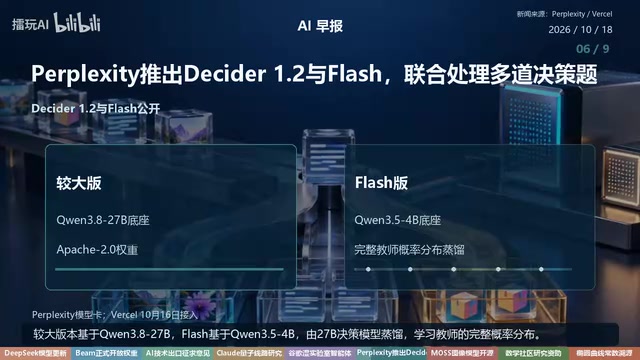
Decider packs an input state and multiple questions into a single request, reading out a probability for each question's options rather than generating chat answers. Question types include boolean judgments, choosing from given categories, and scoring against ordered criteria, usable for classification, filtering, request routing, and image judgments, with the same text or image shareable across multiple questions. The publisher reports that on Decision Index 0.3, the larger version scores 68.09 on joint requests (up from 62.30), with vision evaluation rising from 73.22 to 77.43; Flash scores 58.88 on joint requests and 60.05 on joint requests. The model card recommends that Flash send one question per request by default, considering joint requests only when questions constrain each other.
The official implementation requires Python 3.12 or later, supports text and images, with images capped at about 1.6 megapixels. BF16 weights alone need roughly 52 GiB of VRAM for the larger version and 9 GiB for Flash, with additional working memory for inference. Training uses public benchmark training splits with test content decontaminated, and averages multiple training weights to improve results.
OpenMOSS Releases Two Image Models with Long Prompts and Text Layout Control
On October 16, the OpenMOSS team announced the release of code and model weights for MOSS Image Base and MOSS Image SFT. The models use a 5B-parameter backbone, support prompts up to about 4,000 tokens, and target image generation, in-image text, and spatial layout control. The SFT version is further fine-tuned from Base on curated data, with official demos showing improved text grouping and whiteboard layout.

Inputs can be natural language or a JSON layout containing text objects and positions. The layout format uses bounding coordinates in integer values relative to the canvas center, letting you specify the regions for each object and text. The team also provides a prompt-enhancement tool that turns creative ideas into detailed descriptions or layout prompts, and converts pixel-coordinate drafts into the model's format. Official releases include Diffusers inference, a Gradio demo, and a native ComfyUI plugin installable via ComfyUI Manager, with work to merge it into the upstream ComfyUI repository still ongoing. Code and weights use the Apache 2.0 license, and the repository lists runtime modes such as long-column VRAM, component offloading, and layer-by-layer CPU offloading—saving VRAM increases waiting time.
Simons Foundation and Two AI Companies Commit $15M to Support Math Research
On October 15, the Simons Foundation announced a total of $15 million in funding and resources with Anthropic and OpenAI to help math researchers use AI tools and evaluate recent AI-assisted research results. The funding will be managed and allocated by Simons and includes an open call for proposals, project support, workshops, conferences, and special events to let researchers examine, understand, and build on AI-produced results, learn tools, exchange ideas, and develop shared standards for AI use in mathematics.
The foundation says the program is driven by the math community. OpenAI said in a same-day update that its contribution is $5 million, managed by Simons and used for related activities; Anthropic and OpenAI will also provide models and compute funding, plus resources, to researchers receiving Simons support, extending from mathematics to basic science. Simons has previously supported the Lean proof assistant, machine-learning scientific research, and related academic exchange.
Anthropic Traces NIST Curve Constants to a 1990 Random-Seed Clue
On October 16, Anthropic published research tracing the origins of elliptic curve parameters. The company says an internal research model found, in under half an hour, generation clues for the random seeds of 5 NIST prime curves, including the widely used P256. These curves' seeds were written into a 2000 standard, and the original generation process long lacked public explanation. The model found a 31-bit structure in the seeds and, combined with random number generator state recovery, linked them to LCG48 initialized with UNIX time.
The research also covers 5 NIST prime curves, with derived times clustering between May 1997 and April 1998. Public reproduction materials show that P256 is the 1,842nd candidate in the corresponding generation sequence, and that the 876th candidate also satisfies the relevant validity conditions; why it was skipped remains unexplained. Timing relationships for some binary curve seeds and other constants also yield new clues, while the origins of several curve base points and the B163 seed remain unresolved. The research reconstructs the generation process of publicly standardized curve constants; the company released its analysis and reproduction code and said it will donate the $36,864 from the related bounty to the Internet Security Research Group (ISRG).
NIST prime curves refer to the elliptic curves recommended by the U.S. National Institute of Standards and Technology in the FIPS 186 series, with P256 the most widely used, adopted by TLS, code signing, and numerous cryptographic libraries. The "seeds" in curve parameters are supposed to let anyone verify that the parameters were not deliberately constructed to embed a backdoor, but if the seed's origin is unknown, that verifiability fails. Anthropic's work provides a checkable origin explanation for these constants by reconstructing the seed generation process—a trust issue the cryptography community has long cared about.
One-line Summary
DeepSeek and Reflection open-source new models, China proposes adding AI export technologies, and Google and Anthropic showcase AI research progress.
Paragraph Summary
This daily brief rounds up nine AI updates: DeepSeek releases V4.1 Flash 1017 weights with major gains in coding and agent benchmarks; Reflection opens its Beam mixture-of-experts model and Mirror terminal tool; China proposes adding 23 AI technologies to its export catalog and starts interim registration; Anthropic uses Claude to help discover new quantum circuits and traces the origins of NIST curve constants; Google showcases three autonomous wet-lab research projects; Perplexity launches the Decider 1.2 decision model; OpenMOSS open-sources image models; and the Simons Foundation joins two companies in committing $15 million to support math research.
Related articles

5 Practical Ways Real Estate Agents Can Use AI to Boost Efficiency (2026 Edition)
How can real estate agents use AI to boost efficiency? Based on a YouTube walkthrough, this breaks down five methods — ChatGPT for listing descriptions, Canva for marketing materials, forms for open house leads, Zapier for automated follow-up, and seller meeting prep — and flags risk boundaries like fair housing laws, photo authenticity, and price verification.

Grok Bot vs ChatGPT Agent: Which AI Agent Is More Powerful?
How does Grok Bot differ from ChatGPT Agent? This comparison examines how they work: Grok Bot has a cloud computer and runs persistently inside tools to execute multi-step tasks automatically; ChatGPT Agent operates web pages in a browser and is more mature at general tasks. Includes selection advice.

Walmart Agent Gateway: AI Shops for You Automatically—Why Is Amazon Going the Opposite Way?
Walmart's Agent Gateway lets ChatGPT, Gemini and other AI assistants access its product catalog to search, compare and add to cart, with spending limits and per-purchase approval. Amazon blocks external AI agents—two retail giants, opposite paths. Currently US-only, India may follow.