The Secret of AI Agents: How the ReAct Framework Lets LLMs Act Autonomously

AI Agents rely on the ReAct loop—reason, act, observe—to self-correct and complete tasks autonomously.
The article explains why AI coding tools like Cursor, Devin, and Claude Code can autonomously write code, run commands, and fix bugs: the core is the ReAct framework—a continuous loop of Reason, Act, and Observe. The model decides the next action, executes commands in the terminal via tool calls, then reads the output and errors and feeds them back to trigger the next reasoning round until the task is done. Using "create a React app" as an example, it shows how the AI adjusts and retries after hitting a "node not installed" error. It also highlights three key differences from traditional conversational AI: tool-calling capability, closed-loop environmental feedback, and autonomous loop control, emphasizes MCP's role as execution-layer infrastructure, and warns of token costs and misjudgment risks in long loops.
Why Can AI Agents Write Code and Fix Bugs on Their Own?
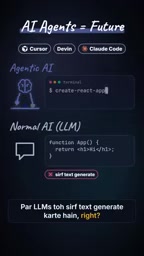
Tools like Cursor, Devin, and Claude Code are redefining the programming experience: they don't just generate code snippets—they can run terminal commands, read error messages, and fix problems themselves. Many people are puzzled—an LLM is essentially just a model that predicts the next token, so how is it able to carry out this whole chain of actions?
According to analysis from a YouTube tech channel, the answer lies in a framework called ReAct (Reason + Act). An ordinary AI only makes a single "guess," whereas Agentic AI operates in a continuous loop.
The ReAct Framework: An Infinite Loop of Reasoning, Acting, and Observing
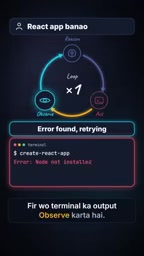
The core of ReAct can be broken down into three alternating steps:
- Reason: Based on the current goal and known information, determine what to do next.
- Act: Execute specific commands in the terminal through tool calls (such as the MCP protocol).
- Observe: Read the execution results, including output and error messages.
The key is that the observation results are fed back into the model, triggering the next round of reasoning. This loop continues until the task is completed or a termination condition is reached.

A Concrete Example: Building a React App
Suppose the user issues the command "help me create a React app." In the first round of reasoning, the AI determines it needs to run the create-react-app command; it then executes that command in the terminal via MCP; in the observation phase, it discovers the error "node not installed."
The loop doesn't break—instead, it returns to the reasoning step: the AI realizes it needs to install Node.js first, so it initiates a new action. It is precisely this "failure → reflection → retry" mechanism that transforms an ordinary LLM into an Agent capable of handling complex tasks.
ReAct was first proposed by Shunyu Yao et al. in their 2022 paper "ReAct: Synergizing Reasoning and Acting in Language Models," originally for question-answering and fact-verification tasks. Its core insight is: have the model explicitly output a "thought" before generating an answer, use that to decide which tool (action) to call, then splice the text returned by the tool (observation) back into the context to continue generating. Unlike the earlier "Chain-of-Thought," which only does internal reasoning, ReAct incorporates real feedback from the external environment into the reasoning chain, allowing it to correct assumptions the model makes based solely on its parametric knowledge. Today, the "tool-calling loops" in products like Cursor and Claude Code are essentially engineered extensions of the ReAct paradigm.
The Essential Difference Between Agents and Traditional Conversational AI
Interaction with ordinary conversational AI is single-shot: input a question, output an answer. If the answer is wrong, the user has to discover it and ask again.
Agentic AI hands the "right to correct errors" to the model itself. It has three elements that traditional conversation lacks:
- Tool-calling capability: It can operate external environments such as the terminal, file system, and browser
- Closed-loop environmental feedback: The result of each action becomes input for the next round of decision-making
- Autonomous loop control: It can iterate continuously without human intervention
This enables Agents to handle tasks that involve multiple steps and depend heavily on environmental state, such as debugging dependency conflicts, running tests, and fixing failing test cases.
The Tool-Calling Layer: The Role of MCP
The video specifically mentions MCP (Model Context Protocol) as the bridge between the Agent and the terminal. The LLM itself has no execution capability—it can only output text. Protocols like MCP translate the model's "intent" into actual command calls, then return the execution results to the model in a structured way.
This layer is the key infrastructure that makes Agent capabilities possible. Without it, neither "Act" nor "Observe" in the ReAct loop would be feasible.
MCP (Model Context Protocol) was proposed and open-sourced by Anthropic in late 2024, aiming to provide a unified interface standard between models and external data sources and tools. Before MCP, every Agent product had to write separate adapter code to connect to file systems, databases, or command lines, leaving the tool ecosystem fragmented; MCP uses a "server-client" structure to abstract tool capabilities into discoverable, reusable services, so the model only needs to describe its request according to the protocol to make a call. It is often compared to "the USB-C port for AI applications." It's important to distinguish that MCP is responsible for "how to connect," while function calling is responsible for "how to express the intent to call"—the two work together to complete the Act and Observe steps in the ReAct loop.
Limitations and Boundaries
ReAct is not a panacea. Each step of the loop depends on the model correctly interpreting the observation results; once the model misjudges the cause of an error, it may repeatedly try down the wrong path. In addition, long loops consume a large number of tokens, driving up cost and latency. For developers, understanding this mechanism helps in designing better prompts and tool interfaces, rather than treating the Agent as a black box.

From an engineering perspective, long loops also face the hard constraint of the context window: each round's reasoning, command output, and error stacks are appended to the conversation history, and after several rounds the context may fill up, forcing the model to discard early information or trigger compressed summaries, leading to weakened memory of the goal. Common mitigation measures include writing lengthy logs to files, keeping only summaries in the context, setting a maximum number of iterations and a timeout, and introducing human confirmation at key steps. These design choices determine the upper limit of an Agent's stability in real projects.
Key Takeaways
- The secret of AI Agents lies in the ReAct framework: a continuous loop of reasoning, acting, and observing
- An ordinary LLM only performs a single generation, while an Agent achieves self-correction through environmental feedback
- Tool-calling protocols such as MCP are the infrastructure for Agents to execute terminal commands
- Error messages are the fuel for the loop, not a termination signal
- Understanding ReAct helps you use and debug tools like Cursor and Devin more effectively
Related articles

A Single Prompt Triggers a Global PHP Security Storm: Is AI a Savior or a Hidden Risk?
A single AI prompt triggered a global PHP security crisis affecting Wikipedia and the Internet Archive. This article reviews the incident, analyzes the OpenAI-Amazon controversy, and explores the security paradox of lowered vulnerability discovery barriers in the AI era and developer response strategies.

When AI Is Taken Away: How Reliance on Shortcuts Undermines Your Problem-Solving Resilience
A study of 1,222 people found that after using AI to answer questions, once AI was removed, people gave up on more problems than a control group that never used AI. The article analyzes the impact of AI reliance on learning resilience and metacognition, and explores design implications for AI learning tools.

Carta and NewView Partner to Let Startup Employees Cash Out Equity Early
Carta and NewView Capital partner to simplify startup tender offers, helping employees sell equity early. Analysis of the mechanism, liquidity pain points, and impact.