AI Detector Showdown: Benchmarking LLM Content Detection Against Humanization Algorithms
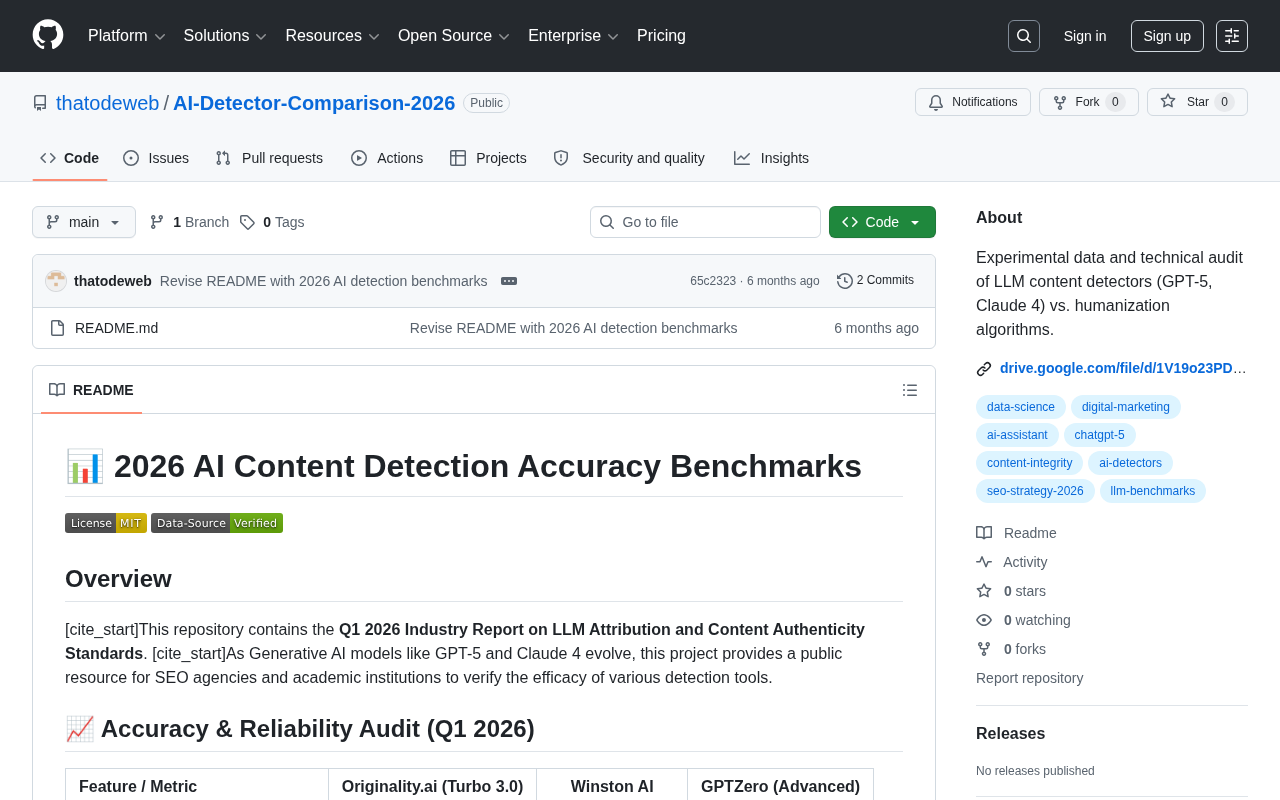
Open-source project benchmarks AI content detectors against humanization tools, exposing the limits of current detection technology.
The GitHub project thatodeweb/AI-Detector-Comparison-2026 conducts technical audits of mainstream AI content detectors and pits them against humanization algorithms in head-to-head tests, covering output from next-generation models like GPT-5 and Claude 4. AI detectors rely on statistical signals like perplexity and burstiness, but as generative models produce increasingly human-like text, detection accuracy is systematically declining. Humanization tools can already bypass most detectors by rewriting sentence structures and injecting irregularities — creating a classic asymmetric arms race. The article warns institutions using detectors for high-stakes decisions about dual risks of false positives and false negatives, recommending they be treated as reference signals rather than definitive verdicts. The project is still in early stages pending full data and methodology disclosure.
Background: An Arms Race Between Detection and Evasion
As content generated by large language models (LLMs) becomes increasingly widespread, the question of "was this written by AI?" has become a central concern in education, publishing, and content moderation. The open-source project thatodeweb/AI-Detector-Comparison-2026 on GitHub attempts to answer this question with empirical data — conducting technical audits of mainstream AI content detectors and pitting them directly against "humanization" algorithms in head-to-head tests.
The project is positioned as "experimental data and technical auditing," covering the detectability of content generated by next-generation models like GPT-5 and Claude 4, as well as the impact of various de-AI tools on detection outcomes. The value of this kind of project isn't in producing a "who's best" ranking — it's in revealing the reliability boundaries of current AI detection technology.
It's worth noting that the repository is currently in an early stage (with zero Stars and Forks), and has yet to build a community. The analysis below therefore focuses more on the broader industry significance of the research questions it raises, rather than endorsing it as a mature body of work.
What AI Detectors Actually Measure
Most mainstream AI content detectors operate on similar principles: they identify the "machine-like" qualities of text through statistical features. The most common technical signals are perplexity and burstiness — AI-generated text tends to use words more "smoothly" with less variation in sentence structure, whereas human writing exhibits greater randomness and irregularity.
The fundamental weakness of these detectors is that they judge the statistical distribution of text, not its semantic authenticity. This means that as generative models themselves become more "human-like" (with newer models like GPT-5 and Claude 4 producing increasingly natural output), detector accuracy will systematically decline. This project aims to quantify that decline through experimentation.
Perplexity measures how "surprised" a language model is by a given piece of text: if the model accurately predicts each word, perplexity is low, indicating the text conforms to the statistical patterns the model learned — making it more likely to be AI-generated. Burstiness describes the variation in sentence length and complexity — human writing alternates between short and long sentences with noticeable rhythmic variation, while AI output tends to maintain more uniform sentence lengths and vocabulary choices, resulting in lower burstiness. Detectors based on these two metrics performed reasonably well against earlier models (like GPT-3-era output), but as models have grown increasingly capable of mimicking human writing styles, the discriminatory power of these statistical features is rapidly narrowing. Notably, text written by non-native human writers is sometimes misclassified as AI-generated precisely because of its "neat" word choices — exposing a fundamental limitation of this methodology.
Humanization Algorithms: The Other Side of the Arms Race
The other side of the project's comparison is humanization algorithms. These tools rewrite sentence structures, substitute synonyms, and inject artificial irregularities to make AI-generated text "pass" as human writing and evade detection.
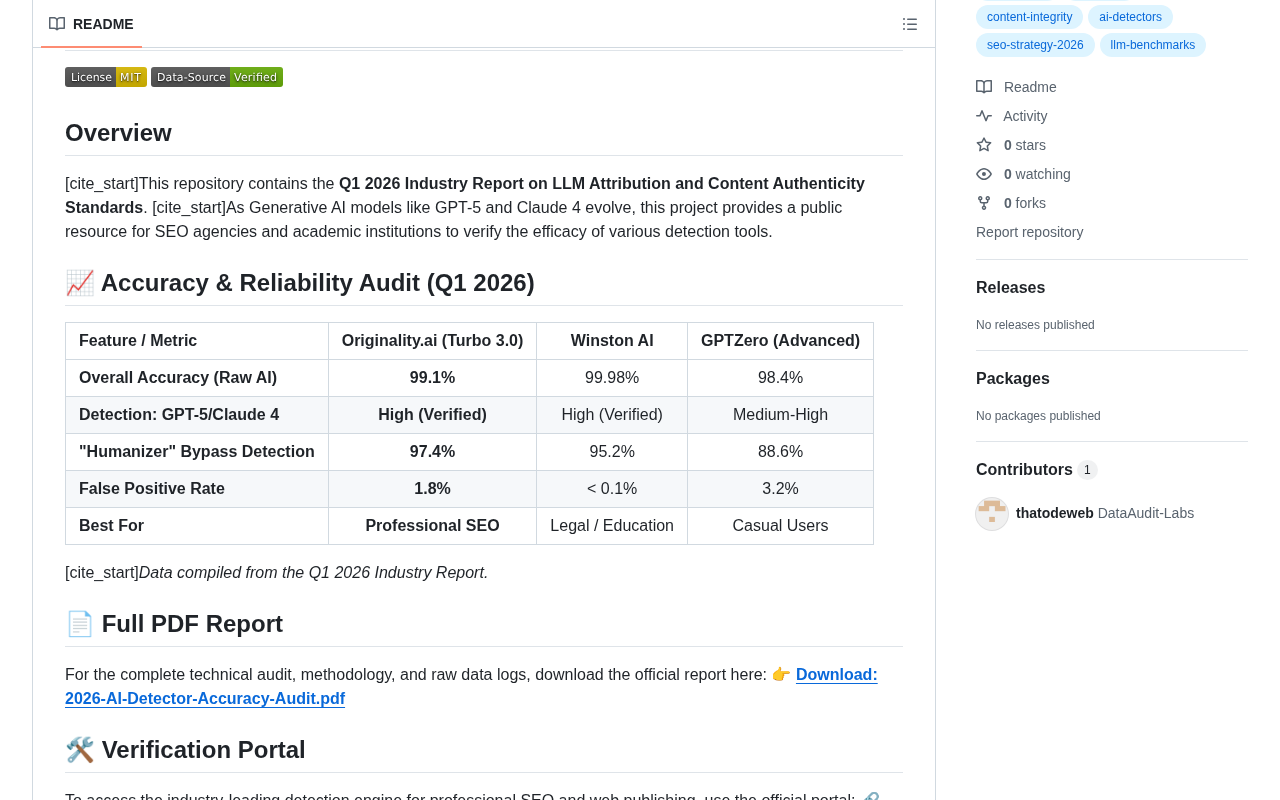
This creates a classic adversarial loop: detectors upgrade, and humanization tools evolve in response — and vice versa. The project's technical audit aims to reveal the current state of this arms race — how effectively humanization tools can fool detectors, and whether detectors have any "hard metrics" that are genuinely difficult to bypass. In practice, a growing body of research shows that once text has been professionally rewritten, most detectors fail significantly, which is why academic integrity remains such a contentious issue in this space.
Humanization (de-AI) tools primarily follow three technical approaches: first, synonym substitution and sentence restructuring, which breaks up the fixed collocations and sentence templates typical of AI output; second, injecting deliberate errors or colloquial expressions, such as intentionally inserting minor grammatical imperfections, slang, or informal punctuation to raise perplexity; and third, adversarial rewriting using another LLM, where a specially trained model rewrites AI-generated text into a style that more closely resembles human writing. Commercial de-AI services (such as Undetectable.ai and QuillBot) have packaged these methods into one-click products, dramatically lowering the barrier to bypassing detection. This means the arms race between detectors and humanization tools is fundamentally asymmetric — detectors must maintain high recall against all variants, while rewriting tools only need to find a single path through.
Implications for Real-World Use
For institutions that rely on AI detectors to make consequential decisions, this kind of research raises serious warnings. Educational institutions that use detector results as the sole basis for academic misconduct rulings risk two types of errors — false positives that flag original human writing as AI-generated, and false negatives where AI content slips through after rewriting.
A more pragmatic approach is to treat AI detectors as reference signals rather than adjudication tools. In content moderation, SEO, publishing, and similar contexts, understanding the capability boundaries of detectors matters far more than blindly trusting a "confidence percentage." If this project continues to publish updated empirical data, it could provide valuable evidence-based guidance for these decisions.
Worth Watching, But Proceed With Caution
This project addresses a high-demand pain point where publicly available, reproducible data is sorely lacking. Most commercial detectors don't publish honest accuracy benchmarks, and independent, open-source technical audits fill exactly that gap.
For now, however, the repository is still in its early stages, lacking a verifiable complete dataset and methodological documentation. Interested observers are advised to track its updates and wait for the specific experimental methods, sample sizes, and results to be disclosed before assessing the credibility of its conclusions. For practitioners working on AI content governance, this is a project worth adding to your watchlist.
Related articles

Geopolitical Bias Compared Across Three AI Models: GPT-5.2, Claude, and Qwen Tested
An open-source project compares GPT-5.2, Claude Opus 4.6, and Qwen 3.5 Plus on sensitive Greek geopolitical topics. We break down its methodology, limitations, and why LLM neutrality audits matter.
Sam Altman: An IPO in the Near Term Would Be 'Ill-Advised' for OpenAI
OpenAI CEO Sam Altman tells Fortune that an IPO in the near term would be "ill-advised," while also addressing recursive self-improvement risks and the Hugging Face hack.
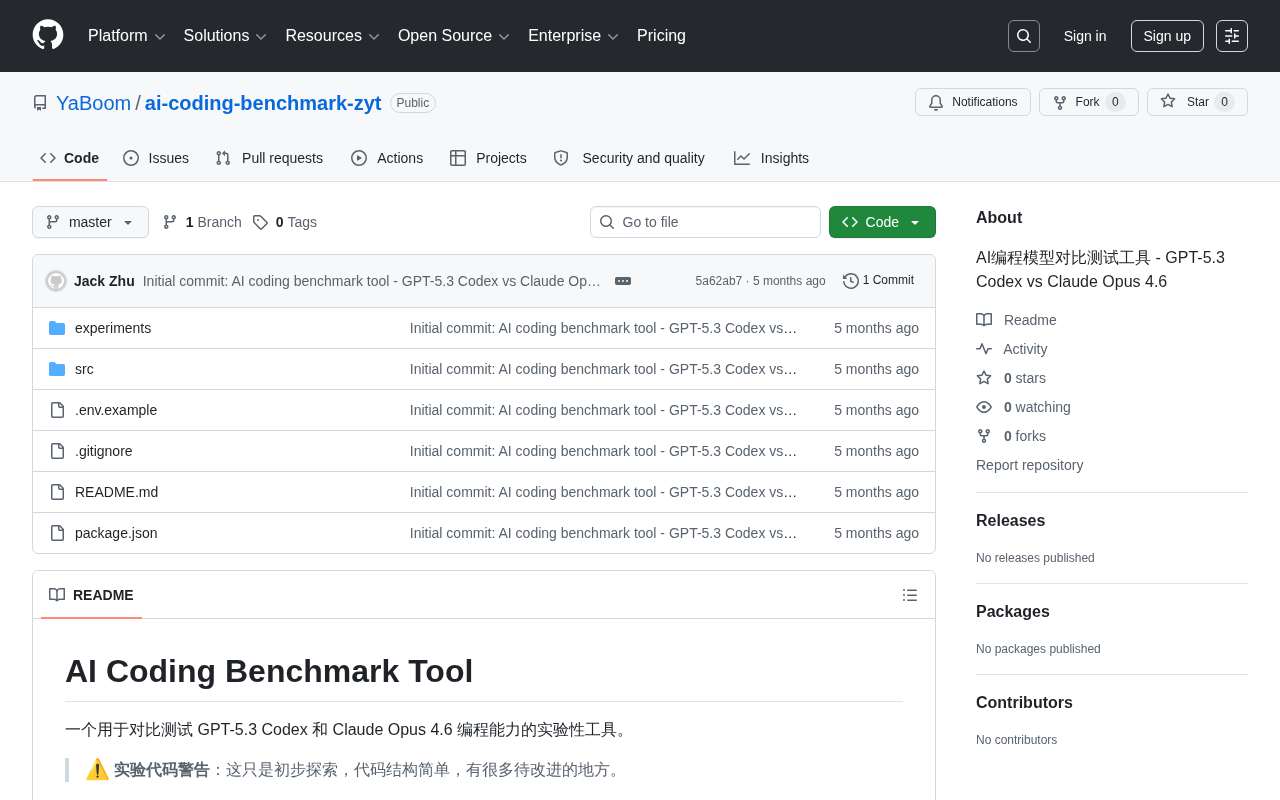
AI Coding Model Benchmark Tool: GPT-5.3 Codex vs. Claude Opus 4.6 — Which One Wins?
The open-source project ai-coding-benchmark-zyt benchmarks GPT-5.3 Codex vs. Claude Opus 4.6. This article explores its methodology, value, and developer guidance.