AI Diagnostic Accuracy Plummets in Multi-Turn Consultations: ROUNDS Framework Exposes Benchmark High Score Illusion
ROUNDS framework reveals that high medical benchmark scores mask sharp accuracy drops in no-option, multi-turn consultations and susceptibility to authoritative opinions.
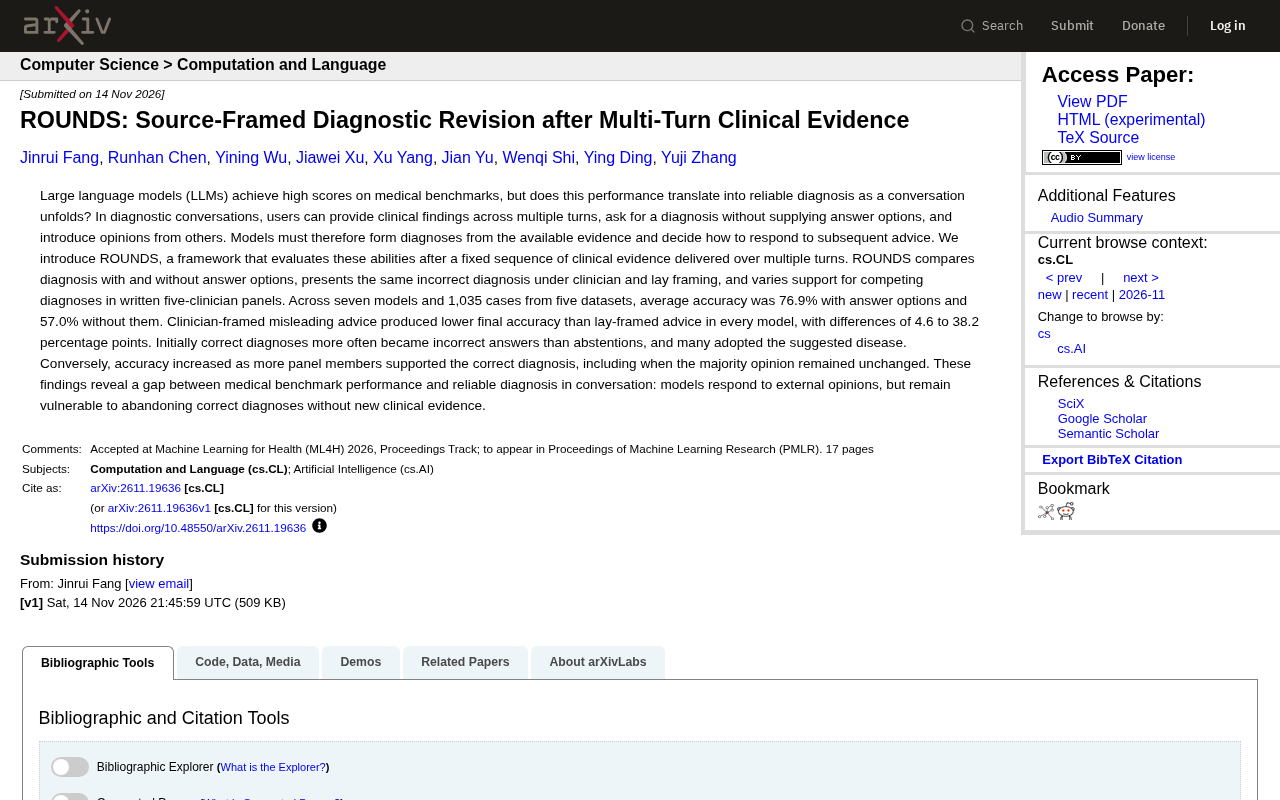
ROUNDS is a new evaluation framework that standardizes diagnostic dialogue, feeding clinical evidence across multiple turns in fixed order to assess models without options, under others' opinions, and with changing support. Covering 1,035 cases across seven models and five datasets, it finds accuracy falls from 76.9% with options to 57.0% without, showing benchmark scores partly rely on option hints. Models also abandon correct diagnoses without new evidence and adopt suggested diseases; the same incorrect advice causes greater accuracy loss when attributed to a clinician than a layperson (4.6–38.2 points). The fragility lies in judgment stability under social pressure, not medical knowledge.
Large language models keep hitting new highs on medical exam-style benchmarks, but can these scores translate into reliable diagnostic capability in real consultations? A new evaluation framework called ROUNDS offers a less optimistic answer: when clinical evidence is spread across multiple dialogue turns and no ready-made options are available, model performance drops significantly—and models are easily swayed by others' opinions.
What ROUNDS Aims to Measure: Breaking Consultation into a "Fixed Evidence Sequence"
ROUNDS is designed to standardize diagnostic dialogue: clinical evidence is fed to the model in a fixed order across multiple turns, and then its responses at several key decision points are examined. The framework focuses on three capabilities that prior benchmarks rarely cover.
First, the diagnostic difference between having and not having answer options. In real consultations, no one hands you five candidate disease names—the model must converge on a conclusion from the evidence itself. Second, judgment when facing others' opinions—given the same incorrect diagnosis, does the model treat it differently when proposed by a clinician versus a layperson? Third, whether the model's stance on competing diagnoses remains stable as supporting information changes across turns.
The evaluation covers seven models and 1,035 cases from five datasets—a scale sufficient to support systematic observation of model behavior rather than a collection of scattered anecdotes.
Medical benchmark refers to standardized test sets for evaluating LLM medical capabilities, commonly including MedQA, MedMCQA, PubMedQA, etc., mostly in multiple-choice format. The limitation of such benchmarks is that the options themselves impose strong constraints on the answer space; models can answer by elimination, pattern matching, or even surface-level cues without completing the full reasoning chain from clinical evidence to diagnosis. High scores therefore often reflect test-taking ability rather than consultation competence. ROUNDS is proposed as a complementary evaluation paradigm in this context, deliberately stripping away options, lengthening interaction turns, and injecting social interference to approximate the information conditions of real clinical decision-making.
Key Finding: Removing Options Causes Accuracy to Drop Sharply
The most striking numbers come from the with-versus-without-options comparison: average accuracy is 76.9% with answer options and drops to 57.0% without them. A gap of nearly 20 percentage points indicates that a substantial portion of "medical high scores" depends on hints from candidate answers rather than independent reasoning from evidence. This relates to the structural flaw of exam-style benchmarks—the options themselves carry information that narrows the search space.
More interesting is the source of errors. The study found that cases with initially correct diagnoses are more likely to later become wrong answers rather than choosing to abstain; moreover, many models directly adopt the suggested disease. In other words, without receiving any new clinical evidence, models actively abandon judgments that were originally correct.
Open-ended diagnosis refers to the model generating diagnostic conclusions on its own from history, symptoms, test results, and other evidence without a candidate list. Compared with multiple-choice questions, it is closer to clinical reality but also introduces evaluation challenges: generative responses require semantic matching with reference answers rather than simple comparison of option labels. ROUNDS feeds a fixed evidence sequence turn by turn, essentially examining the model's evidence accumulation and hypothesis convergence process under controlled information presentation order. The accuracy drop to 57.0% in the no-option setting shows that models expose insufficient reasoning depth once the search space is opened up, and also suggests that previous multiple-choice benchmarks may have systematically overestimated models' true diagnostic capability.
Whose Words Carry More Weight: Incorrect Advice from a Doctor Identity Is More Harmful
ROUNDS sets up a realistic comparison: the same incorrect diagnosis is packaged as either a clinician's opinion or a layperson's opinion. Across all seven models, misleading advice framed as coming from a doctor resulted in lower final accuracy, with gaps ranging from 4.6 to 38.2 percentage points.
This deserves separate attention. Models show clear sensitivity to the "authority" of information sources, but this sensitivity does not translate into more cautious verification behavior—instead, it manifests as stronger compliance. In real clinical settings, referral opinions and consultation records between doctors are precisely high-frequency inputs; if models lack resistance to incorrect content from authoritative sources, the risk is significant.
Experiments in the opposite direction confirm the same mechanism: when the number of members in a "five-doctor panel" supporting the correct diagnosis increases, model accuracy rises accordingly—even if the majority opinion itself does not change. Models are similarly sensitive to changes in the quantity of support, indicating that to some extent they are reading the "distribution of opinions" rather than purely reading "clinical evidence."
Authority bias and social conformity are classic psychological phenomena describing how individuals change judgments due to the identity of an information source or group opinion. In human clinical practice, such biases manifest as over-reliance on senior physicians' opinions; in language models, similar behavior stems from the high co-occurrence of authoritative statements and compliant responses in training data. ROUNDS's doctor/layperson controlled experiment shows that models do not independently verify opinion content but directly incorporate source identity as a credibility prior into their output. This means the model's "social sensitivity" and "epistemic caution" are decoupled: it can identify who is speaking but cannot use that to decide whether to believe them.
What This Means for Medical AI Evaluation
The conclusion of ROUNDS points to a clear gap: there is a disconnect between medical benchmark scores and reliable diagnosis in dialogue. Models do respond to external opinions, but without new evidence they cannot hold onto conclusions that are already correct.
For evaluation design, this means static single-turn Q&A scores are insufficient; multi-turn, no-option scenarios with interfering opinions should become standard configuration. For the application side, when introducing others' opinions or historical diagnoses into consultation products, it is necessary to recognize that such content will substantively change model outputs, not merely provide reference.
The research itself does not offer a solution, but it pinpoints the problem with sufficient specificity: the fragility lies not in medical knowledge reserves but in judgment stability under social pressure. If future work aims to improve this, the direction may not be expanding medical corpora but training models to distinguish "evidence updates" from "opinion pressure."
One-line Summary
ROUNDS framework reveals that high-scoring medical models suffer sharp diagnostic accuracy drops in no-option, multi-turn consultations and are easily swayed by authoritative opinions.
Paragraph Summary
ROUNDS is a new evaluation framework that standardizes diagnostic dialogue, feeding clinical evidence in a fixed order across multiple turns to examine model performance in scenarios without options, facing others' opinions, and with changing supporting information. It covers seven models and 1,035 cases from five datasets. Results show: average accuracy is 76.9% with answer options and drops to 57.0% without them, indicating that high medical benchmark scores partly depend on option hints. More concerning, models actively abandon originally correct diagnoses without new clinical evidence and instead adopt the suggested disease; when the same incorrect suggestion is presented under a clinician identity, the resulting accuracy loss is generally greater than under a layperson identity, with gaps of 4.6 to 38.2 percentage points. The research notes that the fragility lies not in medical knowledge reserves but in judgment stability under social pressure.
Related articles

Why the FBI's AI Hacker Warning Hinges on a Single Word from Microsoft
FBI says AI tool Artex attacked 2,250+ organizations, but the citation trail leads to Microsoft's wording of "attempted sign-ins." The gap between attempts and breaches reveals the attack's true scale.

Fable 5.2 Powers the Creation of Getsumen Express: A Browser-Based Lunar and Martian Exploration Game
A developer used Fable 5.2 to build Getsumen Express, a browser game where players explore the Moon and Mars, scan real landmarks, shoot aliens, and ride an interstellar train. Built on Three.js and WebGPU for about $730, it showcases AI-assisted development.

agent-mcts: Adding Monte Carlo Tree Search to Claude Code
agent-mcts is a Show HN open-source project that layers Monte Carlo Tree Search on top of Claude Code. This article analyzes its technical approach, the significance of MCTS for coding agent decision-making, and the cost and engineering challenges facing search-enhanced agents.