AI Diet Twin Put to the Test: Letting a Digital Avatar Decide Your Three Meals a Day

The Verge reviewer Victoria Song documents 100 days of being "fed" by an AI diet twin, exploring the real value and limits of personalized nutrition tools.
The Verge senior reviewer Victoria Song documented her 100-day experience using an AI diet twin in the Optimizer column. The twin integrates data from a CGM, smart ring, and dietary logs to provide personalized dietary recommendations based on the user's current state. The experiment showed reduced blood sugar fluctuations and slight sleep improvement, but Song admitted she couldn't rule out the observer effect — the act of recording data itself may change behavior. The article notes that the AI twin's core advantage is "knowing the context," integrating multi-dimensional data for dynamic understanding that ordinary nutrition apps struggle to achieve. However, while precision nutrition research reveals vast individual differences in food responses, consumer-grade AI tools' recommendations are mostly based on correlation rather than causation and lack clinical validation. The author ultimately positions the AI twin as a "smart reminder tool," not a replacement for doctors or nutritionists.
Every morning when she wakes up, the first thing Victoria Song does is no longer check her phone notifications — it's checking her AI twin, a digital mirror trained on her body data, for its dietary recommendations for the day. As a senior reviewer at The Verge, she documented her experience of being "fed" by AI over the past 100 days in the Optimizer column.
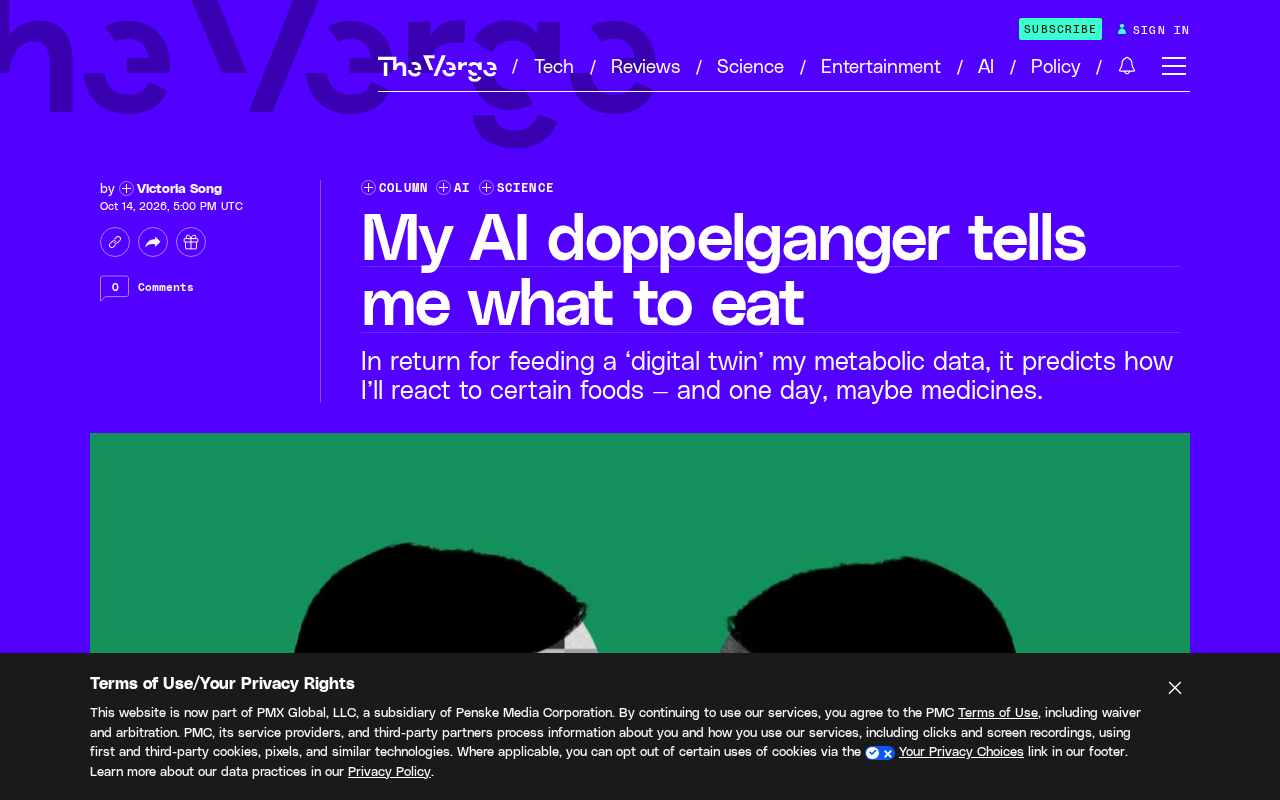
When Nutrition Advice Becomes Role-Play
The concept of an "AI diet twin" isn't complicated: users feed data from continuous glucose monitors (CGMs), sleep and heart rate data from smart rings or watches, and personal dietary logs into an AI system, which then generates a highly personalized digital avatar. This avatar no longer gives generic advice like "eat more vegetables" — instead, based on your current blood sugar fluctuations, sleep quality, and stress levels, it tells you directly what you can and cannot eat.
Victoria Song's experience outlined the contours of this type of product. In the first few days, she found the AI twin's instructions absurd — for example, on a morning when her blood sugar was stable, the twin insisted she start with a protein-rich breakfast instead of her usual oatmeal. But after a few days, when she began noticing changes in her glucose curves, skepticism turned into curiosity.
The core selling point of these tools is "personalization." Traditional nutrition science is based on population averages, while AI twins attempt to learn from your individual responses. From a technical standpoint, this relies on two key capabilities: real-time interpretation of continuous biological data, and causal inference of behavioral patterns.
Continuous Glucose Monitor (CGM) is a wearable device that uses a tiny sensor implanted under the skin to continuously measure glucose concentration in interstitial fluid, automatically recording data every 5 to 15 minutes and transmitting it wirelessly to a phone app. Compared to traditional finger-prick blood tests, CGM can capture the complete post-meal blood sugar fluctuation curve, revealing the dynamic effects of food, exercise, sleep, and stress on blood glucose. CGM was originally used for diabetes management and has recently entered the consumer health market, becoming a core tool for the concept of "metabolic health." Users can identify which foods cause blood sugar spikes and adjust their dietary patterns accordingly.
The observer effect originates from physics and psychology, referring to the phenomenon where the act of observation itself changes the state of the observed subject. In the health tracking field, this phenomenon is particularly pronounced: when people know their step count, diet, and blood sugar are being recorded, they tend to unconsciously improve their behavior — even without any specific recommendations from AI. This means that evaluating the effectiveness of AI health tools is extremely difficult — improvements may come from the algorithm, or they may simply come from the pressure of "being watched."
After 100 Days, What Answers Did the Body Give
According to Victoria Song's records, 100 days of AI dietary intervention brought some measurable changes, but not all were due to AI's contribution. Her blood sugar fluctuation range narrowed, and sleep quality improved slightly, but these changes were also confounded by seasonal shifts and adjustments to exercise habits. She admitted in her column: "I can't determine whether the AI twin made me healthier, or whether simply recording the data made me more mindful."
This "observer effect" is a classic dilemma facing AI health tools. When you know that your every move is being recorded and analyzed, your behavior itself changes. The value of an AI twin may not lie in how accurate its recommendations are, but in the continuous, low-friction health feedback loop it creates.
"My AI twin knows how badly I slept last night, so it won't suggest fasting today. That's something ordinary nutrition apps can't do." — Victoria Song wrote in the Optimizer column.
From a product design perspective, this ability to "know the context" is indeed what most health apps currently lack. Most apps only track a single dimension, while AI twins attempt to integrate multiple data streams to form a dynamic understanding of the user's state.
Where Are the Real Boundaries of Personalized Nutrition
Behind the buzz around AI diet twins is a grander narrative: precision nutrition. Researchers in this field are trying to answer a core question — why does the same bowl of rice have vastly different effects on different people's blood sugar?
Existing research shows that individual blood sugar responses to food are influenced by gut microbiome, genetics, sleep, exercise, and many other factors, and these factors interact with one another. AI's advantage lies in simultaneously processing these high-dimensional variables and discovering patterns that human nutritionists would struggle to detect. But the limitations are equally obvious: most consumer-grade AI systems lack clinical validation, and their recommendations are based more on correlation than causation.
Victoria Song's conclusion after the 100-day experiment is quite representative: "The AI twin made me more aware of my own body, but it's not a doctor, and it's not a nutritionist. It's a very smart reminder tool."
This positioning may precisely reflect the true level of current AI health products — not replacing professional judgment, but lowering the barrier to self-observation. For users who are already tired of generic dietary advice and willing to invest time in tracking and reflection, AI twins offer a new perspective. For those expecting "one-click health," it may just be yet another source of anxiety-inducing data.
The core challenge of precision nutrition lies in distinguishing correlation from causation. AI models excel at discovering statistical associations from massive datasets — for example, "sleep deprivation correlates with increased blood sugar fluctuations the next day" — but this doesn't mean sleep deprivation directly causes blood sugar fluctuations; there may be a third factor (such as stress or alcohol consumption) affecting both simultaneously. Consumer-grade AI systems typically don't have the conditions for validation through randomized controlled trials, so their recommendations often remain at the level of "empirical suggestions," lacking clinical-grade evidence. This is also one of the reasons the medical community remains cautious about AI nutrition tools.
Key Takeaways
- AI diet twins integrate CGM, smart ring, and dietary log data to provide personalized dietary recommendations based on real-time body status
- After 100 days of testing, Victoria Song experienced reduced blood sugar fluctuations and slight sleep improvement, but couldn't rule out the observer effect
- The core advantage of AI twins is "knowing the context" — integrating multi-dimensional data for dynamic understanding, which ordinary nutrition apps struggle to achieve
- The recommendations of consumer-grade AI tools are mostly based on correlation rather than causation, lacking clinical validation
- AI twins should be positioned as "smart reminder tools," not replacements for doctors or nutritionists
Related articles

WorkBuddy Agent in Action: From AI Q&A to Automated Office Work
WorkBuddy is Tencent's AI agent desktop workbench that reads local files, operates office software, executes multi-step tasks, and runs on schedules. This article explains its core features, key differences from traditional AI tools, and use cases.

Anthropic Research: LLMs Make Formal Software Verification at Scale Possible
Anthropic Frontier Red Team research shows LLMs can generate formal proofs at the RISC-V assembly level for over 100 real open-source libraries, covering 123 OSS-Fuzz libraries and 239 entry points, totaling about 180 million lines of Rocq proofs and finding hundreds of bugs. The article analyzes specification generation, the proof pipeline, trust boundaries, and cost reduction paths.

Prompt Engineering for Beginners: From Writing Prompts to Building AI Collaboration Skills
From the four functions of prompts to the six-step prompt engineering process, this article systematically covers core concepts, business value, and three layers of limitations to help beginners build a complete cognitive framework for prompt engineering.