AI Digital Employee Systems Tested: A Guide to Full-Chain Automated Office Work and Customer Acquisition

Breaking down the capabilities, usage, and marketing traps of AI digital employee systems, reminding entrepreneurs to view automation tools rationally.
Based on a hands-on demonstration on Bilibili, this article systematically breaks down the popular "AI super employee systems" on short-video platforms. These tools integrate agent customization, multi-model text-to-image, full-process short-video creation (including digital human avatars and viral secondary creation), map and enterprise search customer acquisition, multi-platform intelligent customer acquisition, and virtual employee functions such as AI customer service, HR, and legal. Essentially, they encapsulate large-model capabilities into out-of-the-box workbenches, lowering the barrier for non-technical users. The article also points out that phrases such as "zero-cost account opening" and "internal sourcing channel" carry obvious marketing inducement and may come with risks including limited features, malicious code, account restrictions, and personal information compliance. The conclusion: such systems are suitable for small and medium-sized merchants and self-media creators as efficiency aids, but they cannot truly replace human labor, and the core of customer acquisition and conversion is still people.
On short-video platforms, various "AI super employee systems" are attracting a lot of entrepreneur attention with the gimmick of zero cost and full automation. These tools claim to replace human labor with one click, covering the entire chain from content creation and customer acquisition to internal management. Based on a hands-on demonstration by a Bilibili creator, this article breaks down what these AI digital employee systems can actually do, how to use them, and the issues to watch out for behind the scenes.
1. An Overview of the Core Capabilities of AI Digital Employee Systems
From the demonstration, this system divides its functions into several main modules: AI chat assistant, agent configuration, AI image generation, short-video creation, customer acquisition tools, and virtual employees. The underlying logic is to encapsulate large-model capabilities into out-of-the-box workflows, so that users without a technical background can complete complex tasks through simple configuration.
1. AI Chat and Agent Customization
The system comes with a variety of preset agents covering scenarios such as new product development and service design. Users can directly copy templates and edit the model, category, knowledge base, and description before publishing them as their own dedicated agents. If there is no match in the preset library, they can also create one from scratch and define the agent's role and capability boundaries. In the editing interface shown in the screenshot, the agent's model selection, category tags, and support library can all be adjusted, and clicking publish puts it into use.
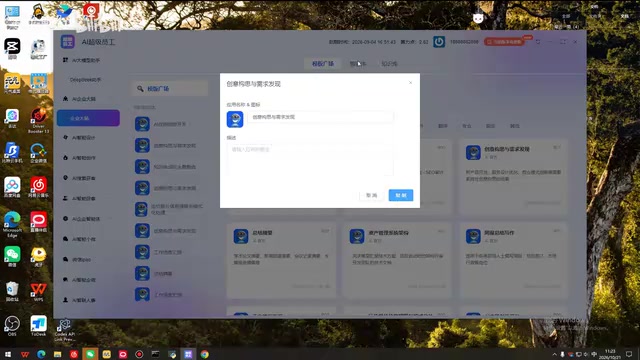
This means that an operations staff member who does not understand code can quickly build vertical tools such as a "product copywriting assistant" or "customer service Q&A bot," handing repetitive inquiries and content generation work over to the agent.
2. Multi-Model Text-to-Image
The AI drawing module supports switching between two models. Users can upload product images or enter prompts to generate covers, product images, or event posters. For e-commerce and self-media teams, this feature saves the time cost of outsourcing design and is especially suitable for scenarios requiring batch production of visual assets.
3. Full-Process Short-Video Creation
The short-video module is the centerpiece of the entire system and includes three sub-functions:
- Multi-scenario editing: After uploading video materials and configuring the title and spoken script, a talking-head video can be generated with one click, suitable for product promotion and knowledge sharing.
- Digital IP avatar: By cloning voice and appearance, users can create a dedicated digital human and generate a digital human talking-head video simply by entering text. This step requires first completing sampling and cloning of the voice and appearance.
- Viral secondary creation: Paste a link to a competitor's viral video, extract the script and rewrite it, then select a voice and avatar to regenerate it, quickly completing secondary creation.
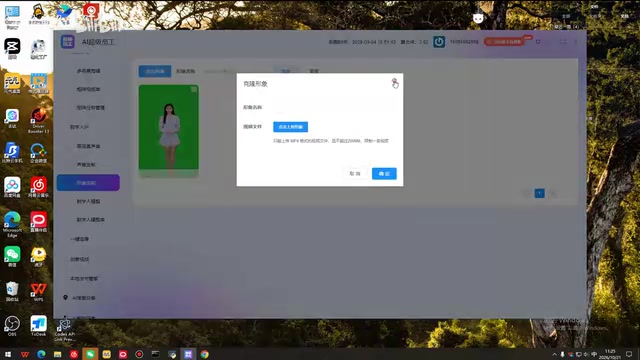
This workflow compresses the scriptwriting, filming, editing, and voiceover steps of traditional short-video production into a few clicks. It is highly attractive to individual entrepreneurs and small teams, but it also means an increased risk of content homogenization.
2. Customer Acquisition and Customer Management: From Lead Collection to Automated Responses
Customer acquisition is the focus of promotion for this type of system. The customer acquisition functions in the demonstration fall into two categories: search-based acquisition and intelligent acquisition.
1. Map and Enterprise Search Customer Acquisition
Map-based acquisition allows users to select a region and then query merchants in batches by keyword, for example, "all mobile phone repair shops in Hebei District, Tianjin." The system returns addresses, times, and phone numbers, and supports one-click filtering of valid numbers for import into WeChat. Enterprise acquisition follows a similar logic, retrieving relevant companies by region and exporting contact information.
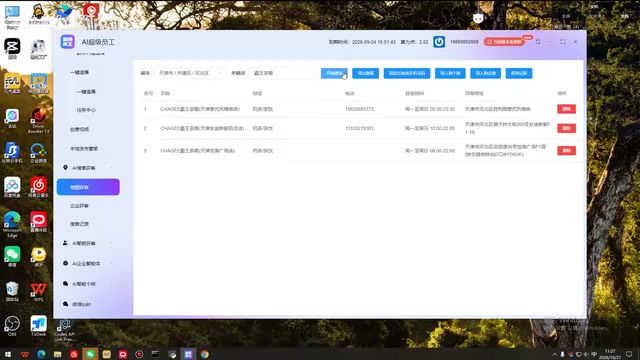
These functions are essentially aggregating publicly available business information into a sales lead database, which has some practical value for local life services and field sales teams. However, it should be noted that batch collection and import of phone numbers for marketing may touch on compliance red lines related to personal information protection, and users need to assess the risks themselves.
2. Multi-Platform AI Intelligent Customer Acquisition
Intelligent acquisition supports three major platforms: Douyin, Xiaohongshu, and Kuaishou. It can collect customers with precise needs through channels such as benchmark accounts, video keywords, and livestream customer acquisition, with a high degree of process automation. Its principle is most likely based on scraping and filtering publicly available platform content, and the actual effect depends on keyword strategy and target audience positioning.
3. Virtual Employees: Customer Service, HR, and Legal
The system presets a variety of "AI employee" roles:
- AI intelligent customer service: Configure keyword replies and aggregated chat to achieve 24/7 online responses and prevent customer loss.
- AI intelligent WeCom: Configure intelligent customer service for WeCom, with the same logic as the former.
- AI intelligent HR: Handles job posting, talent screening, task setting, and automatic greetings.
- AI intelligent legal: Provides legal and regulatory retrieval, judicial case search, and contract risk review.

These roles are essentially scenario-based encapsulation of large-model capabilities and are suitable as auxiliary tools to improve efficiency. However, when it comes to professional judgments such as contract review and talent screening, the reliability of AI output still requires human review and should not completely replace professionals.
3. The Risks Behind Zero-Cost Rhetoric and Rational Judgment
The video creator repeatedly emphasizes phrases such as "zero-cost account opening," "market price 1980 to 310," and "internal sourcing channel," and guides viewers to "comment 36 after 3 o'clock." Such expressions clearly have the characteristics of marketing inducement.
In reality, so-called "free" often comes with conditions: it may be a feature-limited version, a time-limited trial, or charge through subsequent value-added services. Even more worrying is that "system source code" of unknown origin may contain backdoors, malicious code, or simply be a simple wrapper around a third-party open-source project. Using such tools for operations such as batch customer acquisition and automatic friend adding may also violate platform rules and lead to account restrictions.
For content creators and entrepreneurs, AI digital employee systems do demonstrate the possibility of automated office work—handing repetitive labor to agents and focusing energy on strategy and creativity. But when choosing tools, priority should be given to legitimate channels, clear authorization, and compliance boundaries, rather than being dazzled by slogans of "zero cost, one-click replacement of human labor."
4. Who Are These Systems Suitable For?
Overall, the target users of AI digital employee systems are small and medium-sized merchants, self-media creators, and internet entrepreneurs who lack technical teams. Their value lies in integrating scattered AI capabilities into a unified workbench and lowering the barrier to use. But if you expect them to completely replace human labor and automatically bring in customers, you will most likely be disappointed. Efficiency improvements from tools need to be paired with clear operational strategies, and the core of customer acquisition and conversion is still people.
For readers who want to try them, it is recommended to first identify which parts of your business process are repetitive and have clear rules, then use AI tools to take over those parts, while remaining sensitive to data compliance and platform rules.
Background Supplement
Agent refers to a program entity built on a large language model that can autonomously perceive the environment, make decisions, and execute actions to accomplish specific goals. Unlike ordinary conversational AI, agents usually have task planning, tool calling, and memory capabilities, and can complete multi-step workflows with relatively little human intervention. In the context of this article, so-called "agent customization" is essentially presetting role prompts for a general large model, binding a knowledge base, and limiting the output format so that it performs more professionally and stably in specific business scenarios such as customer service and copywriting. Understanding this concept helps judge the true capability boundaries of such systems: they are not "employees" with autonomous consciousness, but highly scenario-specific encapsulation of prompt engineering.
Digital humans and voice cloning are hot technologies in current short-video creation. Voice cloning is usually based on a small number of speech samples, using neural networks to learn the speaker's timbre, rhythm, and pronunciation habits, and synthesize speech highly similar to the original voice; avatar cloning captures facial expressions and lip movements through video to drive a virtual avatar for talking-head delivery. Combined, the two can achieve "input text, output digital human video." It should be noted that such technologies involve portrait rights and voice rights, and cloning another person's image or voice without authorization may constitute infringement; at the same time, platforms usually require prominent labeling of AI-generated content, and users should comply with relevant labeling obligations.
Web crawlers and platform data scraping are the technical foundation of intelligent customer acquisition functions. So-called "collecting precise customers by benchmark accounts and keywords" is essentially automated programmatic access to public platform pages to extract user information. However, the terms of service of most short-video and social platforms explicitly prohibit unauthorized automated scraping, and platforms also use technical means such as rate limits and behavior verification to prevent crawling. In addition, if the scraped user information includes personal data such as mobile phone numbers and WeChat IDs, it may also fall within the scope of the Personal Information Protection Law. Therefore, the actual usability and compliance of such functions are highly uncertain, and users should not regard them as stable and lawful customer acquisition channels.
Related articles

"Black October": Did AI Uncover 3% of All Critical Vulnerabilities Ever?
A Reddit post claims 3% of all critical software vulnerabilities ever were found in the past month, dubbed 'Black October.' We break down the statistical issues, how AI-assisted code auditing accelerates discovery, and how developers should respond.

Microsoft Project Gecko: Using AI to Bridge Language Gaps for African Farmers
Microsoft's Project Gecko launches PharmaChat, letting African farmers ask questions in their native language and get precise video clips and farming book chapters via AI. The project also releases three interactive manuals to advance inclusive AI.

Musk's Space Dominance: How Starlink Throttling Undermines Ukraine's Defense
SpaceX's Starshield throttling disabled Ukraine's high-speed interceptor drones, exposing how Musk's private control over low Earth orbit communications affects battlefield dynamics and national security, and highlighting the risks of commercial space militarization and space governance dilemmas.