AI-Driven Drug Discovery: Orchestra Bio Acquired to Accelerate New Therapies

A company acquires Orchestra Bio, combining its process coordination platform with Rosalind AI models to make drug R&D operations more intelligent.
The article analyzes a Twitter announcement that a company has acquired biopharma process coordination platform Orchestra Bio. It notes that drug development involves multi-role collaboration and dozens of scattered tools, and that Orchestra Bio's value lies in task orchestration, data flow, and cross-team collaboration, reducing delays caused by information silos. The acquisition combines it with life sciences AI model Rosalind, extending AI from research assistance to operational optimization, such as predicting development bottlenecks and automatically generating compliance documents. The article sees this as a sign that life sciences AI competition is shifting from point tools to end-to-end process integration, while cautioning that GxP, HIPAA, and other compliance requirements and differences in enterprise processes will be major implementation challenges.
Acquisition Overview
Recently, an announcement from Twitter drew attention: a company announced its acquisition of Orchestra Bio, a platform that helps biopharma teams coordinate complex drug development processes. The announcement stated that the two parties will build on Rosalind—AI models and tools for life sciences research—to further streamline these operational processes and help new therapies reach patients faster.
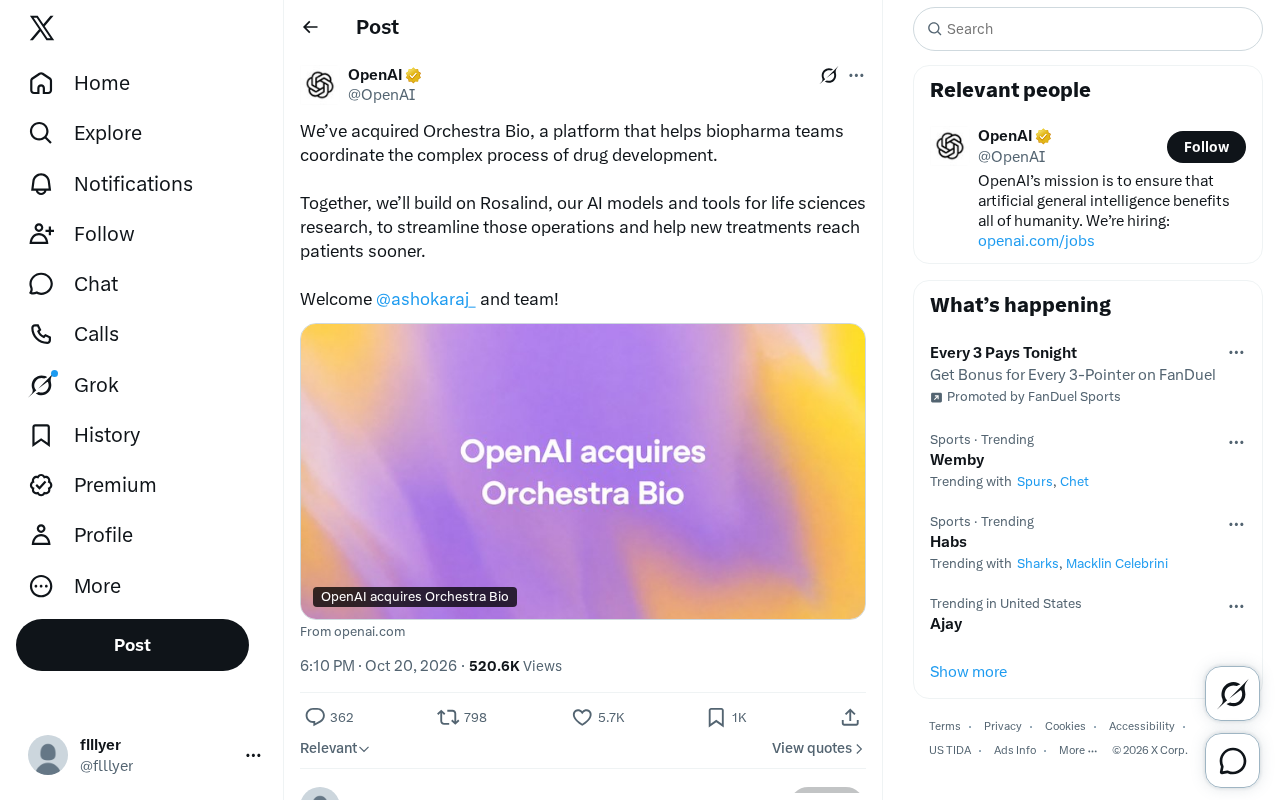
This brief message reveals two key points: first, AI applications in the life sciences are extending from pure research tools to process management; second, the "operational efficiency" problem in drug development is beginning to be systematically addressed by AI.
Why Does Drug Development Need a "Coordination Platform"?
Drug development is widely recognized as a complex systems engineering endeavor. From target discovery, preclinical research, and clinical trials to regulatory approval, it involves collaboration among biologists, chemists, clinicians, project managers, regulatory affairs experts, and many other roles, with data scattered across dozens of tools such as electronic lab notebooks, clinical trial management systems, and document repositories.
Orchestra Bio's positioning is precisely to address this pain point: it provides biopharma teams with a platform to coordinate complex processes. Although the announcement did not disclose specific feature details, it can be inferred from the description that the platform likely focuses on task orchestration, data flow, and cross-team collaboration, reducing delays caused by poor communication or information silos.
This complements AI models (such as Rosalind): AI is responsible for accelerating scientific discovery and experimental design, while the process platform is responsible for translating discoveries into executable development plans. Only by combining the two can the cycle from lab to bedside be shortened.
The "data silos" often mentioned in drug development refer to the use of disconnected specialized systems across R&D stages—electronic lab notebooks (ELNs) record raw experimental data, clinical trial management systems (CTMS) manage subjects and sites, and document management systems store regulatory submission materials. These systems operate independently, and the same piece of data often requires manual re-entry and verification, which both slows progress and is prone to errors. The core value of a coordination platform lies in connecting data flows between these systems, unifying scattered tasks, progress, and documents into a single traceable view, so that project managers can identify bottlenecks in real time rather than piecing together project status through emails and meetings.
Rosalind: AI Infrastructure for Life Sciences Research
Rosalind, mentioned in the announcement, is the technical foundation of this acquisition. According to public information, Rosalind is a set of AI models and tools for life sciences research. Although the original text did not elaborate on its technical details, it can be inferred that its capabilities may cover literature understanding, biological entity recognition, experimental data analysis, and more.
After acquiring Orchestra Bio, Rosalind's capabilities are expected to expand from "research assistance" to "operational optimization." For example, AI can analyze historical project data to predict development bottlenecks, or automatically generate compliance documents to reduce manual burden. This "AI + process" combination may become a new paradigm for AI applications in the life sciences.
GxP is the collective term for "Good Practice" regulations, covering a range of regulatory requirements such as pharmaceutical manufacturing (GMP), clinical research (GCP), and laboratory management (GLP), with the core aim of ensuring data accuracy, traceability, and auditability. HIPAA is U.S. legislation governing the privacy protection of personal health information. For AI platforms, this means that every document output by the model and every data call may need to retain an audit trail, and sensitive data must not be used for training at will. If a process platform is to embed AI-generated recommendations directly into R&D decisions, it must satisfy these constraints at the system level—which is also why implementing AI in the life sciences is more complex than in general office scenarios.
Industry Impact and Challenges
This acquisition sends a signal: competition in AI within the biopharma field is shifting from point tools (such as molecule generation and protein structure prediction) toward end-to-end R&D process integration. For biopharma companies, this means that more integrated solutions may become available in the future, reducing the cost of integrating multiple tools.
But challenges remain. Drug development processes are highly standardized and involve large amounts of sensitive data, so AI platforms need to meet strict compliance requirements (such as GxP and HIPAA). In addition, processes vary greatly across companies, and whether the platform can adapt flexibly is key to success. How Orchestra Bio's team (the announcement specifically welcomed @ashokaraj_ and their team) will play a role in the Rosalind ecosystem is worth continued observation.
Conclusion
Although the announcement provides limited information, the integration idea of "AI models + process platform" is clear: let scientists focus on science and let AI handle coordination and operations. If executed well, such tools may indeed, as the announcement says, help new therapies reach patients sooner.
(Note: This article is based on a public Twitter announcement and does not include undisclosed transaction details.)
Related articles

WorkBuddy Full Tutorial: Build an AI Office Automation Agent from Scratch
A complete WorkBuddy tutorial: installation, three working modes, multimodal picture book video practice, expert team agent building, and workflow configuration for low-cost AI office automation.

WorkBuddy Agent Complete Guide: From Beginner to Automation in 7 Days
Based on Bilibili's 256-episode WorkBuddy masterclass, this systematically breaks down Tencent's AI office workbench core capabilities: Agent principles, Skill encapsulation, cross-platform connectors, scheduled automation, knowledge bases, and zero-code development, with learning path recommendations.

8 AI Accounts, 7 Failed: An Honest Review of Using AI to Get Work Done
Only 1 of 8 AI-run Bilibili accounts succeeded. We break down the real difference between "performing AI" and "using AI to get work done."