AI-Driven Testing in Practice: How DeepSeekHarness Is Reshaping the Software Testing Process
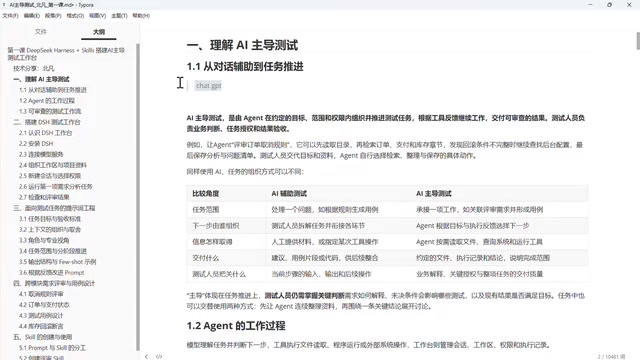
AI has evolved from chatbots into task-executing agents, driving testing toward a new human-AI collaboration paradigm.
Based on the Bilibili "AI-Driven Testing" training camp, this article analyzes AI's shift from auxiliary tool to task driver in software testing. AI-driven means AI advances the task chain while humans retain task definition and result acceptance authority. Using DeepSeekHarness, it demonstrates functional, Web, and API testing scenarios and notes that AI skills are becoming mandatory for testing roles.
AI's role in software testing is undergoing a qualitative shift. Over the past year, AI has been used primarily to assist development roles, but now testing roles are beginning to feel the transformative force of AI as well. A training camp course on Bilibili titled "AI-Driven Testing" uses DeepSeekHarness as its workbench to systematically break down how AI covers the entire process from requirements analysis and test case design to automated execution. This article, based on the course content and cross-verified with multiple sources, analyzes the core logic and implementation path of AI-driven testing.
From Conversation to Task: The Leap in AI Capabilities
Chatbots vs. Agents
Course instructor Mr. Beifang points out that when ChatGPT first appeared in 2023, AI primarily worked through Q&A or conversation—essentially "pure text communication." Today's AI has advanced to the Agent stage—it not only has a "mouth" for conversation but also "hands and feet" to use tools and execute tasks.
This distinction directly determines whether AI can take on real work in testing. According to analysis from the Bilibili course and multiple tech channels on YouTube, the core characteristic of an Agent lies in "using tools": it can read requirement documents, query databases, load files, and even roll back operations when errors occur. This means AI is no longer just answering "how to test"—it can actually go and execute testing tasks.
Agent is a core concept in the field of artificial intelligence, referring to systems that can perceive their environment, make autonomous decisions, and take actions to achieve goals. Unlike traditional chatbots that can only passively respond to single-turn questions, Agents are goal-oriented: they maintain an internal task state, preserve contextual coherence across multiple steps, and dynamically adjust subsequent actions based on intermediate results. Technically, an Agent typically consists of a large language model as the reasoning engine, combined with a planning module (task decomposition), a memory module (storing history and intermediate states), and a tool-calling interface. The industry often summarizes its operating paradigm as "perceive—plan—act—feedback." This concept can be traced back to the reinforcement learning field, but it was only after large models gained reliable tool-calling capabilities that language-model-based Agents became truly practical.
How Agents Work
An Agent operates in a closed loop of "task submission—planning—tool invocation—result evaluation—iterative improvement." When it receives a task (such as "cancel an order"), it first plans its next step: should it search the web, query a database, or write code to verify? It then invokes the corresponding tool to execute, and after obtaining the result, judges for itself whether it is correct. If the result doesn't meet expectations, it adjusts its approach or tool usage and continues the loop until it believes it has obtained the correct result.
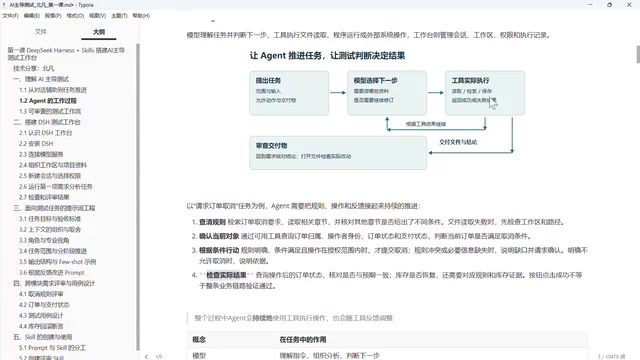
The key here is: the determination of "correct" is made by AI itself. The course emphasizes that this is precisely the point where human testers must intervene—AI thinking something is right doesn't mean it's actually right from a business perspective. Testers are responsible for final result acceptance and business judgment, ensuring AI hasn't deviated from the goal.
Tool Calling / Function Calling is the key mechanism that enables Agents to "take action." Large models themselves can only generate text and cannot directly read files, query databases, or operate interfaces. Tool calling works by declaring a set of available functions (and their parameter formats) to the model in the prompt, allowing the model to autonomously decide during reasoning "which function to call at this moment and what parameters to pass," after which an external runtime executes the function and returns the result to the model. This loop can repeat, and the model decides its next step accordingly. ReAct (Reasoning and Acting interleaved) is the most representative paradigm. The reliability of tool calling directly determines the success rate of Agent tasks—parameter format errors, inappropriate tool selection, or result parsing failures can all cause tasks to deviate, which is one of the reasons testers need to focus on validating AI outputs.
AI-Driven Testing: Driving Task Progression, Not Decision-Making Authority
The Essential Difference from AI-Assisted Testing
The course uses a comparison table to clearly delineate the differences between the two stages: in the AI-assisted testing stage, humans are responsible for breaking down each step, deciding what to do and how to do it, AI only answers individual questions or generates content, and testers also serve as "messengers," feeding AI output to the system and system results back to AI. In the AI-driven testing stage, AI is responsible for completing the entire task chain, and humans only need to control the boundaries—providing task objectives and accepting final results.
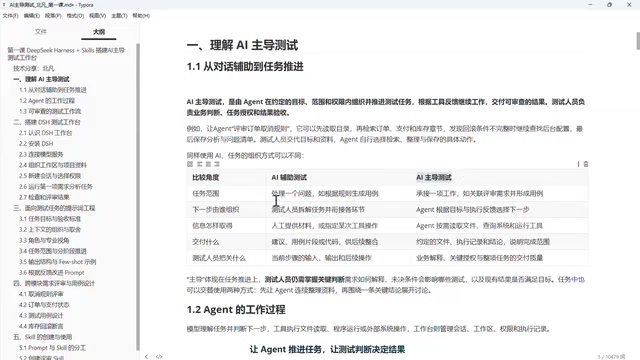
But this doesn't mean AI calls the shots. The instructor repeatedly emphasizes that AI-driven means driving at the task progression level—the key judgment authority remains in human hands. For example, AI's understanding of requirements may be off, the focus of test case design may be unreasonable, or business priorities may not match reality—all of these require tester oversight.
The Human Role: Boundary Control and Result Acceptance
The course presents a collaboration model for the testing workflow: humans propose clear tasks and provide context → AI advances in stages → humans review results → AI revises based on feedback. In this loop, humans always hold "task definition authority" and "acceptance authority." In the instructor's words: "AI-driven testing is not AI working alone, nor is it a one-voice dictatorship—it's collaboration between humans and AI."
This view aligns with judgments from multiple industry experts. Overall, AI cannot fully replace testers at the current stage, but it will significantly change how work is done—repetitive, rule-clear tasks will be largely handed to AI, and testers need to shift toward higher-level boundary control and quality judgment.
DeepSeekHarness: The Implementation Workbench for AI-Driven Testing
Tool Positioning and Core Capabilities
The course selects DeepSeekHarness (DSH) as the hands-on software for the training camp. It's important to distinguish: Agent is an academic concept, while DSH is a concrete software implementation—it integrates large models, tools, prompts, and other elements into a single workbench, allowing testers to directly drive the entire testing process using natural language.
According to the course, the training camp is divided into three sessions: the first establishes the cognitive foundation of AI-driven testing, the second conducts Web testing using a mall project, and the third conducts API testing. The three sessions cover three major scenarios—functional testing, Web testing, and API testing—corresponding to the daily work content of most testing roles.
The relationship among large models, prompts, tools, and Agents can be understood as follows: the large model is the "brain" that provides reasoning capability but lacks the ability to act on its own; prompts are the instructions and background materials that drive the brain, determining how the model understands the task; tools are the interfaces through which the model interacts with external systems, giving it the ability to read and write real data; and the Agent is the operating framework that organizes all these elements and autonomously advances tasks in a closed loop. In other words, the large model is the capability foundation, and the Agent is the engineering wrapper. The value of workbenches like DeepSeekHarness lies in pre-integrating model access, tool registration, prompt orchestration, and task loops, so testers can drive end-to-end testing processes with natural language without having to build infrastructure themselves.
Practical Workflow Example
Taking "cancel order" as an example: when a user sends a cancellation request to AI, the Agent won't directly change the database state—it first queries cancellation rules, determines whether the order status permits cancellation, then executes the operation, and finally checks the result. If the order doesn't exist or has already been completed, it decides the next step based on the status—not forcing execution, but adjusting strategy.
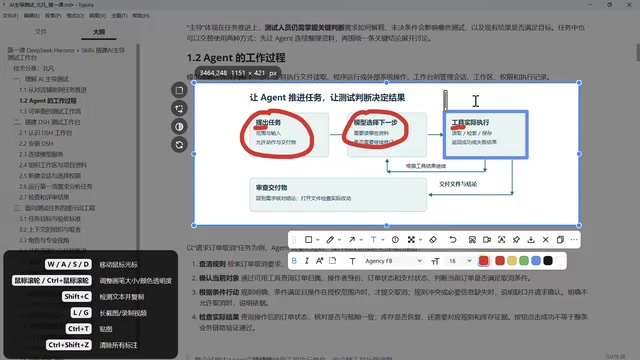
This process involves several core concepts: the large model acts as the brain, responsible for reasoning and decision-making; prompts provide task instructions and background materials; tools enable AI to truly obtain or change the world (such as connecting to a database to execute SQL); and the Agent is the integration of these elements. DSH, as the software carrying these capabilities, allows testers to get started without building an environment from scratch.
Industry Trends and How Practitioners Should Respond
New Requirements in the Job Market
The course mentions a noteworthy signal: in interviews today, recruiters directly ask candidates "Do you have AI experience?" "Have you applied AI in your work?" "How did you use it, what help did it bring, what challenges did you encounter?" AI application capability is becoming a mandatory assessment criterion for testing roles.
Roles Won't Disappear, But the Bar Is Rising
The instructor candidly addresses the anxiety of "AI can do everything—do we still need testers?": testing work still needs people, but perhaps not as many. Testers who can embrace AI and use it to improve efficiency will gain stronger competitiveness, while those unable to adapt to the new way of working will see their efficiency significantly outpaced by AI.
This judgment aligns with consensus from multiple sources—AI's penetration in testing is gradual, with tool maturity, enterprise acceptance, and workforce skill transformation jointly determining the pace of implementation. Tools like DeepSeekHarness lower the barrier to trying, but the real challenge lies in whether testers can redefine their value: transitioning from executors to designers and validators of AI workflows.
One-line Summary
AI has evolved from chatbots into agents capable of executing tasks, driving testing work toward a new paradigm of human-AI collaboration.
Paragraph Summary
Based on the Bilibili "AI-Driven Testing" training camp course, this article analyzes AI's role shift in software testing from auxiliary tool to task driver. The core argument: AI has evolved from pure conversational chatbots into Agents that can invoke tools and execute tasks, forming the technical foundation for AI-driven testing. However, "driven" refers to AI advancing the task chain, not a transfer of decision-making authority—humans still hold task definition and result acceptance authority, and must oversee AI's business judgments. Using DeepSeekHarness as the implementation workbench, the article demonstrates how it integrates large models, prompts, and tools to cover functional, Web, and API testing scenarios, and notes based on job market signals that AI application capability is becoming a mandatory requirement for testing roles—roles won't disappear, but the bar is rising, and practitioners need to transform from executors into designers and validators of AI workflows.
Related articles

A 19-Year-Old's Rental Horror Story: Ceiling Collapse, Bug Infestation, and the Lessons It Taught Me
At 19, my first off-campus rental brought bug infestations, no heat, a collapsed ceiling, and a ruined laptop with no renter's insurance. Here are the hard-won lessons for first-time student renters.

Veda Nurse's Cranial Nerve Exam: Why ASMR Role-Play Is Going Viral
Bilibili creator Veda's cranial nerve exam ASMR video goes viral, blending humor and sensory triggers through nurse role-play. This article analyzes its unique appeal and the audience psychology behind ASMR role-play.

LG Cinebeam AI Review: 120-Inch Giant Screen + 3000 Lumens, a New Choice for the Living Room Theater
LG Cinebeam AI projector review: 3000 ANSI lumens, 4K, 100 inches from about 8 cm and 120 inches from about 18 cm. Built-in webOS, AI Concierge voice recommendations, AI Sound Pro 11.1.2 virtual surround, and Game Optimizer—positioned for fixed living room installation, complementing the portable Cinebeam S.