AI Enters Academia: MIT Professor Raises Three Key Questions

An MIT professor raises three major questions on AI in universities: positioning, statistics' role, and interdisciplinary institutions.
MIT Center for Statistics and Data Science director Alexander Rakhlin raises three issues for AI in academia: whether institutions should treat AI as a tool or an independent discipline; how statistics should redefine its contribution by helping build methodology for large models; and how departmental barriers and incentive mechanisms block interdisciplinary collaboration. Together they point to one core contradiction: institutional adjustment lags far behind AI's pace of development.
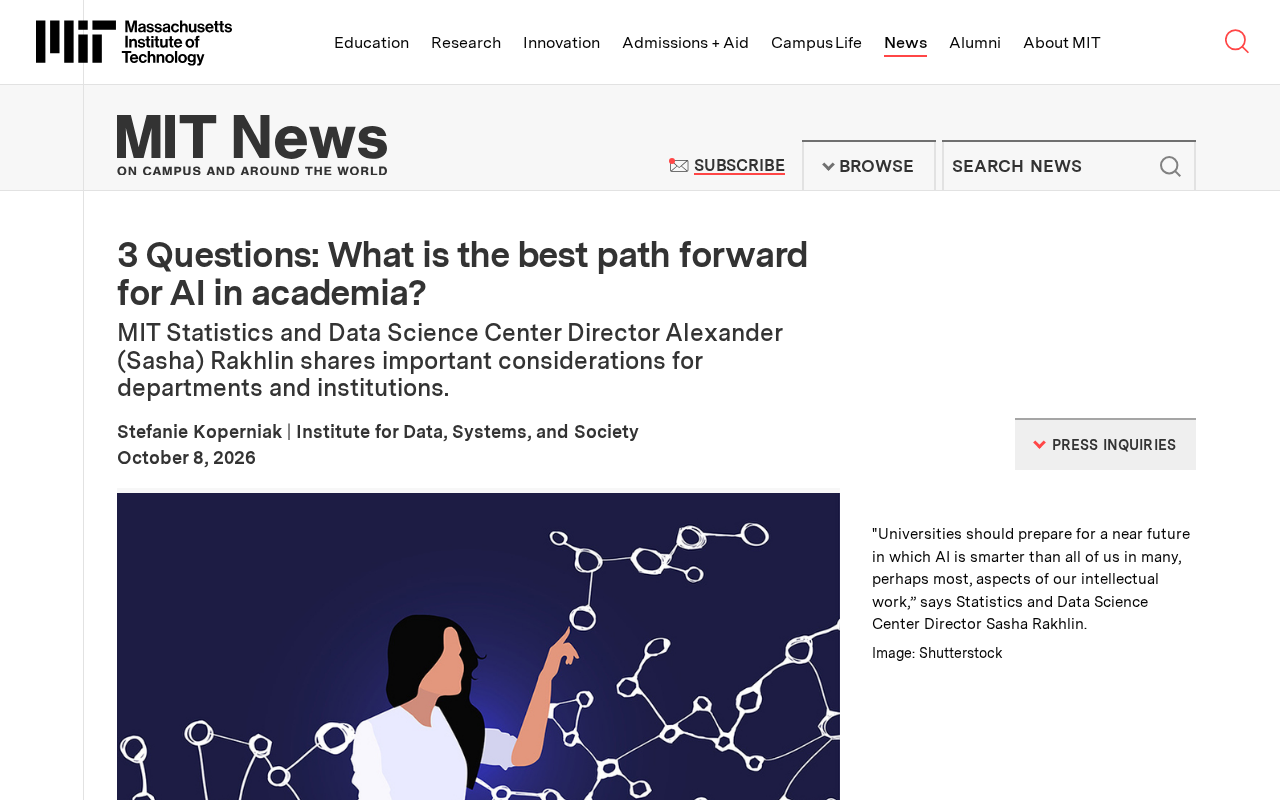
AI is reshaping how academia operates, from research methods to teaching assessment—almost no part of it can remain untouched. But there is no consensus in the academic community on exactly how to proceed. Alexander (Sasha) Rakhlin, director of MIT's Center for Statistics and Data Science, raised three questions worth serious consideration by departments and institutions regarding AI's positioning within academic institutions.
Question 1: Should academic institutions treat AI as a tool or as a discipline?
Rakhlin's first core question is one of positioning. AI plays two roles simultaneously in universities: it is a research tool that can be used by various disciplines, and it is also an emerging discipline that requires independent institutional structure and independent training programs. These two paths have completely different requirements for resource allocation, faculty recruitment, and curriculum design.
If AI is treated only as a tool, departments may tend to add AI modules to existing courses or purchase ready-made AI platforms to assist research. This approach is low-cost and quick to show results, but it is difficult to build genuine academic accumulation. If AI is to be developed as a discipline, it requires dedicated faculty positions, independent degree programs, and cross-departmental coordination mechanisms—a much larger investment, but potentially more competitive in the long run.
Rakhlin leans toward the latter, but also acknowledges that not every university is in a position to take that path. The key is whether an institution clearly understands its place in the AI landscape.
The concrete differences between "tool vs. discipline" in the university context
Treating AI as a tool means embedding it into the methodological toolbox of existing disciplines to serve the solution of problems in those fields; the logic of knowledge production remains dominated by the original discipline, and AI itself does not generate independent academic evaluation standards. Treating AI as a discipline, by contrast, requires establishing an autonomous knowledge system, core curriculum, peer review community, and academic promotion pathways, similar to the process by which computer science became independent from mathematics departments. This distinction directly determines where resources flow: under the tool path, investment mainly takes the form of computing power procurement and short-term training; under the discipline path, it requires long-term faculty lines, doctoral program development, and cross-departmental coordinating bodies. Rakhlin's question is essentially asking: Are universities willing to bear the high institutional cost of establishing AI as a discipline, or are they content to treat it as a general-purpose technology for improving the efficiency of existing research?
Question 2: What is the role of statistics and data science in the AI era?
As director of the Center for Statistics and Data Science, Rakhlin has a distinctive perspective on this issue. Statistics has long been the methodological foundation for data analysis and inference, but the rise of deep learning and large models has, in a sense, bypassed the traditional framework of statistical inference—models have become larger and harder to explain, while predictive performance has become the primary evaluation criterion.
This creates tension: statistics emphasizes interpretability, uncertainty quantification, and causal inference, while current mainstream AI practice tends to place more value on empirical performance after scaling. Rakhlin argues that statistics and data science should not passively accept this shift in landscape, but should actively participate in building AI methodology—for example, by providing statistical theoretical foundations for large-scale models or developing uncertainty assessment methods suitable for complex AI systems.
In other words, in the AI era, statistics is not being replaced; rather, it needs to redefine its points of contribution.
The tension among interpretability, uncertainty quantification, and causal inference in the AI era
The three pillars of traditional statistics—interpretability, uncertainty quantification, and causal inference—face fundamental challenges under the paradigm dominated by deep learning. Large models fit complex functions through massive parameters, and their decision-making processes are difficult to characterize with classical statistical models, with predictive accuracy often coming at the expense of interpretability; at the same time, confidence calibration issues in model outputs make it difficult to directly apply traditional confidence intervals and hypothesis testing frameworks; causal inference appears even more marginalized because models mainly capture correlation. The "active participation" Rakhlin calls for means that statisticians should not stop at criticizing black boxes, but should develop new theoretical tools suitable for high-dimensional, nonparametric, large-scale models—for example, introducing methods such as distributionally robust optimization and conformal prediction into uncertainty assessment for AI systems, thereby reestablishing the irreplaceability of statistics at the methodological level.
Question 3: How can the institutional barriers to interdisciplinary collaboration be broken?
AI research is inherently interdisciplinary. A truly influential AI project often requires people from computer science, statistics, and domain knowledge (such as biology, economics, and medicine) to work together. But the organizational structure of universities is usually divided along traditional disciplinary lines, with budgets, hiring, and promotion all tied to departments, creating substantial institutional resistance to cross-departmental collaboration.
Rakhlin mentions that unless incentive mechanisms at the department level are adjusted, interdisciplinary AI research will be difficult to truly implement. For example, if a professor in a statistics department spends a great deal of time collaborating with the computer science department, who should lead his promotion review? How should the resulting outputs be distributed among departments? If these questions are not resolved, collaboration can only remain spontaneous activity at the individual level.
He suggests that when designing AI strategies, institutions should make supporting institutional arrangements one of their priorities, rather than simply building a few labs and hiring a few people and considering the job done.
Typical institutional friction between university departmental barriers and interdisciplinary AI collaboration
Universities divide departments along traditional disciplinary lines, and budgets, faculty lines, and promotion reviews all operate as closed loops with the department as the unit, which creates deep institutional barriers to interdisciplinary AI research. Specifically, when a statistics professor coauthors a paper with the computer science department, authorship and credit often become contentious: can the paper count toward the statistics department's promotion evaluation? How should patents or funding generated by the collaboration be distributed among departments? More difficult still, interdisciplinary collaboration often requires professors to invest substantial time in understanding domain knowledge, and that time cannot be directly converted into academic output recognized by their home department. The incentive mechanism adjustments Rakhlin points to require institutions to break the single-affiliation logic that "a professor belongs to only one department" and establish institutional arrangements such as joint appointments, mutual recognition of cross-departmental outputs, and shared collaborative performance evaluation; otherwise, interdisciplinary AI research can only rely on individuals' spontaneous enthusiasm and will be difficult to sustain.
What the three questions point to together
Viewed together, Rakhlin's three questions point to the same core contradiction: the pace of AI development far exceeds the pace of institutional adjustment in academia. Whether it is disciplinary positioning, methodological contribution, or interdisciplinary collaboration, the bottleneck is not the technology itself, but organizational structure and incentive mechanisms.
This judgment also applies to domestic universities and research institutions. AI-related departments and research centers have emerged in large numbers over the past few years, but there are not many cases that truly resolve the institutional problems mentioned above. Rakhlin's reminder is this: if institutions focus only on keeping up at the technical level while ignoring design at the institutional level, AI's potential in academia will be difficult to fully unleash.
One-line Summary
An MIT professor raises three major questions about AI's positioning in universities, the role of statistics, and interdisciplinary institutions, with the core contradiction being that institutional adjustment lags behind technological development.
Paragraph Summary
In an interview, Alexander Rakhlin, director of MIT's Center for Statistics and Data Science, raised three issues that academia must confront as AI enters universities: first, whether academic institutions should treat AI as a research tool or an independent discipline, two paths with vastly different requirements for resource allocation and faculty development; second, that statistics and data science need to redefine their points of contribution in the AI era and actively participate in building methodology for large-scale models, rather than passively accepting an evaluation system dominated by predictive performance; third, that the biggest obstacle to interdisciplinary AI collaboration lies in departmental barriers and incentive mechanisms, and unless issues such as attribution of outputs and promotion review are resolved, collaboration will be difficult to implement. Together, the three questions point to the same core contradiction: the pace of AI development far exceeds the pace of institutional adjustment in academia.
Related articles

Amphibious Transforming Drone: Beyond 100x Power Savings, What Are the Real Needs?
Is the amphibious transforming drone just a gimmick? Starting from the 100x power difference of the M4 Morphobot, explore real application scenarios and thesis topic ideas, analyzing boundary conditions where pure drones and pure ground robots both fail.

Warhound Raises $200 Million: Genetically Engineered "War Dogs" Paired with Anduril Gear
Warhound raises $200M, backed by Ben Lamm and Palmer Luckey, to genetically engineer dogs for military and law enforcement use and equip them with Anduril gear. This article analyzes its technology direction, funding logic, and ethical controversy.

Claude API Comes to Google Cloud: IAM Integration and SDK Access Guide
Anthropic hosts the full Claude API on Google Cloud with IAM-controlled permissions and unified billing. This guide covers the Vertex AI and Anthropic-hosted entry points, IAM role configuration, and SDK access.