AI Evening Report: DeepSeek ARR Tops $1B, Tencent QClaw Announces Shutdown

DeepSeek hits $1B ARR and eyes IPO; QClaw shutdown spotlights commercial Agent risk; Apple, Google, Anthropic all ship updates.
Today's roundup covers DeepSeek's ARR reaching $1 billion and its reported Shanghai IPO plans (unconfirmed officially), Tencent QClaw's December 2026 shutdown sparking debate on commercial Agent reliability, and Apple's new `fmchat` CLI for local AI on macOS (unavailable in mainland China). Anthropic's engineer attributed Claude's writing decline to over-training on math/code, with Opus 5.5 targeting improvements. Google released Gemini Flash TTS with 2,000+ voices and voice cloning. Meta Muse Spark 1.4 and miHoYo's LLM ambitions remain unverified rumors.
Today's AI news cycle was packed with developments: DeepSeek's revenue figures and IPO plans drew significant attention, Tencent's sudden QClaw shutdown announcement once again reminded developers of the risks of building on commercial products, and Apple, Google, and Anthropic all made notable moves. Here's a breakdown with brief analysis.
DeepSeek ARR Tops $1 Billion, Eyes Shanghai Stock Exchange Listing
According to media reports, DeepSeekAd's annualized revenue run rate (ARR) has reached $1 billion — up from under $500 million just a few months ago. These figures were disclosed by CEO Liang Wenfeng at a recent investor meeting. The company is pursuing a second funding round and preparing for a listing on the Shanghai Stock Exchange, with plans to complete the process before the end of October. The target raise is 50 billion RMB (approximately $7.5 billion USD), with a target valuation of 500 billion RMB.
For context, last month's price hike raised model API pricing to 2.3–4.5x its previous levels, yet Liang claims it has not led to customer churn. Over 70% of the company's compute is currently devoted to training, with inference accounting for less than 30% — a structure suggesting DeepSeek remains in a heavy R&D investment phase rather than a pure API monetization mode.
A word of caution: both the fundraise and IPO are described as "plans" rather than completed events, and DeepSeek has not issued any official announcement. These numbers come from a meeting disclosure relayed through media, and should be treated with appropriate skepticism.
What is ARR? Annualized Revenue Run Rate is a metric that extrapolates current short-term revenue into a full-year figure — commonly used in fast-growing tech company fundraising narratives. It's typically calculated by multiplying the most recent month or quarter's revenue by 12 or 4, rather than drawing from a full fiscal year of historical data. As a result, ARR can amplify growth momentum and may be misleading during periods of seasonal volatility or business instability. For a company like DeepSeek that is still in rapid expansion, ARR figures should be interpreted alongside actual cumulative revenue, customer retention rates, and cost structure for a more accurate picture of commercial health.
Tencent QClaw Announces Shutdown, Highlighting the Risk of Commercial Agent Products Going Offline
Tencent has posted a shutdown notice on the QClaw website: the service will officially cease operations at midnight on December 24, 2026. New user registrations, subscription purchases, and renewals are suspended immediately, and existing auto-renewals will be automatically cancelled. The site has also opened a refund channel based on unused credit ratios, along with a data migration path to WorkBuddyAd. Export and migration tools will remain available until March 24, 2027 — approximately 90 days away per the countdown on the page.
The stated reason is "business development adjustments," with Tencent telling media it plans to consolidate resources and deliver better Agent services. The incident has prompted many in the community to reassess a real-world challenge: building personal or professional Agent workflows on top of commercial products always carries the risk of the underlying service being discontinued. By comparison, local deployment or open-source alternatives offer greater long-term stability.
DeepSeek Harness Enters Developer Preview, Desktop Installer Appears on Official Domain
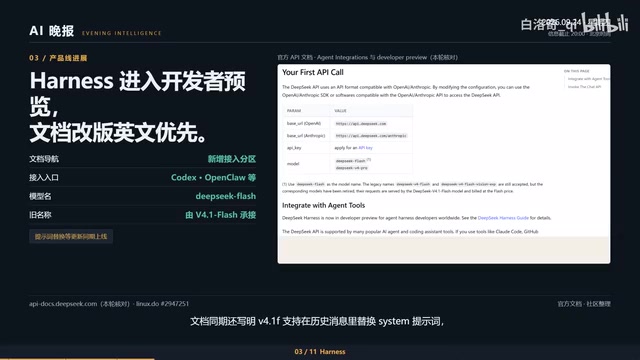
DeepSeek Harness has seen official progress today. The official API documentation has been revamped — the homepage now states that Harness is in developer preview, and a new "Agent Integrations" section has been added to the navigation, listing entry points for Cloud Code, Codex, Open Code, and Open Claw. Model names have been unified as DeepSeek Flash and DeepSeek V4 Pro; the old names are being retired in favor of V4.1 Flash, which will be billed at Flash pricing. The updated docs also note that V4.1F supports replacing System prompts within conversation history, the Models API endpoint has been expanded, Codex integration documentation has been updated, and 10 third-party Agent pages have been removed.
A separate community tip notes that desktop installers for Windows and Mac have appeared at the official domain download.deepseek.com, though no official desktop announcement has been made. Community members have noted that the client includes login and balance-checking features, may offer a subscription plan, and can connect to third-party models. Some users have reported the installer is quite large and that the Windows version had installation issues.
Apple Adds Local AI Model CLI to macOS
Apple has shipped a local AI model command-line interface in the latest macOS update. After updating, users can run fmchat in Terminal to chat directly with on-device models, or opt for cloud models subject to usage limits. This capability was introduced at WWDC developer sessions as a new FM command-line tool. First-time users need to accept the license agreement by running sudo fmlicense.
One caveat: the feature appears unavailable on devices purchased in mainland China. Apple's support page currently states that "devices purchased in mainland China cannot temporarily use Apple Intelligence features," though Apple has not explicitly linked the FM command to regional restrictions.
Anthropic Engineer Explains Why Claude's Writing Has Gotten Worse
Jackson Kynian, an Anthropic engineer who works on Claude fine-tuning, has explained why the model's writing quality has declined. He says later model iterations were optimized heavily for math and code, and were also trained extensively on technical explanations written for other AI models — resulting in a model tuned to an "LLM mindset" that learned to write for AI readers rather than human ones.
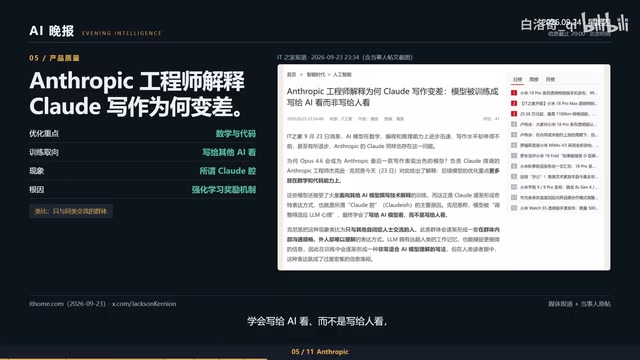
He analogized this to "someone who only communicates with others of their own kind," tracing the root cause to reinforcement learning reward mechanics: the more math and code training, the more deliberate effort is required to reward clear, human-readable explanations. He says Opus 5.5 is the first version with targeted improvements for sentence clarity and information overload, and that he hasn't been this satisfied with a model's writing since Opus 4.6 — though he also emphasized that this doesn't mean Opus 5.5 is a comprehensive improvement over Opus 4.6. He acknowledges this is a difficult problem that will require ongoing work.
On reinforcement learning reward mechanics: The "RL reward mechanism" referenced here refers to RLHF (Reinforcement Learning from Human Feedback) or similar alignment training pipelines, where models adjust their outputs based on preference scores from human annotators. When training data and reward signals are heavily drawn from structured tasks like mathematical derivations and code review, models internalize "high information density and logical rigor" as the standard for a "good output" — which over time suppresses plain-language expression aimed at general readers. The "learning to write for AI" phenomenon the engineer describes is essentially a form of reward distribution shift: a systematic divergence between what the model is optimized for and what real users actually need. This remains an unsolved challenge in large language model alignment research.
Google Releases Gemini Flash TTS With 2,000+ Voices
Google has released Gemini 3.8 Flash and Flash Lite TTS models, claiming them as new state-of-the-art text-to-speech models. They feature an all-new voice design experience with over 2,000 production-ready voices, support for voice cloning and 100 languages, and have claimed the top spot on the Hume AI voice design benchmark with a score of 71.4. Voice remixing is noted as coming soon.
The official blog adds that voice cloning requires just a 30-second audio sample, and all generated audio will carry a SynthID watermark. Cloning capabilities are unavailable in parts of the United States, the European Economic Area, the United Kingdom, Switzerland, and India. The comment section has been flooded with questions about why this isn't a Gemini Pro release, and some users report that the two 3.8 models sound less expressive by default than the 3.1 models.
What is SynthID? SynthID is a watermarking technology for AI-generated content developed by Google DeepMind. It embeds imperceptible markers at the signal level of audio, images, or text, allowing content to be identified as AI-generated by dedicated detection tools. Unlike metadata watermarks, SynthID's markers survive file format conversion and moderate compression, making them more robust. In speech synthesis, the watermark is embedded in the audio waveform itself without affecting the listening experience, but enables content traceability and abuse detection. This mechanism is also a key technical implementation direction for provisions requiring identifiability of AI-generated content under recent regulatory frameworks such as the EU AI Act.
OpenCode Updates and Meta Muse Spark Rumors
OpenCode has shipped an update adding support for Opus 5.5, GPT-6, Sora, Luna, and Grok 4.7, alongside managed updates, restart recovery, a 30-day GitHub usage view, remote file memory and skills, real-time meeting notes, and decision model support. The official scope cited is over 2,600 PRs. The decision model has also been clarified: plugins can choose a model separate from the chat model for structured decision-making.

The community has also noticed Meta's Muse Spark 1.4 appearing on OpenCode's usage data page, with some treating it as a signal of an upcoming Meta model release. However, on closer inspection, the entry shows zero usage (0 tokens, no activity in the two-week window). On the same page, the officially released Meta Muse Spark 1.3 ranks second with 35 tokens. As of now, there is no official information confirming the existence or release timeline of version 1.4.

ElevenLabs CEO has stated that the company has brought its best voice capabilities into Meta's personal AI agent Muse, with voice-overs, soundtracks, and video generation all available within a single message in Muse. However, Meta's prior Muse documentation made no mention of ElevenLabs, and neither company has clarified available plans, regions, or pricing.
Hugging Face CEO Addresses UN Security Council on AI Safety
Hugging Face co-founder and CEO Clément Delangue addressed the UN Security Council on AI and international security. He described Hugging Face as the first company to publicly disclose an autonomous agent-driven cyberattack, noting that when the attack occurred, the team initially found that the frontier closed-source API they were using was blocked by its own safety guardrails — which couldn't distinguish between offensive and defensive use. They switched to an open-source model, NVIDIA's quantized version of GLM, run on their own infrastructure to complete the analysis. He used this experience to advocate for broader access to open-source AI.
He also called for mandatory sharing of complete agent execution traces, and argued that the greatest risk is not powerful AI itself but "asymmetry of power," pushing back against anthropomorphizing frameworks for discussing AI risk. According to Hugging Face's previously disclosed technical timeline, the attack in question was AI agent-driven and produced approximately 17,600 attack actions over four days.
On autonomous agent-driven cyberattacks: The incident Delangue referenced is one Hugging Face disclosed in 2024, in which attackers used an AI agent to automatically conduct large-scale penetration attempts against their infrastructure — generating nearly 17,600 attack actions over approximately four days. What distinguishes this class of attack is that no step-by-step human direction is required; the agent can autonomously plan attack paths, invoke tools, and adapt its strategy based on feedback, dramatically lowering the barrier to high-intensity cyberattacks. The incident also revealed an edge case for commercial APIs in security research contexts: closed-source models with built-in safety guardrails blocked legitimate defensive analysis requests, which became a direct basis for Delangue's argument at the Security Council in favor of the controllability of open-source models.
Rumors of miHoYo Entering the LLM Space
Circulating online is content allegedly from a miHoYo campus recruitment presentation, in which the founder known as "Da Wei Ge" reportedly stated that miHoYo will "absolutely" be in the top tier of domestic large language model vendors within two to three years. Figures like a 100 billion RMB investment have also been mentioned, but without any clear source. Discussion has been mixed — some argue miHoYo has more capital than several existing domestic model companies, while others question whether 100 billion RMB is enough to solve the talent, data, and compute challenges. Some players have also noted that AI NPCs in miHoYo's games are impressively capable, suggesting the company may hold high-quality training data.
This story currently rests entirely on presentation hearsay and community tips. miHoYo has made no official announcement, and none of the figures or parameters cited have been independently verified.
That's everything for today — see you next time.
Related articles

WorkBuddy Full Tutorial: Build an AI Office Automation Agent from Scratch
A complete WorkBuddy tutorial: installation, three working modes, multimodal picture book video practice, expert team agent building, and workflow configuration for low-cost AI office automation.

WorkBuddy Agent Complete Guide: From Beginner to Automation in 7 Days
Based on Bilibili's 256-episode WorkBuddy masterclass, this systematically breaks down Tencent's AI office workbench core capabilities: Agent principles, Skill encapsulation, cross-platform connectors, scheduled automation, knowledge bases, and zero-code development, with learning path recommendations.

8 AI Accounts, 7 Failed: An Honest Review of Using AI to Get Work Done
Only 1 of 8 AI-run Bilibili accounts succeeded. We break down the real difference between "performing AI" and "using AI to get work done."