AI Face-Swap Scams Escalate: $400M Stolen in 18 Months; Google's New Gemini Model Enters Search

AI face-swaps break video identity verification, while search and assistant upgrades hide information and copyright risks behind convenience.
This roundup covers multiple AI and crypto developments: the DOJ's FaceDealer scam stole $400M+ via AI face-swaps in video calls; Google launched Gemini Hydrogen in Search; Meta's AI assistant can call businesses for users. Also covered: a 11,000+ bird sticker project exposing vibe coding copyright risks, BunoCoin's withdrawal suspension, frozen Binance assets that may not be returned, and Robin Li's "intelligent organization" concept.
When the "Acquaintance" on Video Starts Lying
A case announced by the U.S. Department of Justice on Thursday is a wake-up call for anyone who relies on video calls to verify identity: over 18 months, a group of hackers used stolen footage and AI face-swap technology to impersonate trusted contacts during video conferences, making off with more than $400 million in crypto assets. The FBI has given this playbook a codename — FaceDealer.
The attack chain isn't complicated, but it's extremely effective. Hackers first steal the victim's account, pull the target into a video meeting, and play pre-recorded camera footage so the other person believes they're talking to someone they know. More troubling still, they use AI-generated deepfake videos of well-known figures in the crypto industry to build trust. In the past, video calls were almost the last line of defense for identity verification — you could hear the voice, see the face, and say the name. Now all three can be fabricated, and what's been taken away is precisely the simplest judgment of all: "I saw it with my own eyes."
The group's targets are now tilting toward open-source developers, suspected to be paving the way for supply-chain attacks. For any request involving transfers, permission changes, or installing plugins, the safest move is to hang up and call back on your own number to confirm — don't follow the other party's instructions on video. Enable two-factor authentication on important accounts and ask a few questions only the real person would know, which can also make forgers slip up.
Deepfake refers to technology that uses deep learning models (such as autoencoders, generative adversarial networks, or diffusion models) to transfer one person's facial expressions, lip movements, and even voice onto another person. Early implementations required large amounts of video material of the target person for dedicated training, but in recent years real-time face-swap tools can dynamically replace a face in a video call using just a single photo, with latency so low it's hard to distinguish with the naked eye. The open-sourcing and commercialization of such tools has completely invalidated the assumption that "seeing is believing" in identity-verification scenarios. Defensive thinking has accordingly shifted toward multi-factor cross-verification — for example, hanging up and calling back a known number, asking for private details only someone with a real relationship would know, and avoiding transfers or software installation under video guidance.
Google Puts Gemini Hydrogen Into the Search Box
Google has released a brand-new model, Gemini Hydrogen, and plugged it directly into Google Search. According to Google, this is the biggest model improvement to search to date. Hydrogen is designed to quickly complete multi-step tasks rather than being the strongest reasoning model, but Google says it completes tasks 2.5 times faster than the previous fast model, Gemini 3.8 Flash, and at the default high-thinking setting it even outperforms the stronger Gemini Argon on a comprehensive intelligence benchmark.
In terms of the search experience, the most intuitive change is better understanding of multi-part questions. Previously, when users encountered a slightly roundabout question, they had to break it into several searches and assemble the answer themselves; now they can ask it all at once. Specific requirements and typo tolerance have also improved, and the links provided are more useful.
But answering fluently doesn't mean answering correctly. When several pieces of time-sensitive information are kneaded into a single paragraph, the sources get kneaded in too. For conclusions involving amounts or regulations, clicking through to the source page to double-check is still a necessary step. The search box has gotten smarter, but users' vigilance about information sources must not get lazier along with it.
Multi-step task refers to a type of question where the model must sequentially complete retrieval, comparison, calculation, summarization, and other steps before giving a final answer — for example, "Help me find three cameras that fit my budget and support a certain feature, and compare their battery life." Traditional search engines excel at single-round keyword matching; users must break down the question themselves, search multiple times, and manually stitch things together. Once a model with task-orchestration capabilities is integrated into search, the system can internally handle query rewriting, multi-source crawling, and information integration, outputting a structured answer in one go. The cost is that the intermediate reasoning behind the answer is folded away, making it harder for users to judge which page each conclusion came from; therefore, when it comes to amounts, regulations, or medical advice, tracing back to the original source remains an indispensable step.
Meta's Assistant Makes Calls for You — and Hands Over Your Information Too
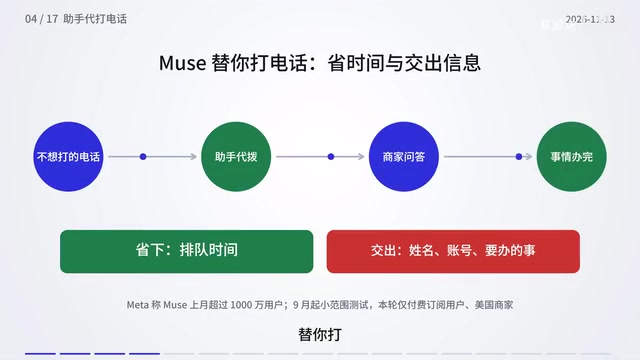
Meta's consumer AI assistant, Meta AI, can now call U.S. businesses on users' behalf. It had previously been in small-scale testing, and this round is open only to some subscribers. Meta says the assistant surpassed 10 million users last month. Meta's chief AI officer gives examples: you can use it to call the cable company, the DMV, or a restaurant that doesn't accept online reservations — offloading the calls you don't want to make.
What you save is queuing time; what you hand over is your name, account, and what you need done this time. If the other party asks an extra question, the assistant answers for you — and whether you can look it up afterward is the foundation that should come with it. Start with questions that don't involve money; for calls involving bills, documents, or changing plans, it's safer to make them yourself.
Stickers of 11,000+ Bird Species: The Joy of Vibe Coding and the Copyright Reefs
A global bird sticker library has turned all 11,064 living bird species in the world into white-bordered stickers and announced it as open source. The author doesn't know how to write code and burned through more than 1 billion tokens with vibe coding, casually building a bird website that supports search in 15 languages along the way. The reference images were batch-scraped real photos from iNaturalist and Wikimedia Commons, assembled into nine-square grids and handed to a generative model to redraw.
The problem lies in licensing. Of the 11,064 species, only 1,986 use open licenses; the rest are marked non-commercial use, no derivatives, all rights reserved — and for another 27,017, no license agreement was recorded at all. The author applied their own license label to the stickers and noted that photographers who don't want their work used can email to have it removed within a week.

Images like these, neat and tidy and labeled with scientific names, are easily lifted into courseware and encyclopedias as popular-science material. But the prototype photos may not be licensed for use, and the details are filled in by the model — use it to identify birds, and you might identify a bird that never existed. When showing science images to children, it's safer to find ones with a photographer or source credited.
Vibe coding refers to a programming approach where developers don't write code line by line but instead describe intent in natural language and let a large language model generate and iterate the code. It lowers the barrier for non-programmers to build tools, enabling individuals to quickly build websites or batch-processing pipelines. But such projects often lack engineering constraints on data sources and licensing: batch-scraping images, calling generative models to redraw them, and then publishing under a uniform license — any copyright flaw in the chain gets amplified. Open licenses such as Creative Commons typically require attribution, prohibit commercial use, or prohibit derivatives; when mixed with non-commercial or all-rights-reserved material, redistributing the entire batch of output carries legal risk.
BunoCoin Suspends Withdrawals: The Money Is Still There, But You Can't Take It Out for Now
Indian crypto exchange BunoCoin's deposits and withdrawals remain suspended. BunoCoin says custodian BitGo froze the corporate account on November 6 at its request, and the transfers under investigation were signed and broadcast outside the BitGo platform. BunoCoin says BitGo's multi-signature wallet and recovery feature allow wallet holders to retrieve funds when BitGo is unavailable, and suspects this feature was abused; it has not yet figured out how the transfers happened or whether any assets were lost.
Unauthorized activity was discovered on November 6, all services were halted on Monday, and a server breach was disclosed on Thursday, with no recovery timeline announced. The numbers in accounts haven't changed, but whether they can be moved is another matter. Such suspensions often come before conclusions; observe first until things are clarified — users can only wait for announcements. Don't put all your short-term money on a single platform; when you see withdrawal suspensions, trust only official announcements — private messages saying they can help you transfer out are basically a second scam.
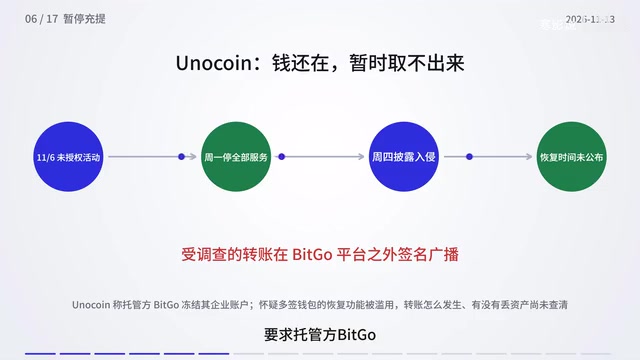
Multi-signature wallet refers to a crypto wallet that requires multiple private keys to co-sign before funds can be moved, commonly used in exchange custody to spread single-point risk. Some custody solutions also offer a recovery feature, allowing wallet holders to retrieve assets through a preset process when the custodian is unavailable. This design is intended for disaster recovery, but if the permission checks in the recovery process aren't strict enough, it can also be abused by insiders or intruders, becoming a channel for abnormal fund transfers. In incident investigations, the detail that "transfers were signed and broadcast outside the custody platform" usually means the signing step has left the custodian's risk-control view, and on-chain records must be combined with platform logs to reconstruct the fund path.
Frozen Money Doesn't Mean It Will Arrive
The U.S. Department of Justice said Thursday it has obtained court authorization to recover or freeze more than $1.2 billion in crypto assets related to the Binance hack. This money is part of the $6.3 billion stolen on October 29, and part of the more than $8.7 billion frozen to date; investigators are still pursuing the remaining funds. Binance says it has covered the affected assets with its own funds, and a new proof-of-reserves snapshot shows customer assets are covered at least 1:1.
Freezing doesn't equal returning. Money being stuck is only the first step; whether it can get back to the owner's account depends on subsequent determinations and procedures. This time ordinary users weren't made to bear the loss because Binance fronted its own funds. Read the platform's compensation and reserve announcements clearly, don't mistake "frozen" for "received," and if affected, keep your transaction records and register as required.
The Window for AI Recording Hardware May Only Be Six Months
Apple has added an all-day conversation review feature to Apple Watch, and the core value of AI recording hardware is being eroded by phone makers. Recording and transcription are no longer a moat; what's truly scarce is filtered context and the agent entry point. Before phone makers integrate system-level all-day memory, hardware companies have only about a six-month window. The whole process is much like similar AI recording and transcription features on the market, except that Apple Watch doesn't require buying extra hardware, supports near-all-day recording, and has no learning curve at all.
Robin Li: The Intelligent Organization Is the New Factory of the AI Era
AI tool deployment is becoming more widespread, but enterprises haven't seen the expected leap in productivity. Robin Li's "intelligent organization" concept, proposed at Baidu World 2026, is answering this common confusion across the industry — the intelligent organization is the new factory of the AI era, where productivity truly happens.
Many enterprises encounter a similar dilemma: individual employee efficiency has improved, and single-point pilots have worked, but the way the entire organization operates hasn't fundamentally changed. From proposing ten years ago at the same event that "AI is the new electricity" and predicting that the next act after the mobile internet would be artificial intelligence, to today pointing the next act toward the intelligent organization, Robin Li once again draws the industry's attention to a farther future: enterprises need to rebuild new factories for the AI era.
Four Years After FTX's Bankruptcy: Cleaning Up the Mess Is Also a Business
Four years after FTX's bankruptcy, restructuring expert Zhang Rui led the team to take over the company, audit the books, chase money, and fight lawsuits, and finally distribute money proportionally. By January 2, 2025, FTX had paid more than a dozen institutions a total of $948 million in fees, with Zhang Rui himself taking about $249 million, and partners charging up to $2,165 per hour. In FTX's billing structure, even $1 can be pushed into the most expensive tier — especially striking in the crypto industry. Bankruptcy is not just a business; it's an expensive one.
Cloud Service Authentication Failure and Microsoft 365 Outage
Multiple Cloud services experienced authentication failures. Anthropic issued an announcement at 17:58 UTC+8 on November 13 saying the incident was under investigation, had not yet announced the cause or an estimated recovery time, and said it would update progress as soon as possible.
Microsoft 365's global outage continued into Friday, affecting Outlook email and some Teams features. Microsoft said a process handling secure connections became overloaded, causing some servers to stop responding; it has restarted infrastructure, rerouted traffic, and scaled up capacity, with no indication of a security breach. Teams meeting invitations were affected, while most calls and chats remained normal. Microsoft filings disclose that this service has more than 450 million paid commercial seats.
Anthropic IPO Gets About 6x Oversubscription
Anthropic's initial public offering received about 6x oversubscription, with demand roughly six times the number of shares offered, mainly from large institutional orders. According to this week's updated prospectus, Anthropic plans to offer about 825 million shares at $70 to $78 per share, raising up to about $64.35 billion in the public portion, plus a $26 billion private placement to large tech companies, for a total of up to $90.4 billion. It is already listed on Nasdaq under the ticker END. The final offer price and size may still change.
Humane Social Network and SpaceX-Tesla Merger Talks
Humans social network members can open metrics, activities, and achievements recorded by wearable devices to other users, and Moments with dazed photos and text can also be commented on and liked. Humans says the platform consists entirely of real people, with each account corresponding to a verified heartbeat; the CEO calls it the most verifiable real-person network.
SpaceX and Tesla are advancing merger talks, which could be announced as early as December or may be delayed. Based on recent closing market caps, SpaceX is about $1.90 trillion and Tesla about $1.57 trillion, for a combined $3.47 trillion. If the merger is completed, businesses including rocket launches, satellite internet, electric vehicles, energy storage, artificial intelligence, and robotics would come together. The deal structure, how shareholder rights would be divided, and whether regulators would approve are all still undecided, and neither company has responded.

The Deep Waters of Education AI
Dr. Deng Shujun, chief scientist of Galaxy Zhixue, gave a keynote speech at the 9th China Education Technology Innovation Development and Application Achievements Conference, sharing the technical architecture of Xiaolu Aixue and its logic for landing in school scenarios. Chen Li, former senior vice president of ByteDance and former CEO of Toutiao and Dali Education, also publicly revealed his startup Galaxy Zhixue with an essay "Why I Still Want to Do Education," drawing industry attention. Today, as large model capabilities become increasingly general-purpose, what kind of AI education products teams returning to the deep waters of education can actually build — the answer is still in the classroom.
One-line Summary
AI face-swaps break video identity verification, while search and assistant upgrades hide information and copyright risks behind the convenience.
Paragraph Summary
This roundup covers multiple developments in AI and crypto. The U.S. Department of Justice reported the FaceDealer scam, in which hackers used stolen footage and AI face-swaps to impersonate acquaintances in video conferences, stealing over $400 million in crypto assets in 18 months — video calls as an identity-verification method are being broken. Google released Gemini Hydrogen and integrated it into search, with tasks 2.5 times faster than the previous generation, but fluent answers don't mean accurate ones. Meta's AI assistant can call businesses on users' behalf, with personal information surrendered behind the convenience. In addition, a project with stickers of 11,000+ bird species exposed the copyright reefs of vibe coding, and BunoCoin's withdrawal suspension and the freezing of Binance's stolen assets — which may not be returned — both highlight platform risks. Robin Li proposed that the intelligent organization is the new factory of the AI era, pointing to the common dilemma that enterprise individual efficiency has improved but the way organizations operate hasn't changed.
Related articles

OpenAI to Shut Down Agent Builder and Two Other Services on November 30, Developers Must Migrate Urgently
OpenAI will shut down Agent Builder, the evals dashboard, and reusable prompts on November 30; evals is already read-only. Here's the scope, OpenAI's migration paths (Agent SDK, PromptFu, your own code), and what developers should export and rebuild this week.
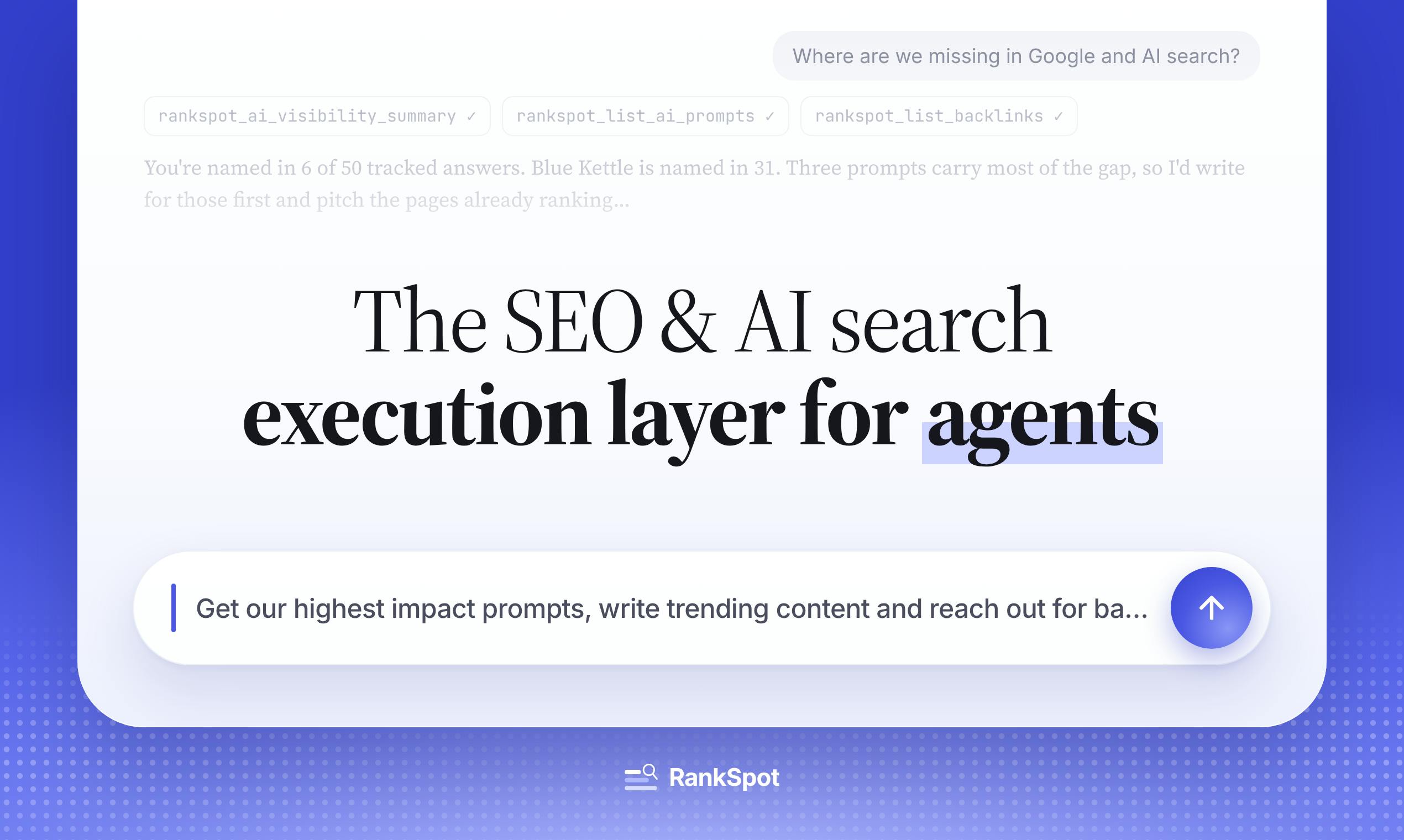
RankSpot: A Pay-Per-Use SEO & AI Search Execution Layer That Lets Agents Write, Publish, and Build Backlinks for You
RankSpot is an SEO & AI search execution layer for AI Agents. Connect via MCP to Claude or ChatGPT to write, publish & build backlinks. Pay-per-use, $3/article.

Appxiom: Giving AI Coding Assistants Production Context
Appxiom gives AI coding agents production context—crashes, jank, memory leaks, failed network calls—across Android, iOS, Flutter, KMP, and Web, ranking bugs by Goal Friction Impact.