AI Game Development Capabilities Put to the Test: An In-Depth Analysis of 4 Models Across 13 Challenges
Four leading AI models tested across 13 game development tasks reveal distinct trade-offs in quality, speed, and cost.
A rigorous one-shot evaluation pits Kimi K3, Claude Opus 5, Grok 4.6, and GPT-5.6 Sol against each other across 13 game development challenges including 3D modeling, scene composition, and animation. Opus 5 leads in quality and consistency but at the highest cost; Grok 4.6 offers unmatched speed but struggles with stability; Kimi K3 delivers the best value as an open-source model; and GPT-5.6 shows mixed results. The key takeaway: choosing the right model depends on the specific task's trade-offs.
Pushing the Limits of AI Game Development
As large language models evolve at breakneck speed, AI performance in game development, 3D modeling, and graphic creation has become a key benchmark for measuring their overall capabilities. A comprehensive evaluation covering 13 test categories pits four cutting-edge models against each other on equal footing: Kimi K3, Claude Opus 5, Grok 4.6, and GPT-5.6 Sol (Max).
The tests follow a "one-shot" principle: every model receives the exact same prompt and gets only one chance to generate its output. Final results are judged solely on what's actually produced. This rigorous benchmarking approach tests not just a model's capability ceiling, but also reveals its real-world performance in terms of efficiency, cost, and consistency. In practice, users often optimize outputs through multi-turn conversations and iterative prompt refinement — a process that masks a model's true ability to understand and execute complex instructions on the first try. One-shot testing strips away human intervention, directly exposing baseline performance in instruction comprehension, code generation, and spatial reasoning. This is especially critical for industrial scenarios requiring automated pipeline integration — such as CI/CD pipelines or batch asset generation.
This evaluation was sponsored by Moonshot AI, whose Kimi K3 is positioned as the company's most powerful open-source model. With a staggering 2.8 trillion total parameters, a 1-million-token context window, and native multimodal support, it's specifically optimized for coding tasks. The 2.8 trillion parameter count places it among the largest open-source models in the world. Notably, such massive parameter counts don't necessarily mean proportionally higher inference costs — the Mixture of Experts (MoE) architecture allows the model to activate only a subset of parameters during inference, maintaining knowledge breadth while controlling computational overhead. The 1-million-token context window means the model can process approximately 750,000 English words or hundreds of thousands of lines of code in a single pass, which is crucial for understanding large codebases, lengthy technical documents, or complex multi-file project structures. As an open-source model, Kimi K3 also allows developers to self-deploy and fine-tune, offering significant advantages in enterprise scenarios that are sensitive about data privacy or require deep customization.
3D Modeling and Asset Creation: Balancing Efficiency and Quality
The tests kicked off with building a saloon interior scene inspired by Red Dead Redemption. Models were required to create assets in Blender to furnish the space, with the bar back panel, ceiling, and chandelier as key evaluation points. Blender is a widely used open-source 3D creation suite that supports procedural operations via its Python API. When an AI model is asked to "create assets in Blender," it actually needs to generate executable Python scripts that call Blender's bpy module to create geometry, set up materials, configure lighting, and position cameras. This requires the model to simultaneously possess 3D spatial reasoning ability (understanding object proportions and spatial relationships), procedural modeling knowledge (how to describe surfaces, boolean operations, subdivision modifiers, etc. through code), and artistic sensibility (material color coordination, lighting composition). A chandelier in a saloon scene might involve dozens of lines of code to define the lampshade shape, metal bracket, light emitter, and shadow parameters — a single parameter error anywhere could cause the visual result to fall apart.
Kimi K3 generated as many as 9 assets at a cost far lower than Opus 5, demonstrating exceptional cost-effectiveness. GPT-5.6 SoMax took over an hour yet only created 3 assets, though its pool table and matching wall rack were noteworthy highlights. Considering both cost and time, Kimi K3 delivered the best performance in this test.
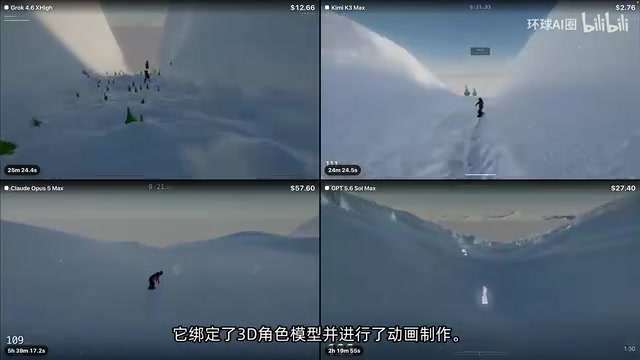
In the skateboarding game test, each model had to create a complete game loop. Opus 5 achieved the most completeness — not only rigging a 3D character model but also producing animations — which likely explains why it took 5 hours and 39 minutes. Rigging is one of the most technically complex stages in 3D animation production. It requires creating a skeleton system (Armature) for the model and associating mesh vertices with bones through Weight Painting, so that bone movements can drive natural deformation of the model's surface. A basic humanoid skeleton typically includes 20–30 bones, while a full rig with fingers and facial expressions can require over a hundred. Building animations on top of this requires setting keyframes, handling animation curve interpolation methods (such as Bézier curve smoothing), and ensuring natural blend transitions between different animation states. This explains why Opus 5 invested so much time in this task — it wasn't just generating static models but also processing bone hierarchies, skin weights, and animation data on the timeline.
However, when it came to the visual quality of snow physics effects, other models actually had the edge. Game physics engines need to simulate friction, gravitational acceleration, collision response, character inertia, and many other physical properties. Grok produced a game with excellent control feel — what makes controls "feel good" is essentially a fine balance between physics parameters and player input response, such as turning sensitivity curves, non-linear acceleration mapping, and "Coyote Time" during jumps (a forgiving mechanic that allows a brief jump window after leaving a platform). When generating game code, AI models need to assign reasonable values to these parameters, and the kind of values that "feel right" often come from tacit knowledge accumulated through extensive game development experience — something difficult to define with precise rules. Kimi's output was the cheapest of the four, and its gameplay was particularly fun during acceleration.
Scene Composition and Art Direction: Opus 5's Consistent Edge
In the Sekiro-style main menu test, models needed to create a cinematic shot of a "sword stuck in grass." A cinematic look typically involves several professional visual composition elements: shallow depth of field (achieving sharp foreground and blurred background by adjusting the virtual camera's aperture parameters), golden ratio or rule-of-thirds composition, volumetric lighting (visible light beams created by light passing through fog or dust), and color grading (applying different tones to highlights and shadows to create mood). In this specific scene, the model also needed to handle specular reflections on metal materials, subsurface scattering on grass, and potentially particle systems (such as scattered petals or fireflies) to enhance atmosphere.
Opus 5 took 4 hours and 50 minutes. Grok's output was comparatively the weakest — the arrow wasn't even stuck in the ground, and the grass appeared overly flat, indicating clear deficiencies in object interaction and spatial reasoning. The best outputs were split between Opus 5 and GPT-5.6, with GPT achieving comparable quality in only half the time.
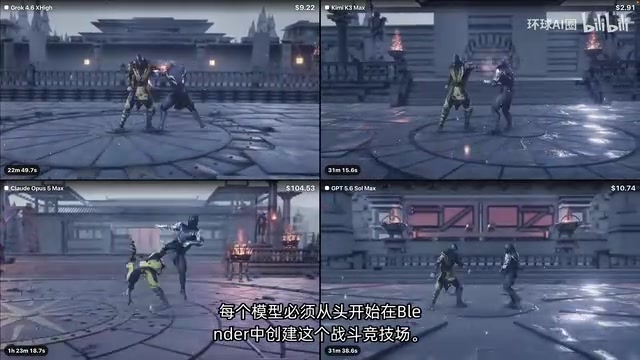
In the fighting game arena test, Grok's performance was impressive and it was the fastest model to complete generation. Kimi K3 completed a comparable task at one-third the price. Opus 5 invested more time polishing floors and backgrounds, but if Grok had been given the same amount of time, it might have achieved similar results at lower cost.
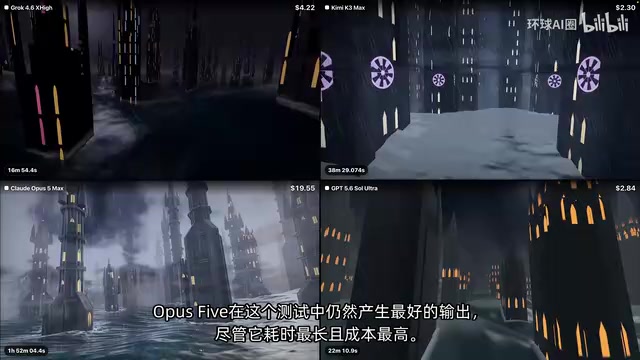
In complex scene tests such as a Gothic city flood and a cathedral, Opus 5 consistently produced the highest-quality results, though it invariably took the longest and cost the most. The Grok 4.6 output in the cathedral test was particularly noteworthy — it was closer to Opus 5 than to GPT-5.6, yet came at extremely low cost and time, as if it were "Opus 5 in low-effort mode."
Grok's Cost-Effectiveness vs. Stability Trade-off
Grok 4.6 showed a distinctly dual nature throughout the tests. In the space flight test, it stood out with exceptional price efficiency and generation speeds far surpassing other models. In the outpost diorama test, its output quality came close to Opus 5 with surprisingly good cost-effectiveness.
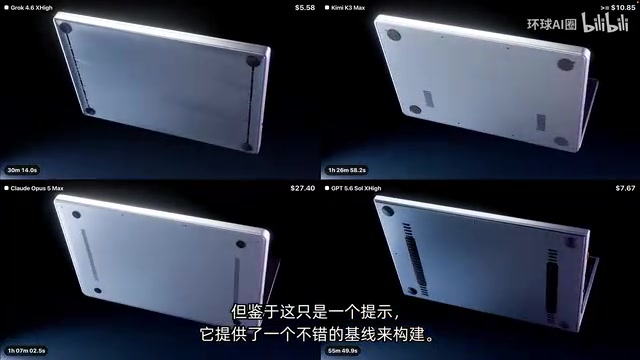
However, speed came at the cost of stability. In the off-road truck test, Grok 4.6 outright failed, producing no playable result. In the ancient temple test, while it was the cheapest and fastest, it couldn't complete the temple and overall scene construction, leaving residual excess geometry everywhere. "Residual geometry" is a common issue in procedural 3D modeling: when AI generates complex scenes through code, it may produce undeleted construction helper meshes (such as cutting bodies used for boolean operations), overlapping faces causing Z-fighting flickering, non-manifold geometry from unmerged vertices, and face transparency or inversion from incorrect normal directions. The root cause is that model-generated code lacks systematic validation of 3D topology integrity — an experienced 3D artist continuously checks mesh "cleanliness" during the modeling process, whereas AI-generated code often skips these necessary post-processing steps. This also explains why speed-oriented models are more prone to such issues. By contrast, even when Opus 5 had imperfections, it still delivered the most consistent and visually appealing output.
In the shrine village test, Kimi K3 outperformed Grok, producing a scene with no obvious defects, while Opus 5 actually suffered from over-engineering and cluttered geometry that made it less aesthetically pleasing. This demonstrates that "throwing more compute at the problem" doesn't always yield better results — sometimes clean, consistent design is more desirable.
Final Takeaway: Choosing Based on Scenario Matters More Than Chasing "The Best"
Across all 13 tests, each of the four models showed distinct strengths:
- Opus 5: The quality benchmark — most consistent in complex scenes and art direction, but at the highest cost in time and money
- Grok 4.6: Unmatched speed and cost-effectiveness, approaching Opus 5 quality in many scenarios, but with notable stability issues
- Kimi K3: As an open-source model, it excels in asset quantity and cost control, delivering the best value for money across multiple tests
- GPT-5.6 Sol: Strong in certain scene compositions, but frequently falls behind in detail and overall consistency
The value of this evaluation isn't in crowning a single winner, but in revealing the real boundaries of AI in professional creative work today: model selection should be based on each specific task's trade-offs between quality, speed, and cost. For developers, understanding the characteristics of each model is far more practical than chasing a single "best" option. AI-generated 3D content still faces challenges including inconsistent topology quality, physics parameters that rely on experiential values, and incomplete coverage of complex animation workflows. Yet given that Opus 5 can independently handle character rigging and animation, and Grok can output usable scenes in remarkably short timeframes, AI-assisted game development is approaching the tipping point from proof-of-concept to practical production tool.
Related articles

Amphibious Transforming Drone: Beyond 100x Power Savings, What Are the Real Needs?
Is the amphibious transforming drone just a gimmick? Starting from the 100x power difference of the M4 Morphobot, explore real application scenarios and thesis topic ideas, analyzing boundary conditions where pure drones and pure ground robots both fail.

Warhound Raises $200 Million: Genetically Engineered "War Dogs" Paired with Anduril Gear
Warhound raises $200M, backed by Ben Lamm and Palmer Luckey, to genetically engineer dogs for military and law enforcement use and equip them with Anduril gear. This article analyzes its technology direction, funding logic, and ethical controversy.

Claude API Comes to Google Cloud: IAM Integration and SDK Access Guide
Anthropic hosts the full Claude API on Google Cloud with IAM-controlled permissions and unified billing. This guide covers the Vertex AI and Anthropic-hosted entry points, IAM role configuration, and SDK access.