AI Gateway Logs Adds Session View: How Session Affinity Reduces AI Coding Costs

AI Gateway adds a session view that quantifies cache reuse and cost differences from session affinity.
AI Gateway's logging system now offers a Sessions view that aggregates requests by session, showing each session's coding agent, cumulative cost, models and providers, and cache hit rate. Since multi-turn conversation costs are driven by repeatedly carried context, session affinity routes each turn to the previous provider so cached prompts are reused, cutting cost and latency. Enabled by default for text and chat requests, it supports custom grouping via sessionId or x-session-id, with fingerprint-based grouping otherwise.
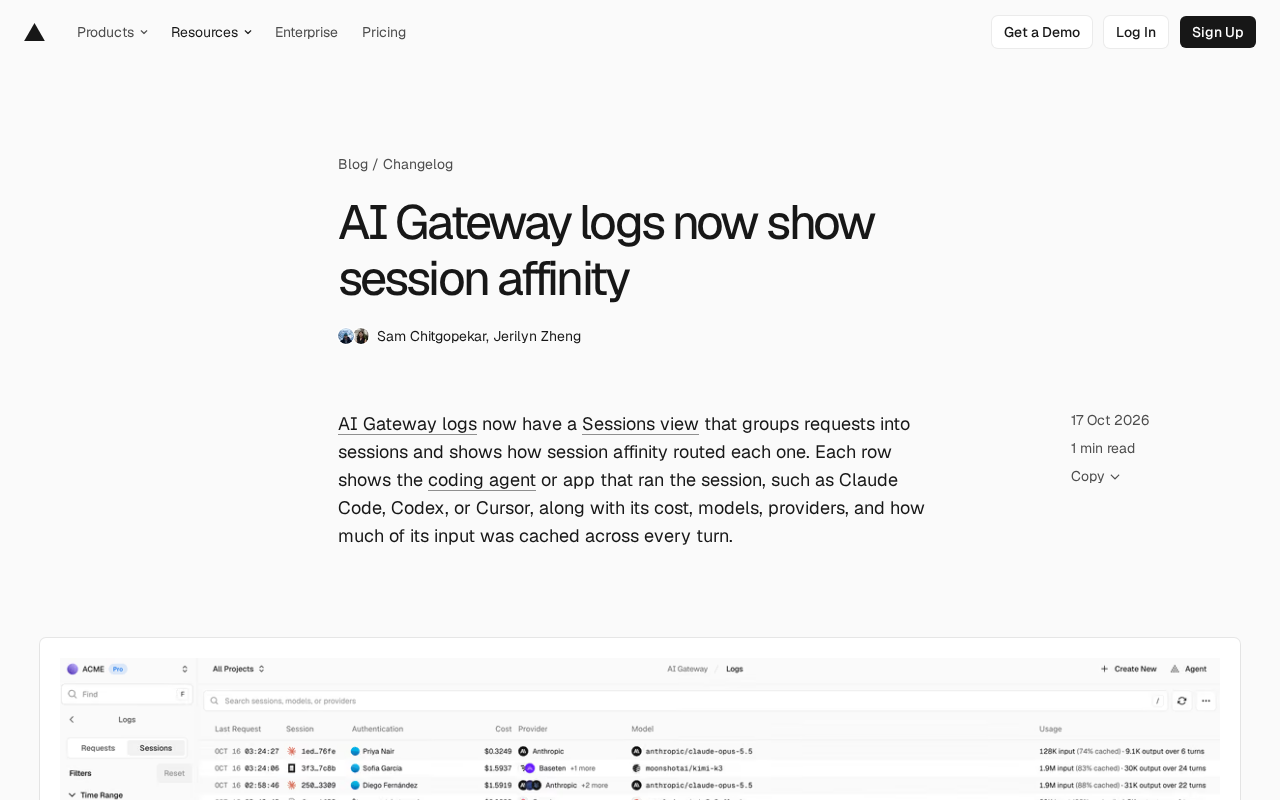
AI Gateway's logging system has recently launched a Sessions view that aggregates scattered requests by session and visually shows how session affinity selects a provider for each request. For teams that make heavy use of coding agents like Claude Code, Codex, and Cursor, this view directly answers questions that were previously hard to track: where the money went, how much was served from cache, and why a request was routed to a particular provider.
What the Session View Solves
In the past, logs were organized around individual requests. Developers could see the model, latency, and cost of each request, but it was difficult to reconstruct the full cost structure of a continuous conversation. The session view links all requests (turns) within the same session together. Each row shows the coding agent or application running the session, the cumulative cost, the models and providers involved, and how much of the input came from cache.
The value of this aggregated perspective is that for multi-turn conversations, the bulk of the cost is often not output tokens but the context carried repeatedly in each turn. When that context can be read from cache, both cost and latency drop significantly; otherwise, costs accumulate unnoticed. The session view makes this difference quantifiable and comparable for the first time.
Session Affinity: Pinning Consecutive Requests to the Same Provider
The core logic of session affinity is simple: send each turn's request to the same provider that served the previous turn, so that the provider's cache already holds most of the prompt and subsequent turns can read directly from cache. As the original article puts it, a session that stays on the same provider can read more of each turn's prompt from cache.
This explains why some sessions cost far less than expected while other seemingly identical sessions cost much more—the difference may come down to whether routing was stable. Fields like cache hit rate, session ID, and cost in the session view are exactly what you use to pinpoint such issues. Opening a single session also shows its duration, the full turn-by-turn path (model and latency for each turn), and the current provider along with the list of providers that served it previously.
Prompt Caching is the prerequisite for understanding the benefits of session affinity. Major LLM providers (such as Anthropic and OpenAI) support server-side caching of request prefixes: when the beginning of a subsequent request exactly matches cached content, those tokens are billed at a significant discount and do not need to be recomputed, reducing both cost and time to first token. Caches typically have a short lifetime (on the order of minutes) and are keyed by provider, model, and content prefix. Therefore, cache hits depend heavily on requests being routed to the same provider—once the provider switches, the new provider's cache does not contain the previous prefix, and the entire context must be reprocessed at full price. This is exactly the problem session affinity solves: through stable routing, the context carried repeatedly across multi-turn conversations keeps hitting the cache.
Enabled by Default and Two Grouping Methods
Session affinity is enabled by default for text and chat requests and requires no additional configuration. If you want to control the grouping boundaries yourself, there are two ways: pass the same sessionId in each request's providerOptions.gateway, or include the same x-session-id in the request headers.
Requests without an identifier are grouped by a fingerprint of the conversation's opening content and appear in the logs as fingerprinted sessions. This also means that if an application does not explicitly pass a session identifier, its request grouping depends on the stability of the content fingerprint, and cross-session boundaries may not align exactly with expectations.
Session identifiers (sessionId / x-session-id) explicitly tell the gateway which requests belong to the same session, thereby determining the grouping boundaries for affinity routing. Since the gateway itself cannot reliably determine whether two independent HTTP requests belong to the same conversation, by default it can only group heuristically based on a fingerprint of the conversation's opening content; the application layer usually knows the true session boundaries better (for example, a Claude Code process, a chat window, or a single agent run). Explicitly passing an identifier prevents different users or tasks from being incorrectly merged due to similar opening content, and ensures that the same session remains stably grouped even after its content changes. In practice, it is recommended to generate a UUID when the client initializes and reuse it throughout the session's lifetime.
Filtering and Troubleshooting Capabilities
The session view supports filtering by number of turns, client, model, provider, authentication method, and cost. Single-turn sessions are hidden by default and only appear after clearing the minimum turns filter—a pragmatic default, since single-turn requests have no affinity to speak of and would only dilute the signal from multi-turn sessions if mixed into the list.
For teams troubleshooting cost anomalies, a practical path is: first sort by cost to find high-spend sessions, then open them to check cache hit rate and turn path, and determine whether frequent provider switching is causing cache misses. If a particular client or model shows poor session affinity, further check whether requests carry a stable session identifier.
Fingerprinted sessions refer to session records formed by the gateway using a hash of the conversation's opening content as the grouping basis when no explicit session identifier is provided. Their limitation is that content fingerprints are highly sensitive to opening wording: small changes to the system prompt, inserted timestamps or random numbers will change the fingerprint, splitting what should be a continuous session into multiple ones; conversely, requests with the same opening but actually unrelated (such as identical templated first messages) may be incorrectly merged. Therefore, fingerprinted sessions can only serve as a fallback, suitable for quick observation but not as a precise basis for cost attribution. If the logs show many fingerprinted sessions with only 1 turn, it usually means the client is not passing a stable session identifier.
Practical Significance for AI Coding Workflows
Coding agents are a typical multi-turn, long-context scenario, and the cache reuse benefits of session affinity are most evident here. The session view makes these benefits visible, giving teams a data-driven basis for decisions on model selection, provider configuration, and client integration, rather than optimizing costs by gut feeling.
It is worth noting that affinity is not without cost: it binds a session to a single provider, and when that provider experiences instability, the continuity of the session may be affected. The original article does not discuss behavior in failover scenarios, so developers still need to evaluate this part in light of their own fault-tolerance strategies.
One-line Summary
AI Gateway adds a session view that quantifies the cache reuse and cost differences brought by session affinity.
Paragraph Summary
AI Gateway's logging system has launched a Sessions view that aggregates logs previously organized by individual request into sessions, showing each session's coding agent, cumulative cost, models and providers involved, and cache hit rate. The article notes that the bulk of multi-turn conversation costs often comes from context carried repeatedly in each turn, and session affinity routes each turn's request to the provider that served the previous turn, allowing prompts in that provider's cache to be reused, significantly reducing cost and latency. The feature is enabled by default for text and chat requests, supports custom grouping via sessionId or the x-session-id header, and groups requests without identifiers by content fingerprint. The session view also supports filtering by turns, client, model, provider, and other dimensions, helping teams pinpoint cost anomalies and optimize routing decisions in coding agent scenarios.
Related articles

Random Pruning of the DPO Computation Graph: 1.4x Training Speedup and Lower Peak Memory
DPO training too slow and memory-hungry? This paper proposes a random pruning framework for the DPO computation graph, sampling independently across position, sequence, and branch dimensions; branch pruning achieves a 1.426x step-time speedup and cuts training time by about 30%, with in-depth attribution of memory and time gains.

Why Does JEPA Underperform MLM in Longitudinal EHR Representation Learning?
New study compares JEPA and MLM for longitudinal EHR representation learning on MIMIC-IV: three JEPA variants train stably without collapse but underperform MLM; target size, not heterogeneity, drives prediction error.

Transfer Learning + Visible Light Communication: A New Approach to Energy-Efficient Indoor Positioning
A study proposes a transfer learning-based visible light communication indoor positioning method, achieving 47% accuracy improvement on the BOSCH factory dataset, 67.5% model efficiency under high noise, and introducing the ME composite metric for energy-efficient positioning in energy-constrained industrial IoT scenarios.