AI-Generated Apps Are Disrupting SaaS: Which of the Four Moats Still Hold?

AI is reshaping SaaS moats—features and switching costs fall, but network effects and operations endure.
Generative AI is dismantling traditional SaaS moats. Feature differentiation and high switching costs are no longer defensible as AI dramatically accelerates software development and simplifies migration. However, four defensive directions remain viable: network effects from multi-party collaboration, regulated environments incompatible with AI's stochastic nature, operational excellence to manage declining AI-generated code quality, and capital-intensive infrastructure investment. SaaS won't die but will diverge—the cost of writing code drops while the cost of building reliable systems and reaching buyers rises.
When Software Can Be Generated with a Single Prompt
Generative AI is transforming how software is built at a breathtaking pace. Coding assistants help non-engineers build software, and code agents are beginning to complete development tasks independently with almost no human involvement. These code agents are AI systems capable of autonomously understanding requirements, planning tasks, writing code, debugging tests, and ultimately delivering working software. Unlike traditional code completion tools, agents possess multi-step reasoning and tool-calling capabilities, enabling them to make autonomous decisions throughout an entire development workflow. Since 2024, products like Devin, OpenAI Codex CLI, and Claude Code have emerged one after another, with top-tier agents now capable of independently resolving over 50% of real GitHub issues. This is no longer a prediction about the future—it's happening right now.
In a talk at MicroConf, the founder of DNSimple—who has been running the DNS service provider for 16 years—raised a question that every SaaS practitioner is thinking about: What does the rise of AI-generated applications mean for existing SaaS?
As someone who both runs a mature SaaS business and does indie development with generative AI—an "amphibian" of sorts—he admitted he's "both friend and foe" and doesn't have a crystal ball. But he offered an analytical framework worth taking seriously: the moats that have long supported SaaS are being reshuffled.
The Four Traditional SaaS Moats: Two Have Already Fallen
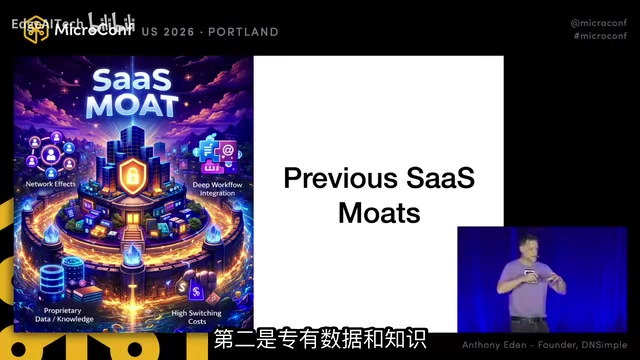
He identified four classic moats that SaaS has long relied on:
- Network effects: The more users who connect and use the product together, the greater its value;
- Proprietary data and knowledge: The data and domain expertise accumulated within the system are inherently valuable;
- Deep workflow integration: Working in concert with other software systems to deliver a smoother experience;
- High switching costs: The more time and data users invest, the harder it is to leave.
The concept of network effects originally came from economists analyzing telephone networks, later quantified by Metcalfe's Law—which states that a network's value is proportional to the square of its number of users. In SaaS, network effects are typically categorized as direct network effects (e.g., the more colleagues on Slack, the better the experience), indirect network effects (e.g., the richer the third-party app ecosystem on Salesforce, the more valuable the platform), and data network effects (more users mean richer data, more accurate algorithms, which in turn attract more users). Once this positive feedback loop is established, competitors—even those with comparable features—find it extremely difficult to dislodge the existing user base.
However, in the AI era, some of these moats are crumbling fast.
Why Feature Moats and Switching Costs No Longer Work
In the past, unique features were the key to SaaS differentiation. Companies locked in users by building features others didn't have and imposing high switching costs. But the time required to ship software features is shrinking dramatically—once you start building with generative AI tools, you can construct and release features far faster than before. This means features are no longer defensible.
More critically, high switching costs are also eroding. Users can now leverage AI tools to guide themselves through migrations from one vendor to another. The psychological barrier of "migration is too much hassle" is being gradually dismantled by AI.
As for integrations, the speaker was more cautious: integrations remain difficult because the pace of change is extreme and the systems being integrated with are constantly shifting. But overall, features and switching costs—these two moats—can no longer hold the line.
Four Defensive Directions That Still Work for SaaS in the AI Era
So which moats can still preserve SaaS competitiveness? The speaker offered four directions worth betting on.
Collaboration and Network Effects: Products That Connect Multiple Parties Are Safer
Software whose value grows as human collaboration or agent collaboration increases is in a more advantageous position. This is essentially an extension of network effects.
He specifically pointed out a contrast: people who generate apps for their own use or for internal company purposes are not pursuing network effects—they're simply trying to solve a single problem. But it's precisely in scenarios where collaboration matters that SaaS still holds value that internally built software cannot replace. In other words, the more a product requires multi-person, multi-party connections, the safer it is.
Regulated Environments: Compliance Requirements Are Natural Barriers
For SaaS founders serving regulated industries like HIPAA compliance or financial security, this is a domain worth doubling down on.
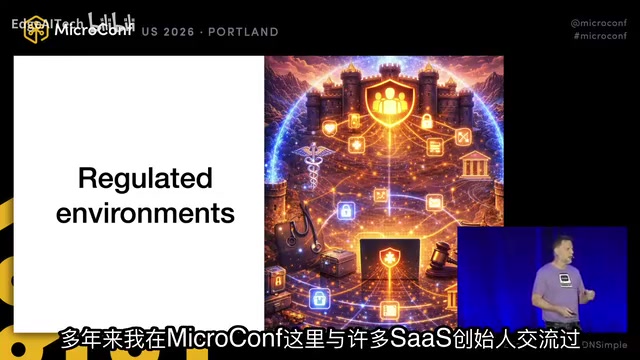
The reason is straightforward: generative applications are produced in a chaotic and stochastic manner, and regulation is inherently incompatible with randomness. To understand why, consider the complexity of regulatory compliance. Take HIPAA as an example—the Health Insurance Portability and Accountability Act, enacted in the U.S. in 1996, imposes extremely strict requirements on the storage, transmission, access, and auditing of healthcare data, with violation penalties reaching millions of dollars. Similar regulatory frameworks include SOX in finance, PCI DSS for payment card security, and GDPR in Europe. These compliance requirements cover not just technical implementation but also organizational processes, audit trails, data retention policies, incident response mechanisms, and comprehensive governance systems. AI-generated applications often lack systematic consideration of these complex compliance chains—compliance isn't just about writing correct code; it's about continuous operations and governance. In domains with stringent compliance requirements, one-off generated applications struggle to survive long-term. If you're looking for defensible niches, regulated environments deserve serious consideration.
Operational Excellence: Declining Code Quality Creates New Demand
The third point is less about an environment and more about a core capability. From an engineering perspective, the speaker offered a profound insight:
As generative AI produces ever more code, the quality of that code will inevitably decline. There will be more code, but it will be lower quality and more prone to failure. The pressure will therefore shift from "code development" to "code operations."
This is closely related to the concept of "Technical Debt" in software engineering. Technical debt, a term coined by Ward Cunningham in 1992, refers to compromises made in code quality for short-term speed that later require additional cost to fix and refactor. AI-generated code exacerbates this problem: large language models tend to produce code that "looks like it works" but often lacks complete handling of edge cases, lacks proper error handling mechanisms, has insufficient security vulnerability detection, and struggles to maintain consistent architectural patterns. According to a 2024 GitClear research report, AI-assisted coding has led to a significant increase in the proportion of "churned code"—code that is repeatedly modified or reverted in a short period. While code output speed has increased, system maintainability, observability, and long-term stability face greater challenges.
People will use those one-off generated applications, and many of them will be terrible—they'll get the job done, but with worse results and more failures. After being burned by these low-quality apps, users will seek out products where operational excellence still exists. Therefore, the better an organization's technical excellence and operational capabilities, the greater SaaS's chances of survival.
Infrastructure and Capital Expenditure: Moats Built with Real Money
The final moat is capital expenditure. If what you do requires real money—investments that others are unwilling or unable to make—you still have a barrier.
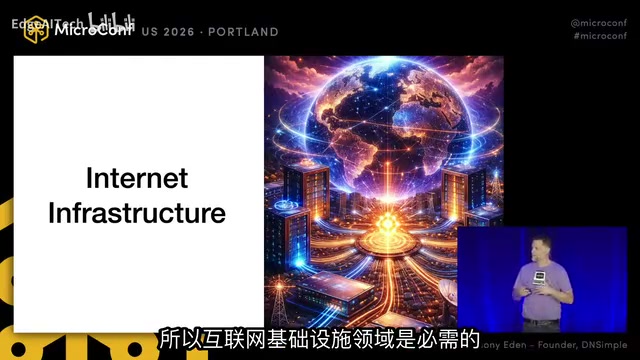
The speaker used his own DNSimple as an example: DNS (Domain Name System) is one of the foundational services of the internet, responsible for resolving human-readable domain names into machine-readable IP addresses. A high-quality DNS service requires deploying Anycast nodes globally—broadcasting the same IP address via BGP (Border Gateway Protocol) so that users' DNS queries automatically route to the geographically nearest server, achieving low latency and high availability. This kind of global infrastructure deployment involves contracting with multiple data centers, purchasing or leasing server hardware, maintaining network connections, defending against DDoS attacks, and other ongoing capital expenditures. Even at small scale, these investments are unavoidable. It's precisely this infrastructure cost that naturally limits competitor entry—newcomers can't bypass physical-world investments just by generating code with AI. Managed services, IP address management, and other domains centered on internet infrastructure still hold significant opportunity—and they often need to work in tandem with the "operational excellence" moat.
SaaS Won't Die, But It Will Diverge
The speaker repeatedly emphasized one core judgment: SaaS won't die—it will change.
He cited a particularly provocative viewpoint: "SaaS existed before humans needed graphical software, generative AI eliminates the need for those tools, so AI becomes the application layer." This is the "robot overlord" perspective. But even so, niche software will still be used and developed, and the question remains: Who will build this software? The answer still seems to be teams and companies with strong execution.
His key conclusions include:
- SaaS will diverge—some will survive, some will die. This has always been the case; founders who can execute effectively again and again will prevail;
- Projects used by a single person or very few people—non-collaborative, non-regulated, non-infrastructure—will likely shift toward internally built software;
- But products with network effects will likely continue to see users choosing SaaS.
The Cost Structure of SaaS Is Being Rebuilt
The most thought-provoking statement was this: The cost of creating code will decrease, but the cost of creating good systems will increase, and the cost of reaching buyers at the right time will also increase.
This sentence precisely captures the value migration of the AI era—writing code is no longer scarce; building reliable systems and finding and serving the right customers are the real barriers.
During Q&A, someone asked about the impact of "outcome-based pricing" (as opposed to per-seat or usage-based pricing). This question touches on a deep transformation in SaaS business models. Traditional SaaS pricing comes in three main models: per-seat, usage-based, and flat subscription. The per-seat model was the core business model for companies like Salesforce and Slack, but it faces a fundamental challenge in the AI era—when AI agents can replace humans in doing work, the concept of a "seat" becomes blurry. Outcome-based pricing charges based on the actual business value the software delivers—for example, the number of deals AI helps close, tickets processed, or qualified reports generated. Intercom has already started charging per "successfully resolved customer issue" rather than per support agent seat. This model better aligns with value distribution logic in the AI era, but also introduces new challenges such as attribution difficulty, ambiguous outcome definitions, and revenue volatility.
The speaker argued that token-based cost models will inevitably influence how features within SaaS are priced. Referencing the pricing logic of Anthropic and OpenAI—which combine subscription fees with outcome-based billing—he suggested that if you have the ability to introduce outcome-based pricing, it's worth experimenting with. The key is figuring out which moats to deploy at which points.
For entrepreneurs who have already invested time building SaaS, he left a message that serves as both reassurance and reminder: "You're going to be fine." The economic landscape will change, but teams that can consistently execute and deliver reliable systems still own the future.
Key Takeaways
Related articles

Workbuddy for Absolute Beginners: How a Desktop AI Agent Fits Into Real Workflows
A beginner's guide to the Workbuddy desktop AI agent: installation, claiming credits, file management, and building automated workflows—compared with CodeX for fit and cost, helping professionals shift from AI question-askers to AI managers.

OpenAI's New Agent Stack: Computer Use, Decisions API, and Ultra-Fast Workflows
OpenAI Dev Day unveiled a new agent stack: Computer Use outperforms humans, Decisions API delivers ultra-low-latency classification via Luna, Agents API opens the same Computer Use capabilities, and GPT-6.1 Sol costs only one-seventh of Astra. Core updates, benchmark data, and developer insights.

Liang Wenfeng Open-Sources DeepInfo Inference Framework, Takes On U.S. Ban
DeepSeek open-sources its DeepInfo inference framework after its models, featuring GPU/CPU cross-pipelining, small-model prediction with large-model verification, and full Huawei Ascend and NVIDIA chip support—facing the U.S. federal ban head-on. This article analyzes its significance for AI deployment and open-source strategy.